
Greek airline SKY Express has joined Athens’ emergency repatriation effort, operating special rescue flights from Oman to Greece as part of a government-led airlift responding to the widening Middle East crisis.
New Partner in Greece’s Middle East Airlift
SKY Express has emerged as a key new player in Greece’s rapidly expanding repatriation operation, mounting special flights from Muscat in Oman to Athens under the coordination of the Ministry of Foreign Affairs. The move comes as Greek authorities race to bring home citizens stranded across the wider Middle East due to airspace closures, mass flight cancellations and security concerns.
According to official statements over recent days, the airline operated at least one dedicated rescue sector from Muscat International Airport to Athens International Airport, carrying dozens of Greek nationals and their family members who had been unable to travel on regular commercial services. The mission is part of a broader package of emergency flights that also involves other carriers, but marks the first time SKY Express has been prominently involved in a government-directed evacuation from the Gulf state.
The decision to enlist SKY Express reflects both the urgency of the situation and the flexible role smaller carriers can play when traditional route networks are upended. While the airline is best known for its domestic Greek network and select regional links, it has rapidly adapted to operate longer sectors from Oman as authorities seek every available option to clear backlogs of stranded travelers.
Greek diplomats based in Riyadh and elsewhere in the region have been closely involved in compiling passenger lists, coordinating documentation and ensuring that those most in need of evacuation are prioritized for the limited seats available on each special flight.
Coordinated Government Effort as Crisis Deepens
The SKY Express operation slots into a wider national strategy that has seen the Greek government orchestrate multiple repatriation flights from conflict-affected areas since early March 2026. Under the Foreign Ministry’s direction, Athens has turned to a mix of Greek and foreign carriers to move citizens out of Oman and the United Arab Emirates as the regional security picture deteriorates.
In total, hundreds of Greek nationals have now been flown home from the Middle East on a combination of special services, with Oman emerging as one of the principal staging points. Officials reported that 89 Greek citizens and family members were transported from Oman on a dedicated SKY Express service, complementing earlier rescue flights by Aegean Airlines and operations using Air Arabia aircraft from Sharjah in the UAE.
The coordinated airlift has been designed to remain agile as conditions evolve. Routes, timings and aircraft types are being adjusted on short notice in response to airspace restrictions, shifting risk assessments and the availability of landing slots at increasingly congested regional airports. Passenger manifests are compiled through consular registrations rather than normal airline booking channels, underscoring that these are state-managed missions rather than commercial flights.
Officials in Athens have emphasized that the operation remains ongoing, with contingency plans for further departures if security or aviation disruptions persist. Emergency contact points at Greek embassies and consulates across the region have been reinforced to handle a surge in calls from citizens seeking evacuation or travel guidance.
Operational Challenges on the Muscat to Athens Corridor
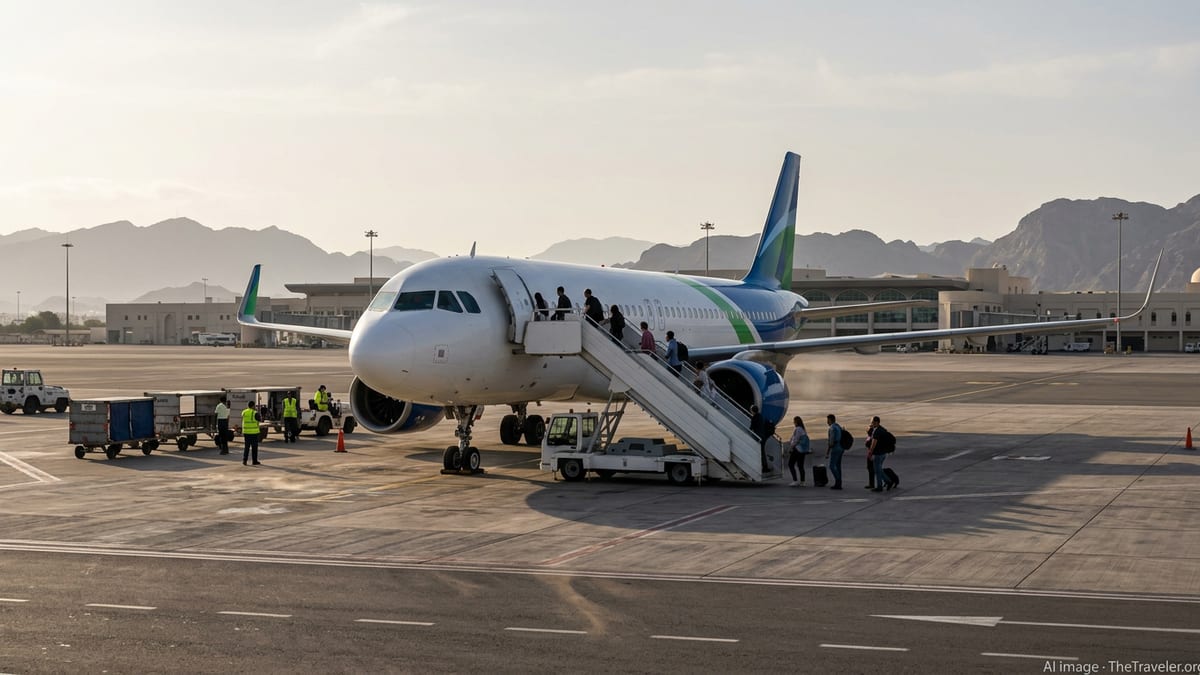
For SKY Express, the Muscat to Athens operation presents both logistical and operational challenges that differ sharply from its core domestic network. The carrier deployed an Airbus A320neo configured for medium-haul routes, operating a roughly six-hour sector between Oman and Greece under tight scheduling constraints and heightened security protocols.
Flight planning teams must navigate shifting airspace advisories, potential rerouting around sensitive areas and strict coordination with regional air traffic control authorities. Crew duty times, fuel contingencies and alternate airport options all require careful recalculation amid a dynamic operating environment that has seen other airlines alter or suspend services.
Passenger handling in Muscat is also more complex than on a typical scheduled route. Many evacuees have faced multiple itinerary changes or cancellations before reaching the Omani capital, arriving with a patchwork of tickets, expired connections or disrupted travel insurance arrangements. Check-in and boarding procedures are therefore closely coordinated with Greek consular staff, who verify eligibility and documentation before passengers are cleared for the special flights.
On arrival in Athens, returning citizens are met by officials who provide onward travel advice and, where necessary, assistance with temporary accommodation or domestic connections. The government has framed these operations as humanitarian in nature, focused on ensuring safe passage out of a volatile region rather than maintaining normal commercial links.
Impact on Travelers and Greece’s Aviation Sector
The decision by SKY Express to join the government-led airlift underscores how deeply the Middle East crisis is affecting travelers with even indirect links to the region. Many of the evacuees boarding the Muscat to Athens services had originally planned trips that passed through Gulf hubs on their way to or from Asia, Africa or Oceania, only to find themselves stranded when airspace closures and conflict-related restrictions cascaded across airline networks.
For passengers, the special flights represent both a relief and a reminder of the unpredictability now surrounding long-haul travel corridors that traverse sensitive airspace. Seats on repatriation services are finite, departure times can shift with limited notice, and passenger priorities are determined by government criteria rather than fare class or frequent flyer status. Travelers reaching Athens often report a mix of gratitude at being safely home and uncertainty about future plans.
Within Greece’s aviation sector, the involvement of SKY Express alongside larger carriers highlights a broader trend toward closer collaboration between government and airlines in crisis response. Authorities are drawing on the full spectrum of available fleet and crew resources, from flag carriers to smaller operators, in order to mount rapid, point-to-point missions that commercial timetables are not structured to provide.
Industry analysts note that these emergency operations can temporarily reshape airline networks and may influence longer term strategic decisions, from fleet deployment to regional partnerships. For SKY Express, the Oman missions expand its operational footprint and visibility in the wider region, even as they are framed above all as a public-service contribution rather than a commercial venture.
What Comes Next for Repatriation Flights
With tensions in the Middle East still fluid as of early March 2026, Greek officials have signaled that repatriation flights could continue if the security environment remains unstable or additional airspace restrictions are imposed. Planning cells within the Foreign Ministry and transport authorities are monitoring developments daily, ready to activate further missions from Oman or alternative departure points if required.
Airlines such as SKY Express are keeping aircraft and crews on flexible standby patterns, aware that future operations may need to launch at short notice and potentially involve new routings or stopovers. Decisions on whether to extend or expand the government airlift will hinge on the pace at which commercial schedules recover, the status of regional air corridors and the number of Greek citizens still seeking assistance to leave the region.
For now, the special Muscat to Athens flights stand as a vivid example of how quickly a domestic-focused carrier can be drawn into an international crisis response when called upon by the state. They also underline Muscat’s role as an emergent evacuation hub, providing a relatively stable gateway for those trying to exit areas closer to the front lines of the conflict.
As travelers weigh future itineraries through the Middle East once conditions ease, the experience of the current crisis is likely to shape demand, insurance coverage and risk assessments for some time to come. In the meantime, SKY Express and its counterparts remain a crucial bridge between stranded citizens and the safety of home.