
Many of the “sold out” signs displayed in Spain are debatable. This perception cannot be understood without observing how the live music industry operates today: “sold out” is an internal advertising tool within the music industry. In Madrid, the most paradigmatic example is the Movistar Arena (formerly the WiZink Center), which has operated as a modular venue for years. Although its maximum capacity is around 17,000 people, it allows for configurations starting at just over 3,500 spectators and other intermediate sizes of between 5,000 and 10,000. In these latter configurations, tickets sell out, but the building, in physical terms, is far from full. Promoter and event programmer Javier Domínguez (Madrid, 43 years old), better known as Ferrara, sums it up like this: “They try to sell an image of constant growth to justify numbers that often do not correspond to the reality of the artist.”
In this context, announcing a sold-out concert at a major venue serves as a legitimizing argument for festivals, public programmers, or local promoters, even when the event’s financial viability has been precarious or even negative. Ferrara, programmer for events like Mazo Madrid and Sound Isidro, recalls an example that illustrates just how normalized this logic has become: “Once at [Madrid venue] Joy Eslava, with a capacity of 900, they had sold around 270 tickets, had a guest list of 600, and declared it sold out.” This isn’t an isolated incident, but rather a recurring practice in markets where the narrative of growth carries as much weight as actual attendance.
None of this can be explained without considering how the music industry has changed since the early 21st century. The expansion of the festival model (between 900 and 1,000 festivals were held in Spain in 2025) has altered how artists are compensated. Unlike concerts in venues, where income depends largely on ticket sales, at festivals musicians receive a fixed fee agreed upon in advance. In this scenario, posting a “sold out” sign, whether genuine or not, becomes a negotiable asset: it serves not so much to generate revenue for that specific concert as it does to increase the price of their appearance at the festival.
For Juan Santaner (Mallorca, 59 years old), who currently manages Industrias Bala and has worked for decades in promotion companies, agencies, and record labels, this inflation has clear limits: “I understand that a band playing in a club might charge €3,000 and at a festival €6,000. Because the festival has bars, sponsors, public funding… What you can’t do is charge €3,000 in a club and €30,000 at a festival.” Santaner warns against artificial inflation: “I once left a company and everyone started calling me because my successor had tripled the fees. What I was offering for €4,000, he was offering for €15,000, and of course, no band had experienced a corresponding increase in their fees.”
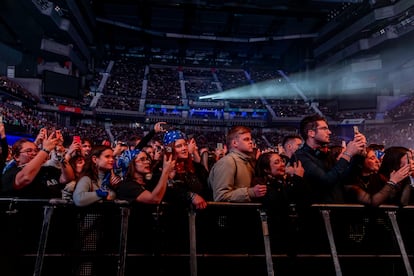
Added to this logic is a less visible, tangible issue: the true costs of live performance. Not all “sold out” concerts are necessarily profitable, and the resulting deficit is seen as an investment in brand positioning. “Selling a projection of success isn’t free,” Ferrara insists. However, not all organizations can afford to take that risk. Take the case of The Music Republic, a network that combines a talent agency with ownership of festivals like FIB, Festival de Les Arts, and Viña Rock. In 2024, the American fund KKR acquired Superstruct Entertainment (owner of The Music Republic) for approximately €1.3 billion. This ecosystem creates a vicious cycle that’s difficult to break: the same players who inflate their artists’ fees are also the only ones who can afford to pay them.
The consequences are felt particularly strongly by small and medium-sized festivals. David Cuerdo (Oviedo, 45 years old) is one of the directors of Prestoso, a festival with 1,500 attendees in Cangas del Narcea (Asturias): “Prestoso would be, at most, the smallest corner within a macro-festival. This practice affects festivals like ours.” Cuerdo also points to the centralism of the sector. Before Prestoso, he was a programmer at the La Salvaje venue in Oviedo: “Once, a band that had filled La Riviera (in Madrid) came here and only drew 17 people. I also had the case of a band that drew 60 people to a free concert in Oviedo, and they were asking Prestoso for €10,000. For me, that’s devastating: it doesn’t even benefit the person who receives that €10,000.” Ferrara, in addition to centralism, adds another distortion to the price calculation: “Monthly listeners don’t correlate with ticket sales. For me, for example, an urban artist with 200,000 or 300,000 listeners is equivalent to the ticket sales of a rock band with 30,000 or 40,000.”
A similar logic to Prestoso is observed at Festival Observatorio, which has been held for eight editions in Balboa (León) and deliberately maintains a reduced capacity. “We’ve kept practically the same capacity for several years now,” explain Hannah Olmedilla (Madrid, 28 years old), Jaime Torrego (Madrid, 29), and Iván Dueñas (Madrid, 34), the festival organizers. However, both Observatorio and Prestoso admit that, in certain cases, bands are willing to lower their fees in exchange for other benefits. “There are artists who know that the initial fee doesn’t make sense for a festival like ours, but they still want to come because it’s worth it for other reasons,” point out the Observatorio organizers. “Being on our lineup puts you in a showcase that isn’t proportional to the actual size of the festival, but it is to its potential within a certain niche.” Prestoso agrees: “A band that would be third or fourth in line at a major festival, at most, is headlining here. Plus, there are no clashes: everyone comes to see you, and people come to hear real music.”
Even so, the capitalist logic of the market is still felt. Observatorio recalls that in 2022 they almost had to cancel the festival: “Sales were very bad and we had to issue a statement: if we didn’t sell X more tickets, the festival wouldn’t go ahead and the losses would come directly out of our pockets. ‘Sold out’ is always celebrated, even though it’s often a lie, but the opposite is almost never acknowledged,” they point out. “And that’s also part of the reality of live music.”
Pressure to succeed
All those interviewed agree that the inflation of fees is accompanied by increasing pressure to project success: “We live in a culture of constantly selling success,” explains Ferrara. “This puts pressure on artists to always try to play to bigger venues.” Santaner sums it up from experience: “I’ve worked with many artists who have been around for 20 years and are always in the same place. They have their audience, and that’s who they’ll stick with. And that’s fine. But for emerging artists, it’s a different story.” This pressure is what sometimes kills emerging musical projects. Bego (Toledo, 37 years old), vocalist and leader of Monteperdido (a band signed to Sonido Muchacho and disbanded in 2023), describes it this way: “Before Monteperdido, I wasn’t obsessed with numbers. I had the childish idea of wanting to do well. That started when I entered that environment. The experience with the industry damaged me psychologically a lot.” After playing several times at Sala El Sol (Madrid), her next concert was planned for a larger venue. Shortly afterward, she decided to distance herself from the industry: “It destroyed my social fabric, my creativity, everything.” Even so, she avoided announcing the end as a farewell: “The [venue] Copérnico concert was our last in Madrid, but we were forced to disguise it for fear that [festivals] Sonorama and Canela Party, where we were scheduled to play that summer, would be canceled. That devastated me, because the industry’s financial gain was valued more than the band’s well-being.”
The use of fictitious “sold out” figures as a tool for legitimization has ultimately disrupted the balance of live performance: it distorts the perception of success, puts pressure on fee-setting, and shifts risk to the most vulnerable areas of the sector. The gap between narrative and reality not only affects the finances of venues and festivals, but also the sustainability of the artistic projects themselves.
Sign up for our weekly newsletter to get more English-language news coverage from EL PAÍS USA Edition