
RAPID CITY, S.D. (KOTA) – Scientists at the South Dakota School of Mines and Technology have helped lead a major international discovery in particle physics, one that could shape future research happening right here in South Dakota.
A team led by Mines researchers has achieved the first-ever measurement of neutrino-induced kaon production in argon, an extremely rare particle interaction. The discovery helps scientists better understand how some of the smallest particles in the universe behave.
The findings come from years of data collected by the MicroBooNE experiment at Fermilab in Illinois.
Researchers Martinez Caicedo and Jairo Rodriguez recently published the results in Physical Review Letters, one of the world’s leading journals for physics research.
While MicroBooNE includes scientists from around the world, Mines served as the lead institution for this particular analysis. Rodriguez led the project as part of his doctoral research.
Former Mines postdoctoral researcher Arturo Fiorentini also contributed to the early stages of the work.
Finding something incredibly rare
The study focuses on neutrinos, tiny, nearly massless particles that pass through the Earth constantly. In fact, trillions of them pass through our bodies every second, and we never notice.
In the MicroBooNE experiment, scientists fired a beam of neutrinos into a massive detector filled with liquid argon. Every once in a while, a neutrino collides with an argon atom. When that happens, it can create a short-lived particle called a kaon, also known as a K meson.
But catching that interaction is incredibly difficult.
Researchers analyzed three years of data from the detector, looking for signs of the rare event.
“Out of hundreds of thousands of neutrino interactions over several years, we identified just 10 candidate events,” Rodriguez said. “From those, we determined eight out of 10 to be kaon candidates in the detector, and we were able to see them. That may sound small, but in particle physics, this is a major achievement.”
The team relied on MicroBooNE’s highly detailed imaging system, which can track particle movements with millimeter-level precision.
Why this discovery matters
Beyond studying neutrinos themselves, the measurement could help scientists tackle one of physics’ biggest unanswered questions: whether protons eventually decay.
Protons are one of the fundamental building blocks of matter, and many scientific theories suggest they may slowly break down over extremely long timescales. If that happens, the decay could produce kaons — the same particles studied in this research.
Detecting proton decay would dramatically reshape scientists’ understanding of the universe.
A connection to South Dakota
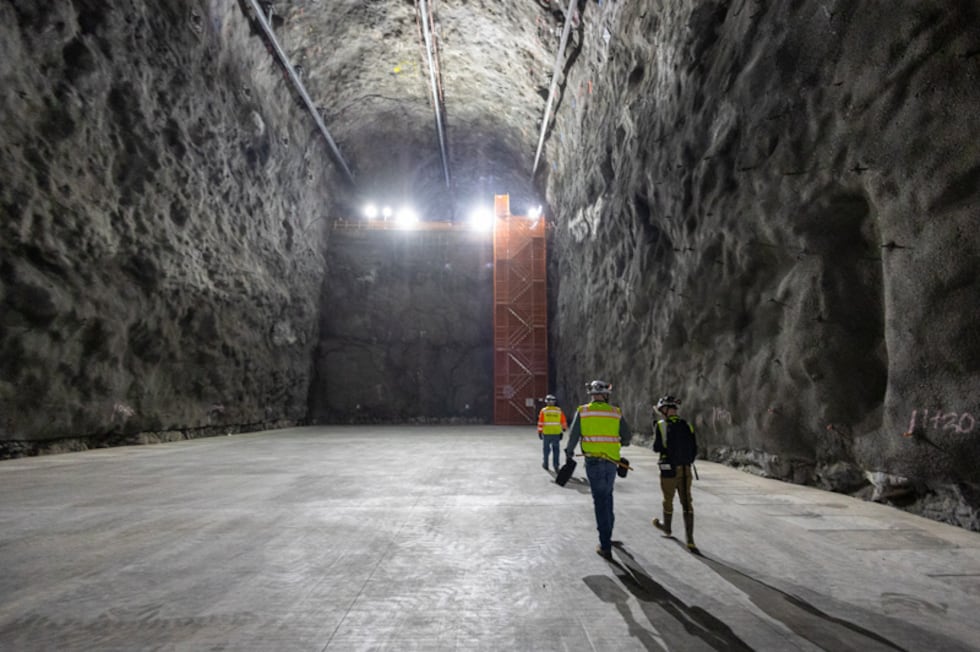
The discovery is also important for the Deep Underground Neutrino Experiment, better known as DUNE.
DUNE will be based at the Sanford Underground Research Facility and is expected to become one of the largest particle physics experiments in the world.
MicroBooNE was designed as a smaller prototype for DUNE, using the same liquid-argon technology.
Once DUNE begins operating, it will collect far more data over decades, giving scientists a better chance of spotting rare particle interactions like the one Mines researchers just measured.
For the South Dakota team, the milestone is another step toward preparing for that future research — and toward answering some of the biggest questions about how the universe works.
See a spelling or grammatical error in our story? Please click here to report it.
Do you have a photo or video of a breaking news story? Send it to us here with a brief description.
Copyright 2026 KOTA. All rights reserved.