
Southern right whales—once driven to near-extinction by industrial hunting in the 19th and 20th centuries—have long been regarded as a conservation success. After the International Whaling Commission banned commercial whaling in the 1980s, populations began a slow but steady rebound. New research, however, suggests climate change may be undermining that recovery.
“In my lifetime the right whale was thought to be extinct and their protection and return to Southern Hemisphere coastlines gave hope for their recovery,” said Robert Brownell Jr., a biologist at the National Oceanic and Atmospheric Administration’s Southwest Fisheries Science Center marine mammal and turtle division. “Their future is now in doubt.”
Southern right whales are no longer reproducing at normal rates, according to a study published this month in Scientific Reports, which Brownell co-authored with research partners in Australia and South Africa.
Historically, southern right whale females would give birth to a calf every three years. They’re now calving every four years, said Claire Charlton, a lead author of the study and associate researcher at Flinders University in South Australia.
The study found the extended calving interval has been evident since about 2015, with climate change identified as a primary cause because of changes melting Antarctic ice has had on ocean food webs.
“This reproductive decline represents a threshold warning for the species and highlights the need for coordinated conservation efforts in the Southern Ocean, in the face of anthropogenic climate change,” the study states.
A Changing Southern Ocean
Southern right whales congregate in Antarctic and sub-Antarctic waters each year from about January to June to gorge on krill, their preferred prey. Each whale can eat more than 800 pounds of the tiny crustaceans a day. The energy they store from consuming this amount over several months is meant to sustain them during long migrations, where they won’t eat for months, back to warmer breeding grounds in Australia, South Africa or Argentina.
“These whales depend on building up fat reserves in the Southern Ocean so they can support pregnancy and nurse their calves,” said Matthew Germishuizen, a postdoctoral fellow at the Mammal Research Institute’s Whale Unit at the University of Pretoria in South Africa, who led the study’s environmental analysis.
But the Southern Ocean is changing rapidly. As global temperatures rise, intensifying marine heatwaves and melting sea ice are reshaping entire marine food webs.
Krill, for instance, rely on sea ice to survive for shelter, especially as juveniles. They also feed on algae that grows beneath the ice. But in recent years, sea ice coverage in Antarctica has reached record lows. As their frozen habitat dissipates, the crustaceans are moving farther south into colder waters, or disappearing altogether from some locations, forcing their predators to travel greater distances and expend more energy while feeding.
“Their food is moving and changing, and so they have to work harder to find food,” Charlton said.
This is taking a long-term toll on the whales’ health. When feeding conditions are poor, there are longer gaps between calves, said Germishuizen in an email.
“The timing of the reproductive slowdown aligns closely with major shifts in sea ice patterns, ocean warming and broader climate variability across the Southern Ocean,” he said.
Decades of Data
The study draws from more than 30 years of data, collected between 1991 and 2024, by Australian Right Whale Research, a southern right whale monitoring program led by Charlton.
Every year, from about May to October, a population of right whales that feed in Antarctica spends several months in the Great Australian Bight—a vast bay stretching more than 700 miles along Australia’s southern coastline, which serves as a critical breeding and calving ground.
Over the years, researchers have tracked the whales and their behavior during these months, primarily using photo identification. This is a widely used research method that allows scientists who study whales to distinguish animals by their natural markings and follow them over time.
Southern right whales have distinctive white and gray patches of thickened skin on their heads known as callosities. Because the shape and arrangement of these markings are unique to every individual like a fingerprint, researchers have been able to use the photos of these features to identify individuals.
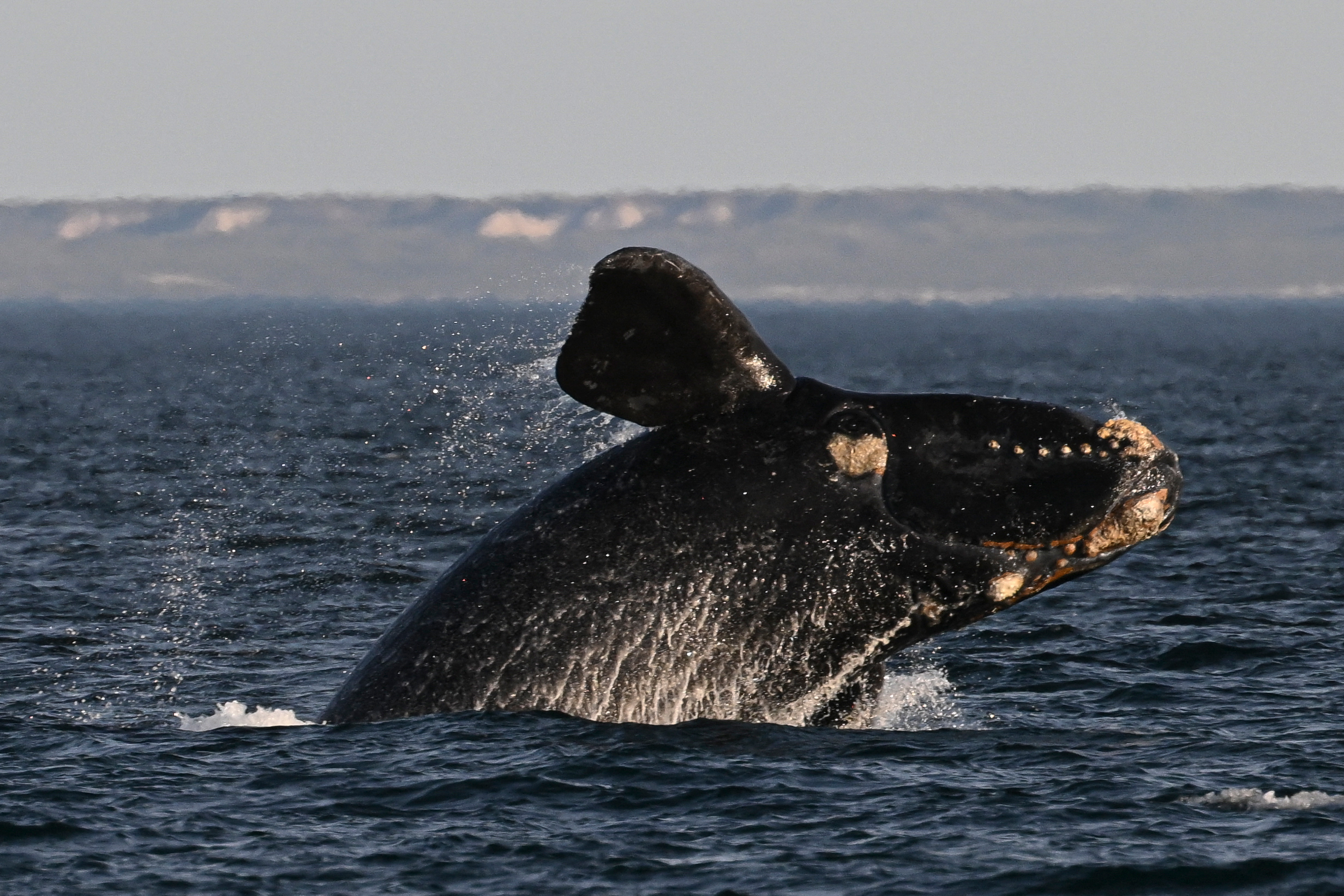
By matching these images from year to year over decades, Charlton said, the team built a detailed catalogue of more than 3,000 whales, recording their calving intervals and migration histories. The long-term record ultimately revealed the sustained decline in birth rates.
That dataset, researchers say, makes clear that the slowdown in reproduction amongst southern right whales is not a short-term fluctuation, but a persistent shift unfolding as a result of environmental change in the Southern Ocean—a troubling indicator not only for the right whales, but for the broader marine ecosystem.
Previous research has shown other whale species that feed in Antarctica are being affected, too.
“We have documented similar impacts on humpback whales,” said Ari Friedlaender, an ecologist and professor at the University of California, Santa Cruz, who has studied whale foraging behavior in the Southern Ocean for more than 20 years. “Lower sea ice years lead to lower pregnancy rates the following year as a result of lower prey availability.”
While Friedlaender was not involved in the southern right whale research, he commented on the importance of its findings: “This study really demonstrates the value and need to develop and maintain long-term data sets or time series that allow scientists to see trends over time.”
This story is funded by readers like you.
Our nonprofit newsroom provides award-winning climate coverage free of charge and advertising. We rely on donations from readers like you to keep going. Please donate now to support our work.
A Call for Protection
This information can, and should, be used to advocate for stronger protections for the species to increase their chances of survival across their ranges, Charlton said. “We have this duty to manage and reduce threats.”
Noise pollution, vessel strikes and entanglement in fishing gear all pose additional dangers to the whales as they migrate between their feeding and breeding grounds.
“The pressure that we’re putting on food webs through prey harvesting is a really big one as well,” Charlton said.
Last year, commercial fishing vessels caught close to 620,000 tons of Antarctic krill in the Southern Ocean—a record catch that has raised concerns amongst scientists about the potential impacts on whales and other krill-dependent predators.
“While the krill fishery may not take a large amount of krill relative to the total amount that is in the larger area, the fishery extracts the vast majority of their catches from a small area [around the Antarctic Peninsula] that we know is a critical feeding area for baleen whales, including humpback, right, blue, fin and minke whales,” Friedlaender said. This can intensify competition for prey among marine mammals already under duress from climate impacts.
To alleviate the escalating and cumulative pressures confronting the animals, Charlton emphasized the urgent need to expand marine protected areas in key feeding and calving habitats, which would limit or prohibit human activity.
The High Seas Treaty, which went into force in January, presents an additional mechanism for designating protected zones in international waters that would mitigate the impacts of intensifying global shipping traffic on whales as they migrate. Ultimately, however, Charlton said, significant reductions in greenhouse gas emissions must be achieved in order to tackle the root cause of climate change and reverse the current trajectory of warming oceans and melting ice for the good of southern right whales.
About This Story
Perhaps you noticed: This story, like all the news we publish, is free to read. That’s because Inside Climate News is a 501c3 nonprofit organization. We do not charge a subscription fee, lock our news behind a paywall, or clutter our website with ads. We make our news on climate and the environment freely available to you and anyone who wants it.
That’s not all. We also share our news for free with scores of other media organizations around the country. Many of them can’t afford to do environmental journalism of their own. We’ve built bureaus from coast to coast to report local stories, collaborate with local newsrooms and co-publish articles so that this vital work is shared as widely as possible.
Two of us launched ICN in 2007. Six years later we earned a Pulitzer Prize for National Reporting, and now we run the oldest and largest dedicated climate newsroom in the nation. We tell the story in all its complexity. We hold polluters accountable. We expose environmental injustice. We debunk misinformation. We scrutinize solutions and inspire action.
Donations from readers like you fund every aspect of what we do. If you don’t already, will you support our ongoing work, our reporting on the biggest crisis facing our planet, and help us reach even more readers in more places?
Please take a moment to make a tax-deductible donation. Every one of them makes a difference.
Thank you,

Oceans Correspondent
Teresa Tomassoni is an environmental journalist covering the intersections between oceans, climate change, coastal communities and wildlife for Inside Climate News. Her previous work has appeared in The Washington Post, NPR, NBC Latino and the Smithsonian American Indian Magazine. Teresa holds a master’s degree in Journalism from the Craig Newmark Graduate School of Journalism. She is also a recipient of the Stone & Holt Weeks Social Justice Reporting Fellowship. She has taught journalism for Long Island University and the School of the New York Times. She is an avid scuba diver and spends much of her free time underwater.