
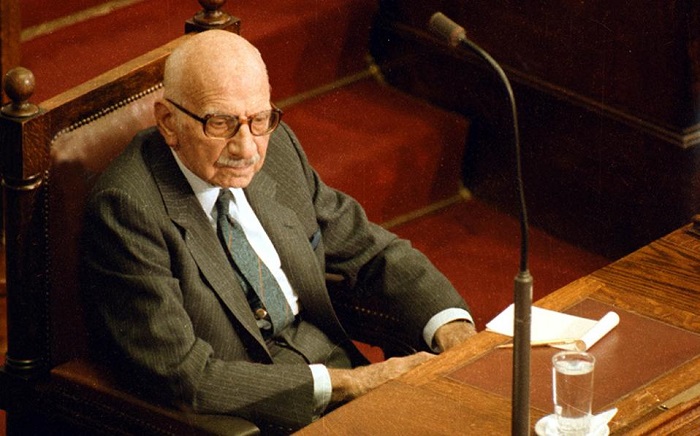
On Greek Language Day, many Greeks recall the speeches in English, peppered with words and phrases of Greek origin, delivered in the late 1950s by economist and politician Xenophon Zolotas.
Zolotas was the director of the Bank of Greece when he appeared before an audience at an International Bank for Reconstruction and Development conference in 1959. He delivered two speeches in English using primarily Greek words to emphasize the wealth of the Greek language and the fact that countless Greek words enrich English.
Greek remains a language that profoundly influences international scientific discourse; more than any other, it developed, shaped, and expressed the earliest scientific theories, philosophical thought, and literary traditions that underpin most modern Western languages.
Zolotas’ English-Greek speech delivered on October 2, 1959
Kyrie,
It is Zeus’ anathema on our epoch and the heresy of our economic method and policies that we should agonize the Skylla of nomismatic plethora and the Charybdis of economic anaemia.
It is not my idiosyncrasy to be ironic or sarcastic but my diagnosis would be that politicians are rather cryptoplethorists. Although they emphatically stigmatize numismatic plethora, they energize it through their tactics and practices. Our policies should be based more on economic and less on political criteria. Our gnomon has to be a metron between economic strategic and philanthropic scopes.
In an epoch characterized by monopolies, oligopolies, monopolistic antagonism and polymorphous inelasticities, our policies have to be more orthological, but this should not be metamorphosed into plethorophobia, which is endemic among academic economists.
Numismatic symmetry should not antagonize economic acme. A greater harmonization between the practices of the economic and numismatic archons is basic.
Parallel to this we have to synchronize and harmonize more and more our economic and numismatic policies panethnically. These scopes are more practicable now, when the prognostics of the political end economic barometer are halcyonic.
The history of our didimus organization on this sphere has been didactic and their gnostic practices will always be a tonic to the polyonymous and idiomorphous ethnical economies. The genesis of the programmed organization will dynamize these policies.
Therefore, I sympathize, although not without criticism one or two themes with the apostles and the hierarchy of our organs in their zeal to program orthodox economic and numismatic policies.
I apologize for having tyranized you with my Hellenic phraseology. In my epilogue I emphasize my eulogy to the philoxenous aytochtons of this cosmopolitan metropolis and my encomium to you Kyrie, the stenographers.
Born in Athens on April 26, 1904, Zolotas studied economics at the University of Athens and later studied at the Leipzig University in Germany and the University of Paris in France.
Zolotas was director of the Bank of Greece in 1944–1945, 1955–1967 (when he resigned in protest at the regime), and 1974–1981. He published many works on Greek and international economic topics. He was a Keynesian, and was active in socialist circles with his close friend, Professor Angelos Angelopoulos.
Zolotas died on June 10, 2004 at the age of 100. He is buried in the First Cemetery of Athens.
Related: Greek Language Day: The Mother of All Western Languages