
It’s the summer of 1992 and while in England on a six-week tour with Kronos Quartet, Princeton Professor of Music Steven Mackey is watching the demise of Jim Morrison on the television. The biographical film “The Doors” had been released the year prior and followed Morrison’s life, from his Californian college days and formation of his rock band to his untimely death in a Paris bathtub.
Mackey was newly tenured, sleep deprived from touring, and packing up his bags and changing hotel rooms every night — all while an impending divorce weighed on his conscience. He was haunted by his decision to temporarily give up stability for an intrepid life on the road. Mackey couldn’t help but recognize a tame shade of his overwrought life in Morrison’s self-destructive tendencies.
While the film played, Mackey couldn’t help but wonder: “Am I Jim Morrison? Am I throwing away the stability of my marriage to traipse around the world with this famous string quartet?”
Now a Grammy-winning composer, father of two, former chair of Princeton’s Department of Music, William Shubael Conant Professor of Music, and member of the composition faculty at the Curtis Institute of Music since 2022, Mackey is soon to retire after 41 years of teaching at Princeton.
Mackey began his teaching career at the College of William & Mary when the College Music Society came in to advertise a job opening at Princeton.
“I thought Princeton was way up here,” he says, gesturing his hand upward. Mackey is perched on a red couch beside his daughter, Dylan, for an interview with The Daily Princetonian in the Nassau Inn. A fire crackles beside him. Back in his twenties, Princeton seemed like an exotic, lofty institution.
“When I saw this job announcement, I thought, ‘old boy network,’” he said. “And so I didn’t apply.”
Mackey went to high school in Northern California, began his undergraduate studies at the University of California, Davis as an intended physics major before switching to music. He received a M.A. in composition at the State University of New York at Stony Brook.
It was at Brandeis University while completing his Ph.D. that Mackey met his lifelong friend and mentor, Paul Lansky GS ’73, who retired as the William Shubael Conant Professor of Music in 2014. Lansky had been invited up to Massachusetts on a visiting committee to review Brandeis’ music department and faculty performance. He was walking through the hall when he heard a string quartet rehearsing one of Mackey’s pieces.
While listening, Lansky thought the piece “sounded like somebody from Brandeis, except really good.”
He opened the door. “What’s this?” he recalled asking.
The string quartet motioned to Mackey and the two introduced themselves, but it wouldn’t be their last encounter.

Forgetting about the job application, Mackey went away and visited his parents for the holidays. Upon his return, he noticed the deadline for the faculty position had been postponed. “I thought, if they already knew who they wanted, they wouldn’t have postponed the deadline. So maybe they’re looking for something that they haven’t seen yet. Maybe it’s me.”
After he applied, Lansky invited him to an interview over dinner.
“Members of the faculty were very enthusiastic about him,” Lansky recalled. “He was primarily a guitar player, and this was sort of unusual for a new music position. But things were changing at that point, and a guitar player was no longer a creature from another planet.”
When Mackey was hired in 1985, music was “aesthetically at a crossroads. We were coming out of a period of, what I would call, academic modernism: a modernist movement starting in the beginning of the 20th century [that] got taken over by academia.”
At the time, Princeton was the leading institution of serialism, a movement that shook the classical music world by replacing the long-established tonal system with structured atonality. One faculty member in particular, the late mathematician and former William Shubael Conant Professor of Music Milton Babbitt, championed the technique by uniting classical, jazz, and electronic genres.
When Babbitt retired in 1984, Mackey didn’t inherit his predecessor’s strict and contrarian twelve-tone legacy. Mackey understood the intellectual processes of musical composition and also had a soulful groove. He brought a wide taste, inventiveness, and eclectic sensibility to the music department at Princeton. For instance, in one of his compositions titled “Banana/Dump Truck,” a pizza is delivered in the middle of the piece to the double bass player.
“I brought a rock music background, a vernacular music interest that was earnest and with experience,” he recalled.
Or, as Lansky used to tell Mackey, “The DNA of your music is made up of equal parts Led Zeppelin and Igor Stravinsky.”
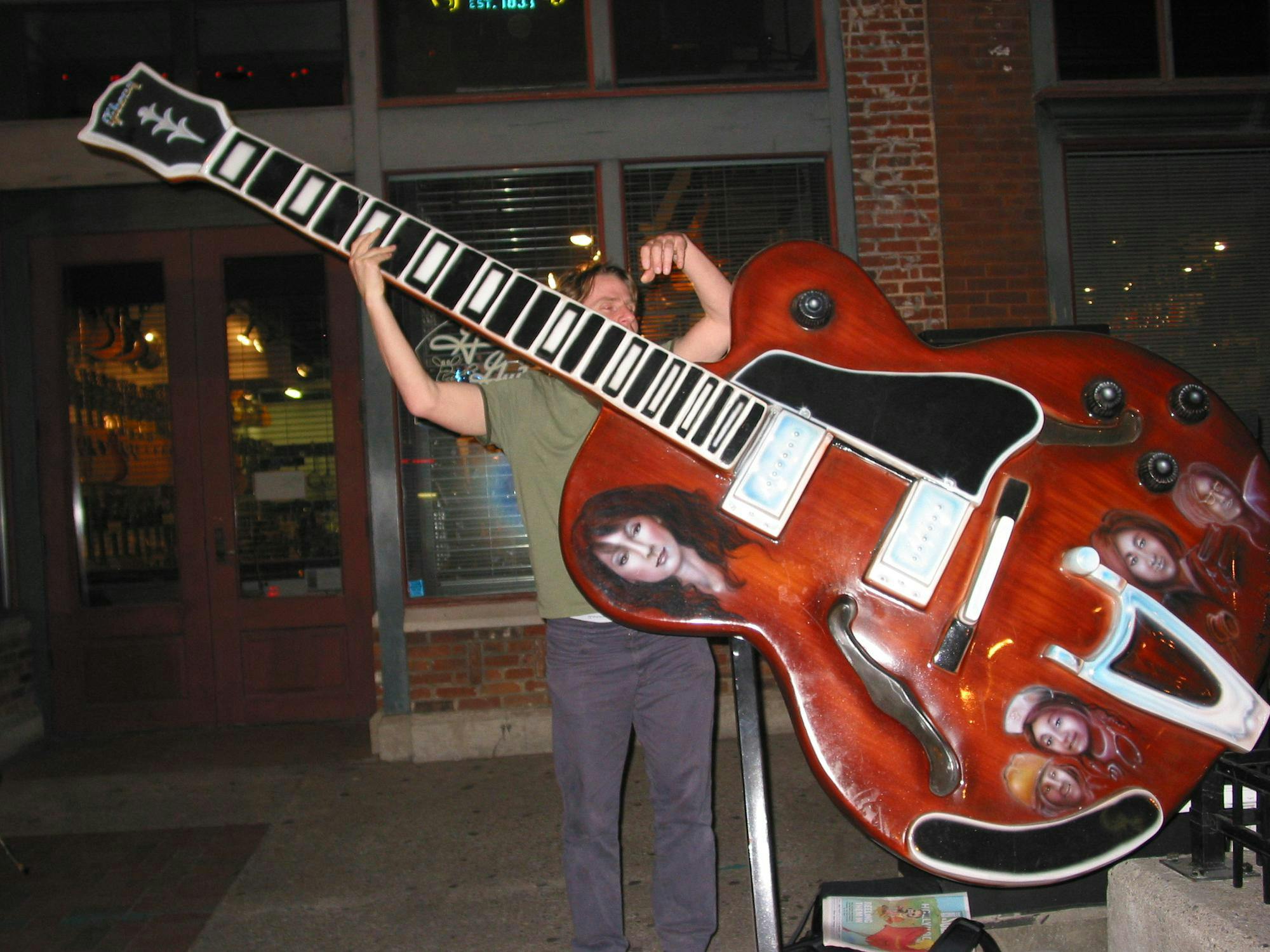
Steven Mackey with a giant guitar in Nashville, Tenn.
Photo Courtesy of Steven Mackey
At 29 years old, Mackey’s first course was MUS 205, a music theory class that gave leeway for Mackey to improvise in his teachings based on what he wanted to discuss and what he wanted to inspire in his students. It was taken by a relatively small group of students, but Mackey remembers one in particular: Michael Artin ’87.
Artin was also one of Lanksy’s senior thesis advisees and the only music major of his graduating class. He became interested in music through writing and recording rock-and-roll songs which, he believes, is what bonded him to Mackey.
“As a music major, I felt very much alien because there were other people taking music classes who had a much more traditional classical music background,” Artin said. “They could hum and sing the Brahms melodies when people said, ‘Do you know the Second Symphony?’ And I didn’t know that.”
Artin lived with his grandmother instead of the dorms, so Mackey would visit his grandmother’s house, where they did improvisational jamming sessions.
Being a young instructor meant students objected to Mackey’s authority and made respect in the classroom precarious during his first year teaching, especially among some graduate students who were deep into their 30s and early 40s.
“‘What’s this kid doing? You know, teaching me?’” Mackey recalled his students’ attitudes toward him and even a petition that argued: “Steven Mackey didn’t even go to Princeton. How is he qualified to teach at Princeton?”
Mackey’s colleagues, however, ignored the students’ criticisms.
“He was in touch with cultures that we have only limited contact with,” Lansky said, viewing Mackey’s younger age as an advantage.
These schisms in the Music Department are ones Artin remembers well — how old school and new school approaches could collide in the same room. When music majors in the Class of 1986 presented their creative theses in front of all the professors, Artin recalls how the end of one student’s rock song faded out. While traditional composers were appalled that a piece could end not in an earned cadence, but in a simple fade-out, Mackey took no offense.
“Steve was like, ‘No, no, no. This thing is continuing in the air, and you’ve dipped into it, and you’re experiencing it for a while, and now you’re just pulling yourself back out, and it’s continuing on without you,’” Artin recalled.
Mackey received the University’s President’s Award in Distinguished Teaching in 1991, the first year it was awarded. In the same year, he emerged from a graduate seminar and checked his mailbox with all his students surrounding him to find an envelope inside from Harold T. Shapiro, the then-president of the university. He had received tenure.
Mackey, now 70, has experienced various stages of teaching over his career as a professional composer. In the beginning, he tried teaching students everything he knew, but came to learn that composition doesn’t have an “absolute truth” that every composer can be cloned as. There’s no right or wrong. A quirky sound in a piece might be interpreted as a weakness but, if worked on, that weakness can become someone’s trademark.
“Then I went through a few years where I was overly permissive, a cheerleader — just trying to help people.”
Now Mackey has reached the point of candidly conveying his opinion.
“It becomes really ironic. Now that I’m retiring, I think I’m doing my best teaching in the last 10 years because of that comfort in my own skin; comfort with my knowledge; confidence in what I have to say; and security that if you don’t take my advice, it’s not a slight on me,” he explained.
A down-period in Mackey’s life came in the wake of 9/11.
He expressed that the terrorist attacks made everything feel so useless. He couldn’t bring himself to compose a guitar orchestra piece commissioned by the Holland Festival, set to premier in 2003.
“What’s the point of composing music?” he thought, then remembered the illnesses in his family. “Mom’s gonna die, and my dog’s gonna die, and the country’s going to shit — you know, just bleak. I have no interest in composing. I can’t concentrate.”
Despite his nihilistic feelings, Mackey eventually brought himself to composing again. With a TA covering his class, he cooped up in his house and didn’t change out of his pajamas until he finished the commissioned piece. It was cathartic for him to undergo so much trauma and make art out of it. “Dream House” was a metaphor for being lied to about the existence of weapons of mass destruction, the subsequent invasion of Iraq, and Mackey’s own feelings of culpability as an American deceived by the CIA.
As the world has changed dramatically over the decades, so has Princeton. But despite being at the same place for so long, Mackey has never felt stuck in the sameness of his surroundings. Even after all this time spent at Princeton, he feels like he “didn’t stay in one place for 41 years, because students keep coming through.”
Mackey likened his time as a professor to being parked in a car with student passengers hopping in and out while the scenery outside the vehicle constantly changed: politics, culture, musical tastes. Friends coming and going, like Lansky and Artin. Moving offices to the Effron Music Building. Weighing in on the upholstery of the newly erected Lewis Center for the Arts.
While some students are ships passing in the night, others linger at the harbour, seeking Mackey’s continued mentorship.
Yuri Lee ’27 has taken four courses with Mackey since the beginning of her first semester at Princeton. Now, Mackey is her junior project advisor.
“Every time I walk out and away from my JP meeting, I’m always like, ‘Wow. Everything is so beautiful in this world, and it’s so colorful, and I’m so enlightened, and I feel like I’m levitating,’” Lee described. “He has so many useful tricks, composition tricks, that I’ve never thought about or heard from other people.”
Toussaint Santicola Jones ’25 had Mackey as his senior thesis advisor. He fondly recalled the day he showed Mackey a line of his concerto that led up to what would usually be considered a wrong note. Mackey proceeded to grab his laptop and punch in several more wrong notes.
“Play the wrong notes,” Mackey constantly told him.
When Mackey mentors students, he simultaneously observes their youth, vitality, and the possibilities ahead of them. While he sometimes faces nostalgic fantasies of returning to the past and reliving his career, Mackey feels settled in this stage of his life.
“If my fairy godmother came down and said, ‘I can make you twenty-eight again, put you right back there,’ I would say, ‘No, thank you. Everything worked out just fine. I have a fantastic daughter, fantastic son, fantastic wife and career,” he said.
Mackey is stepping away from Princeton at a moment in his career where he still feels a sense of creative freedom, openness, and malleability in the realm of contemporary concert music. However, if he could go back and relay something to his twenty-nine-year-old self, new blood in the Princeton faculty, he would say, “Don’t change a thing.”
“There’s a rawness to where I’m at now that makes me feel like, yeah, I can make stuff with my hands, and dig them in the clay,” Mackey says, uncurling his fingers and gripping that potential of his career. “I can shape things, and make things happen. I want to be able to do that more.”
Lola Horowitz is an assistant Features editor and staff Archivist for the ‘Prince.’
Please send any corrections to corrections[at]dailyprincetonian.com.