
Posted on December, 11 2025
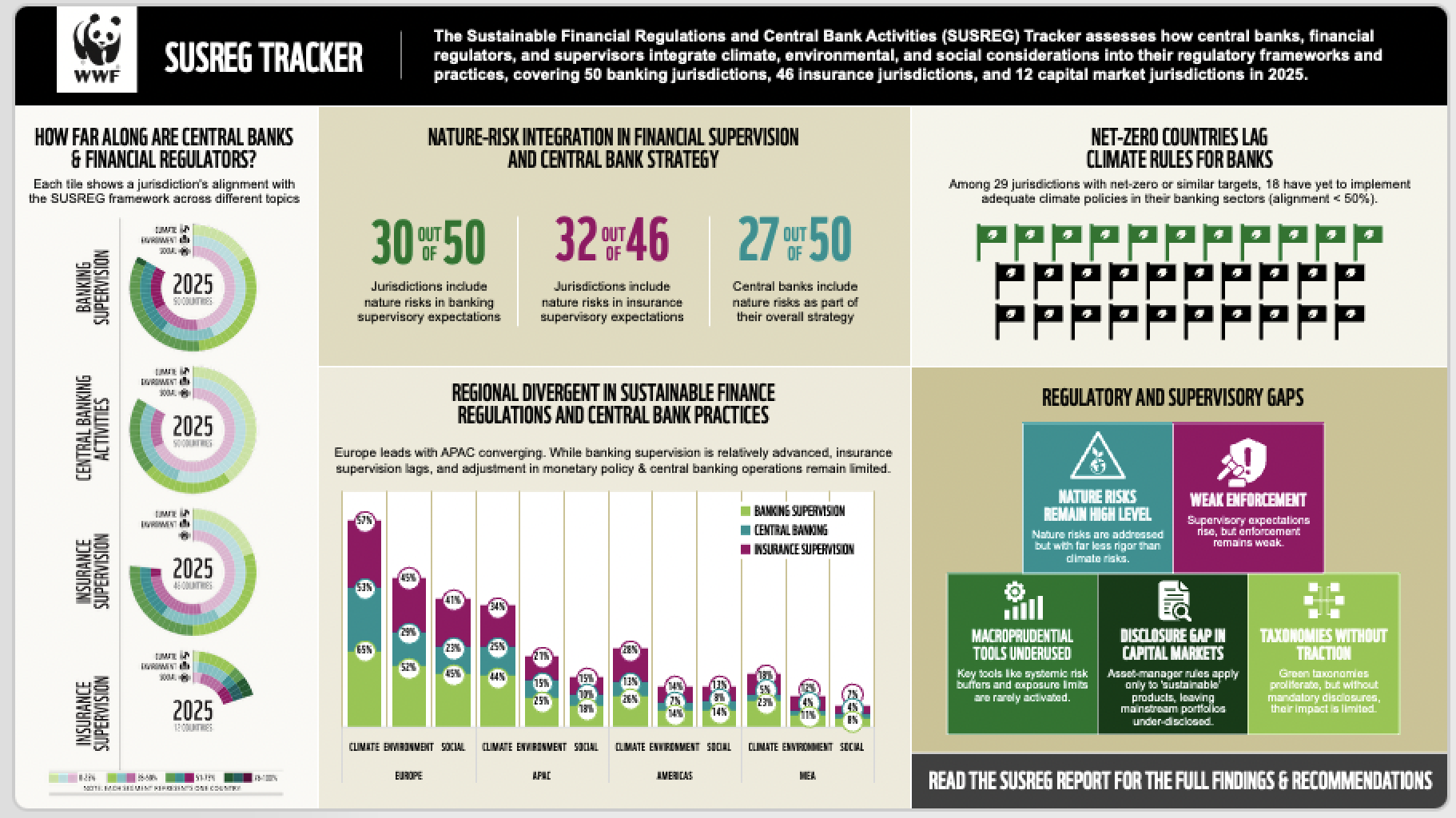
WWF´s Sustainable Financial Regulations and Central Bank Activities Assessment 2025 (SUSREG 2025) warns that although frontrunning central banks and financial regulators are taking important steps, the major drivers of nature loss (for example; land, freshwater and sea use change; climate change; and the direct exploitation and pollution of terrestrial, freshwater and marine ecosystems)
The fifth edition of WWF´s Greening Financial Regulation Initiative global benchmarking exercise evaluates how climate, nature and social risks are being integrated into central banking, financial regulation and supervision.
The report highlights the importance of integrating nature-related risk more fully, activating key macroprudential tools, and aligning capital rules to reflect environmental impact alongside establishing a clear and consistent framework for transition plan disclosures. With 2030 fast approaching, and less than five years to deliver on global climate, nature and development goals, decisive regulatory action is essential to guide the financial sector toward a net-zero, nature-positive, and socially equitable future.
Some central banks and financial regulators in Europe and the Global South are demonstrating strong supervisory follow-up and notable progress in bringing industries into closer alignment with their expectations. Regulators and supervisors in jurisdictions such as Bank Negara Malaysia and the European Central Bank show clear advances supervisory follow up, illustrating how effective oversight can drive meaningful improvements. Supervisors in emerging markets (including Colombia, Morocco, Paraguay, and Türkiye) have also issued or strengthened guidance on climate and ESG risk management and disclosure. The Hungarian Central Bank (MNB) has expanded its climate related financial disclosure framework to explicitly include ecosystem and biodiversity risks, using the WWF Risk Filter Suite to assess nature-related risks in its foreign exchange reserves and monetary policy portfolios. These good practices, and many others that are outlined in SUSREG 2025, clearly demonstrate that progress is not only possible but underway. The monetary, supervisory and policy instruments needed to close remaining gaps are already available and can be deployed successfully.
At the same time, the report identifies several important areas where further action is needed:
-
Major drivers of nature risk (such as biodiversity loss, ocean degradation and water stress) remain largely overlooked in financial regulation. Unlike climate-related risks, they are not addressed with the same level of rigor. Integrating them into regulatory frameworks is essential for capturing the full scale of system-wide vulnerabilities.
-
Macroprudential tools remain underused, even though they are vital for managing system-wide risks. Instruments such as Systemic Risk Buffer (SyRB) and exposure limits are still rarely activated.
-
Supervisory expectations for climate and nature risks are increasing, but enforcement remains weak, with little follow-up on non-compliance when financial institutions are falling short.
-
Green taxonomies are proliferating, but without mandatory disclosures against them, their impact on capital redirection is limited.
The SUSREG 2025 report outlines clear, actionable steps that financial authorities can take:
-
Strengthen the integration of nature into central banking and financial supervision by embedding it in monetary policy tools and setting concrete expectations for financial institutions – including which nature-related risks to identify, what data to collect, how to measure those risks, and what due-diligence standards to apply;
-
Deploy the macro-prudential toolkit, including stress tests, capital buffers and exposure limits to prevent and monitor system-wide climate and nature risks;
Maud Abdelli, WWF Greening Financial Regulation Initiative Lead said: “The outcome of COP30 underscores the urgency of the SUSREG 2025 findings. As global negotiations continue to fall short on delivering clear roadmaps to phase out fossil fuels and halt deforestation, central banks and financial supervisors will increasingly need to step up to ensure that climate and nature risks are properly identified, priced and managed. They are crucial players in strenghtening the financial system´s ability to build the resilience needed to withstand these accelerating shocks.”
Siti Kholifatul Rizkiah, WWF SUSREG Lead said: “We must take a genuinely precautionary approach to climate and nature risks. The consequences of inaction will far outweigh the costs of early intervention. The financial system can no longer pretend that environmentally harmful assets are low risk when the evidence proves otherwise. Taking decisive action now is not only a strategic business imperative but also a key to unlocking the emerging green opportunities and safeguarding future economic growth.”
About WWF´s Greening Financial Regulation Initiative SUSREG Assessment
In 2021, WWF launched the first Sustainable Financial Regulations and Central Bank Activities (SUSREG) assessment to evaluate how environmental and social risks are integrated in regulatory and supervisory practices, as well as in central banking and other financial activities that support the redirection of financial flows towards more sustainable practices. The aim of the assessment is to help central banks and financial supervisors benchmark their policies against emerging regional and global good practices with the overall goal of redirecting financial flows toward sustainable practices, and moving away lending, underwriting and investment from the most environmentally harmful businesses and sectors, in support of a net zero, nature positive economy. Countries assessed are mostly members and observers of the Basel Committee on Banking Supervision (BCBS), the International Association of Insurance Supervisors (IAIS), and the Network of Central Banks and Supervisors for Greening the Financial System (NGFS). Assessments are published on a yearly basis, with an accompanying annual report.
This year’s assessment covers 50 jurisdictions for central banking, 46 for insurance, and 12 for capital markets – representing over 89% of global GDP and 75% of global emissions. It broadens its scope, adding capital markets to the assessment and introducing a new thematic focus on deforestation, freshwater, and ocean health, underscoring the increasing relevance of nature-related risks and the threat of nearing ecosystem tipping point collapse for financial stability.