
Clint Bentley’s saga about a logger played by Joel Edgerton who experiences love and loss in the early 1900s reflects changing times.
SAN ANTONIO — In Netflix’s “Train Dreams,” set in the latter days of the 19th century and opening of the 20th, a rugged logger named Robert Grainier (Joel Edgerton) spends months out of each year laying down railroad track and uprooting trees—evidence of a country literally transforming itself in order to close the distance between its growing cities.
In a movie centered around its protagonist constantly looking to carve his path forward without fully recognizing the beauty around him, the metaphor is pretty clear. And in the hands of writer/director Clint Bentley – who was born in Florida and now calls the Oak Cliff neighborhood in Dallas home – and his creative team, that idea carves out depth through the texture of the film’s storytelling, the profundity of its cinematography and the quiet intensity of its performances.
Nature, like life, “Train Dreams” likes to remind its audience, has a way of rendering itself an undeniable force.
This may be a Netflix movie, but it wasn’t a Netflix production; the streamer acquired Bentley’s film out of the 2025 Sundance Film Festival. Adapted from the Denis Johnson novella of the same name, it’s since gone on to become one of the most critically acclaimed movies of the last year—and is now up for four Academy Awards, including Best Adapted Screenplay for Bentley, a nomination he shares with creative partner (and fellow Texan) Greg Kwedar. The movie’s other nominations: Best Cinematography, Best Original Song and Best Picture.
Bentley spoke with KENS 5 before the Oscars on Sunday about immersing himself in the Pacific Northwest environments that inspired it, the uncertainties of modernity and crafting an eventual Best Cinematography nominee that many would later see on their TVs.
(Note: This interview was condensed for clarity and length. Watch it here.)
KENS: Clint, it’s been 13 months in “Train Dreams'” life cycle, since people started watching it, writing about it in-depth. Can you talk about what the last 13 months have been like for you and does it feel like you’re reaching a finish line with the Academy Awards?
Bentley: It’s been very surreal. We were racing to the finish line to finish the film to get it to ready for Sundance, and I really didn’t know how it would be received. And it was really a beautiful reception there. Since then it’s just grown and it’s been wild. There were times along the way, like before Toronto (Film Festival) when we came back out and then before our theatrical release, there were a few times along the way where I was nervous cause I was like, “Maybe it won’t be received well.”
The love for the film has just grown and continues to. On the one hand, it is a finish line of sorts. But it also feels like the film will continue to grow in the world. I’m really incredibly grateful for that as people continue to find it.
KENS 5: I have to apologize because my first question for you about the film is actually kind of a philosophical one, but it’s one that is at the forefront of my mind as I’m thinking about this movie. How do you view the natural world as it pertains to man finding its place in the world, and did that perspective change while you were making “Train Dreams”?
Bentley: That’s a good question. It’s always fun to get one that’s not just the standard fare…
KENS 5: I like to start heady.
Bentley: It wasn’t so much that it changed in making “Train Dreams,” because a lot of what the film concerns itself with are things I wanted to put out there in the world and put into the film. They were ideas that I’ve been wrestling with for a long time. I feel like it’s the tragedy of being a human that we feel somehow separate from the natural world and humanity in general.
I think that’s the great tragedy, but also a unnecessary one. We feel like we’re so separate from things and separate from the natural order of things. I think we’re seeing, in very clear terms over the last 100 to 150 years, what impact we’re having that ultimately harms us. It’s like burning down your own house, you know, that you live in.
One thing I that I’m remembering from set that kind of struck me that I didn’t think about before was we had that cabin that Gladys and Grainier live in. That log cabin was built by our production designer Alex Schaller and her team. They built this fully functional log cabin that you could have moved into, and lot of us wanted to move into it. But there was something really interesting when we were out there filming where you weren’t so disconnected from nature in that space. When it was hot, we opened the doors and opened the windows to let the breeze in. When it was cold, we closed everything up, lit the oven to warm up the place. But you really felt influenced by the elements. You had to wear a jacket or you had to take a jacket off, and then I would get back to my Airbnb at night and if I was hot, I would just like press a button on the wall and make the air colder. There’s something, I think, to that that we can forget how intertwined we are with everything in the world.

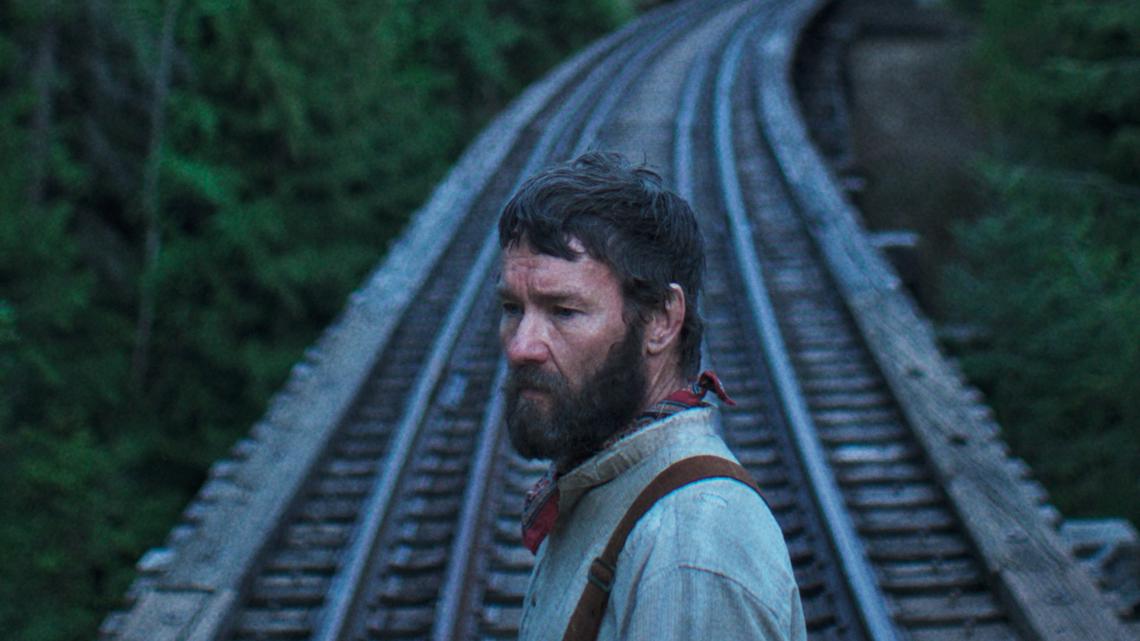
KENS 5: Greg has said about how you both wrote this during the pandemic, how before truly starting production on the movie, y’all drove through Idaho, through all these environments that Johnson himself would have been inspired by. Was it cathartic, after COVID, to get out and be in that environment?
Bentley: Oh yeah, man. I came out of COVID and out of the pandemic just very grateful for everything all over again, you know? I was so grateful to go and travel, I was so grateful to go and see my grandmother without worrying about if I was gonna accidentally kill her. Grateful for film festivals. We had made “Sing Sing” (when) it was still COVID, but at the tail-end of it and just like the number of protocols we had to do with everybody wearing masks that makes it so much more difficult. And so to be really out of COVID and make the film, it just felt like such a gift.
KENS 5: You can’t really appreciate “Train Dreams” without appreciating what you and (cinematographer) Adolpho (Veloso) achieved as far as the cinematography. Just the shot selection and just how y’all were able to achieve the balancing act of the environment in the movie feeling so much larger than just Grainier, but also syncing up pretty intimately with his emotional journey. To me, certain shots almost function like beats in the story, similar to how narrative pivots would. I think of certain shots as mile marker shots. Was that the intention for you and Adolpho to have those kinds of shots that just hit a little bit harder or was that organically going a byproduct of where the story was going?
Bentley: We did think about those like banner shots that are gonna be emblematic of a moment or a section, right? But not necessarily in where they would go because a lot of that was found in me working with Parker Laramie, our great editor on the film. A lot of things moved around, like that tree shot (of it) falling was much later than it ended up being. It just became clear it was too good to wait on that shot.
But you’re always looking for those shots to kind of like settle in and shots that become bigger than what they are because of what’s around them. That’s something you can only plan so much for, and you also don’t always know what shots people are gonna really connect with.

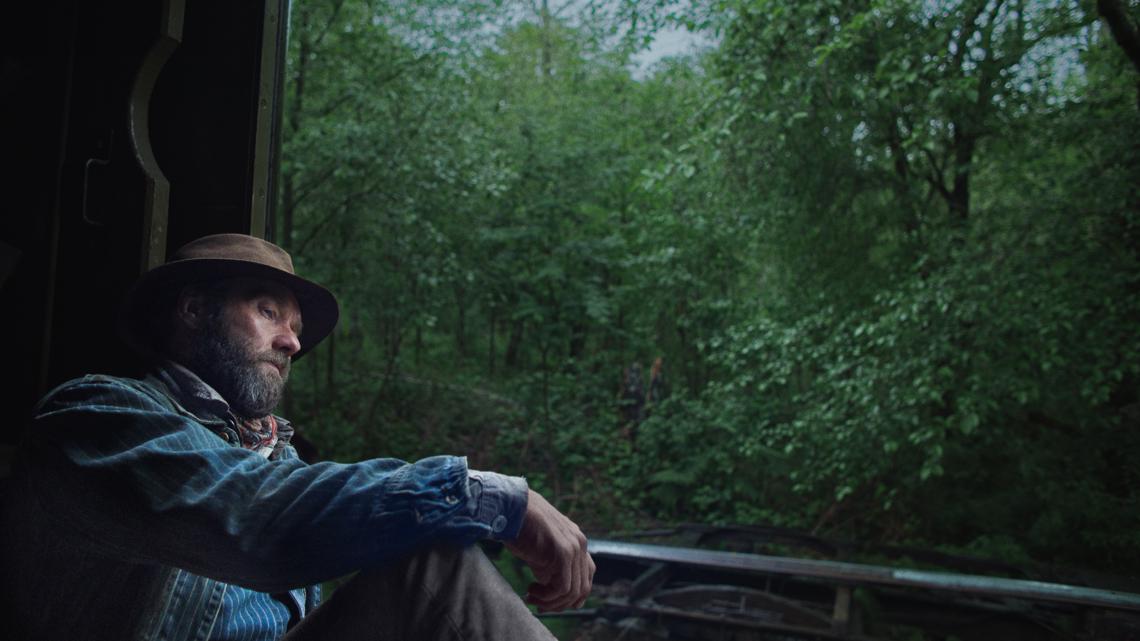

KENS 5: Can you talk about your approach to capturing that enormity of life in Grainier’s environment in “Train Dreams,” knowing that you’ll be inevitably constrained by the size of screen people decide to watch your movie on?
Bentley: I honestly don’t think too much about it. It’s funny, as filmmakers we talk about shooting things for the big screen, and for this one certainly that was in mind. We wanted to make it something to where it would reward you if you watch it on a big screen. I think any movie is better if you watch it in the theater, of course.
But then I also know from growing up the way I consumed films – mostly on VHS when I was a kid – a good movie is a good movie is a good movie. It functions on any screen. And it’s funny, as we’re making our films as directors, we’re holding a little monitor where we’re watching as we’re shooting it, and it’s just this big. (Creates small square with his hands.) It’s a little like 10-inch monitor that you’re watching it on. So you’re just trying to get it to work there, but then, Adolpho and I were conscious of this, and also Alex Schaller, our amazing production designer on the film, was integral in this as well: putting little details into the frame that are going to reward you for seeing it on a big screen. There are things I think that might not come across very quickly on a smaller screen in somebody’s house.
KENS 5: Right, that makes sense.
Bentley: At the same time, everybody’s TVs are so big now, so maybe it doesn’t matter.
KENS 5: That’s true! I also appreciate that there’s almost a tension between when we see certain flourishes throughout of modernity encroaching, like the shot of the bridge in the distance with cars zooming by while Grainier is on the train. And closer to the end, when he finds himself in the city, completing that transition. I appreciated how destabilizing that felt, because it felt intentionally like he just time-traveled decades in the future, when really it’s just in a movie that captured the natural world so well that any sign of modernity and civilization is destabilizing. Toward the end, I thought about the uncertainty of things coming into our world, like AI. Did you think about how destabilizing it would feel finally moving into civilization, but also knowing that that’s where Grainier ultimately finds his catharsis by movie’s end?
Bentley: It’s a good question. I wanted it to feel that way. That was very intentional, that it felt like this guy time-traveled forward. When we flash forward in the beginning of the film to the scene on the bridge, that was something that came very late in the edit—taking that shot and kind of giving us a preview of what’s to come.
But I definitely wanted it to feel like you’re with this guy, you’re in this world, and that not only he time-travels forward, but you do as well. And I didn’t want it to feel as simplistic as, you know, modernity bad, tradition good, or whatever. Because there are some things sprinkled throughout the film as well. One of the characters dies and the narrator says, “Had he been born a generation later, his heart condition would have been easily diagnosed and cured.”
There’s things like that, even now as we’re struggling with what’s happening with AI. I was reading some articles this morning that are just like incredibly troubling. But it’s also like, it could potentially cure cancer, you know? And it’s mapping all the proteins that we know of. It’s wild. And so there’s this real paradox of moving forward in time on a bigger level as we’re gaining a lot from technology, but we’re also losing a lot in the same way that I think we all experience it as individuals, where we move forward in life. As the poet goes, “Though much is taken, much abides.” We lose a lot, but we gain a lot along the way.
KENS 5: I also thought about Texas’ own natural diversity. How has Texas’ natural diversity influenced your art and filmmaking?
Bentley: This is maybe a a roundabout way to answer it, but this film is so specifically set in Washington (state), and I feel like a lot of times Washington on film looks a very specific way. A lot of times because people are shooting in British Columbia, pretending that it’s Washington so they can get tax rebates in the past. But, in the same way that Texas is, Washington is incredibly geographically diverse. Its natural elements are incredibly diverse, and you’ve got all these microclimates throughout the state, at least four if not five of them. I really wanted to represent that with the film, showing the feeling of different forests and all the different sides of the state.