
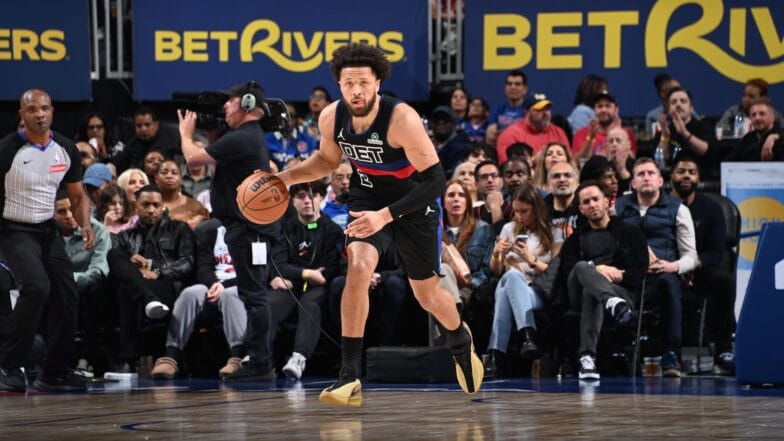
Cade Cunningham is adamant that he “never” wants to go back to the days of two seasons ago, when the Pistons won 14 games and were the laughingstock of the league.
Editor’s Note: Read more NBA coverage from The Athletic here. The views on this page do not necessarily reflect the views of the NBA or its teams.
***
As Cade Cunningham tells it, not much has changed over the last two years.
Although the Detroit Pistons guard became an All-Star starter for the first time this season and is on the verge of superstardom, he doesn’t feel any different. For some, going from a franchise-worst 14-win season to spearheading a turnaround that has elevated the Pistons to the top of the Eastern Conference could be cause for swagger.
While Cunningham’s “depressing” 2023-24 campaign made him more sure of himself, the regular-season success he’s experiencing now hasn’t gone to his head.
It all traces back to his upbringing.
“I’ve seen my parents get up and work their asses off every day and never complain about it,” Cunningham told The Athletic. “Struggle and never complain, and make it feel like the world was great because of their perspective, you know what I mean? I was raised by two parents who were hard-working and just had a great perspective on life.”
Level-headedness was instilled into Cunningham early. Cunningham’s father, Keith, was pivotal in providing that outlook. Keith was one of the top quarterback recruits in the 1980s out of Arlington, Texas, and committed to play for Texas Tech.
But once move-in day rolled around in Lubbock, Keith lifted a bed that knocked down a ceiling fan and caused an injury to his throwing arm. His career at Texas Tech was limited to just two seasons due to the accident. He later went on to work as an electrical engineer.
He and his wife, Carrie, who worked as a travel agent, laid the foundation for Cunningham and his older siblings, brother Cannen and sister Kaylyn.
“I can’t say enough about his parents and the way they brought him up and helped rear him into the human being he is,” Pistons coach J.B. Bickerstaff said. “He’s a blessing to be with and work with every single day.”
Sure, Cunningham has more attention now, but despite his rise over the last two seasons, he’s intent on making this his new norm.
“It’s more pressure,” Cunningham said. “To come from the (14-win season) to where we’re at now, I never want to go back to that. I know how small of a margin it is to get back to that. So there’s more pressure. And also, what’s the point of coming all the way up to the top if you ain’t going to do something with it?
“Might as well just stay at the bottom and go home in April every year. Keep collecting millions, have fun being an NBA player, enjoy the life and s–t, but I don’t think anybody is here to just be an NBA player. I know I’m not here to be just an NBA player. The whole point of all of this is to be a champion, to win and to be great.”
While Cunningham is on pace for his most impactful season yet, as evidenced by his career-best 7.0 win shares, he’s not satisfied. He’s averaging 25.2 points, 9.9 assists, 5.8 rebounds and 1.5 steals per game. His ability to remain unflappable has helped to maximize his potential. Cunningham has been that way since he was a freshman at Bowie High School in Arlington.
“I’ve always, in a way, seen the world in this way,” Cunningham said. “Even though I didn’t know I was going to make it to the NBA, I felt like what’s the point of even waking up and going to practice or just going to school or whatever, if you’re not trying to go accomplish something and elevate the world, you know what I’m saying? Or your world, at least.”
Not only has Cunningham elevated his world, but he’s also elevated the expectations of Pistons fans in the process. This is the Pistons’ first time notching back-to-back seasons with at least 40 wins in nearly 20 years. Their last time doing so was 2006-07 and 2007-08.
Despite Detroit’s depth, the team is aware that its success hinges on Cunningham.
“Being a good player in this league isn’t just while you’re on the court,” said Jalen Duren, Cunningham’s All-Star teammate who’s known the point guard since they were teenagers. “It’s how you take care of your body, how you take care of your mind off the court. And the things that he does on a day-to-day basis contribute to his success. Being with him these last couple years, watching his work ethic, it’s no surprise (he’s an All-Star).
“He’s right where he should be, and he’s going to continue to grow.”
Pistons assistant coach Jarrett Jack also believes Cunningham is where he should be. Jack works closely with Cunningham daily. He has 13 seasons of NBA experience and has played with future Hall of Famers, so he’s seen what it takes firsthand.
“He’s refreshing in the sense of him being a superstar and being low maintenance,” Jack told The Athletic. “I think that’s what makes him different. That isn’t common. The leadership qualities mixed with the talent isn’t common. Performing at a high level but also wanting to share the game with your teammates, share the spotlight — that isn’t common.”
Considering Jack has played with some of the NBA’s most talented scoring guards in Steph Curry and Kyrie Irving and coached Devin Booker as a Phoenix Suns assistant, who does Cunningham’s leadership style remind of most?
“Steph was like that,” Jack said. “Don’t get me wrong, I’ve been around a bunch of guys who I think are low maintenance, that wore that superstar tag. But I think Steph just went about his business. He wanted to be a regular dude, but we already knew what he was starting to become. (Devin Booker) was like that.
“But I think the thing with Cade is, he very much would be like, ‘Yo, I want to learn.’ Cade’s only 24.”
Ahead of his near 42-point triple-double against the New York Knicks in their last meeting of the season, Knicks coach Mike Brown was asked if there’s been any part of Cunningham’s game that’s been underrated. Brown complimented Cunningham’s skill for his size and discussed how it creates disadvantages for defenses. But he ended his answer by explaining how Cunningham’s demeanor factors into what makes him such a challenging player to game plan for.
“Maybe his composure,” Brown said. “When I watch him, he seems like he’s composed all the time. When your main guy is like that, a lot of times the rest of your group follows. So to have that presence, from what I’ve seen from afar, seems like a pretty good thing to have for their team. And it probably doesn’t get talked about a ton.”
To Brown’s point, Cunningham’s composure translates to his teammates’ comfort level. Though Ron Holland II is only in his second season as Cunningham’s teammate, he, like Duren, has known Cunningham since they were both youngsters in Texas.
“He lets everyone be themselves,” Holland said. “I feel like that’s a major thing on this team; everyone gets to be themselves out there. Everyone is on the same page, and everyone brings their own energy. … And we’re all doing it together.
“With Cade, having his leadership and having that person we can trust to give the ball to and go make plays. He’s going to make sure everyone else eats, and he’s going to make sure he eats.”
That selflessness also contributes to the way Cunningham is viewed by his competitors. He ranked second in media voting for All-Star starters in the East, fourth by fans and first among other players.
“When you go out in a league that’s this competitive, with guys who are this competitive and they respect your game at that level, it just talks about exactly what he’s accomplished,” Bickerstaff said. “And the impact he’s had on the game, this team and this organization. The impact that he has on his teammates, his coaches.
“He’s done all those things to deserve (being an All-Star starter). Coming from guys you respect, it means a lot.”
Getting to this point in his career hasn’t been a linear path. Cunningham endured being the face of the league’s laughingstock. And because he remained poised during those tumultuous times, he has an even greater appreciation for the present. He believes there was an accumulation of small mindset changes and tweaks in perspective along the way that have catapulted him to where he is now.
“Life really hasn’t changed, bro. That’s the crazy part,” Cunningham said. “I still get my work in, get my treatment, still have the same circle around me. … That’s the biggest difference, is I just have a better understanding of the game. Everything’s slowed down for me. I’ve seen so much now that I feel like I’m more comfortable out there.
“Stay humble and keep working, you know what I’m saying? That’s kind of the name of the game. I try not to get ahead of that. I don’t feel like I’m better than anyone. I just am me, and I try to be me every day.”
***
Hunter Patterson is a staff writer for The Athletic covering the Detroit Pistons. Before joining the NBA staff, Hunter was an editor on The Athletic’s news desk and provided occasional Sacramento Kings coverage. Prior to The Athletic, he worked for the NBA as a broadcasting assistant. Hunter graduated from Loyola Marymount University and earned his master’s degree in Specialized Journalism at the University of Southern California. Follow Hunter on Twitter @HunterPatterson