
Like most Germans, I feel deep shame about Germany’s crimes under the Nazis and think of myself above all as a European. I cherish the idea that Europe may one day become a United States of Europe, with its many different nation states standing tall under one umbrella. The start of the single currency – the Euro – was a proud moment for me. Like many, I saw this as Europe finally getting its act together.
Europe is not getting its act together. Sadly, the opposite is true and Russia’s invasion of Ukraine is shining a harsh light on this. At the most basic level, there are three distinct problems: (i) EU decision making rules that give small, often totally corrupt countries the power to torpedo what’s in the interest of the overwhelming majority; (ii) an ECB that’s become hopelessly co-opted by high-debt countries, giving them the means to wield outsized influence within the EU; and (iii) a democracy deficit, with the “cordon sanitaire” in France or the “Brandmauer” in Germany writing off large parts of the electorate for the benefit of a small, increasingly out-of-touch policy elite.
All this stuff has come to a head in recent weeks. With regard to its decision making rules, the EU this week will announce its 20th Russia sanctions package. Originally, the plan had been for a ban on maritime services for ships transporting Russian oil. This would have shut down primarily Greek oil tankers, which – as the blue bars in the chart below show – are about one-third of Russia’s export capacity in the Baltic. At the behest of its ship owners, the Greek government pushed back against this and it sounds like this was successful. What’s left is a hollowed-out sanctions package that makes the EU look weak and emboldens Putin.
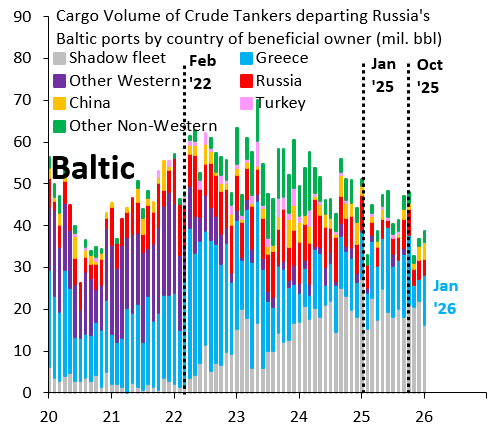
It just can’t be that Greece – a client state of its shipping oligarchs – has this kind of power. What’s needed are two things. The unanimity rule that gives Greece a de facto veto needs to go. But – more importantly – without the means to kick countries out of the EU, there’s no downside for Greece to continue its awful behavior. If anything, the status quo emboldens Greece to act badly, which is why its central bank Governor this week called on Berlin to drop its opposition to Eurobonds. Without the ability to kick out poorly behaved countries, the EU is in an inevitable race to the bottom.
With regard to the ECB having become hopelessly co-opted by high-debt countries, recent headlines that Bundesbank President Nagel backs Eurobonds is another sign – not that one was needed – that creditor countries like Germany have lost any say at the ECB. The basic problem is that high-debt countries have far more influence than low-debt ones, which is why Jens Weidmann, Axel Weber and Jürgen Stark – Germans who stood up for separation of monetary and fiscal policies – resigned. These departures taught those that remain from Northern Europe they must go along with the high-debt South, or else their careers are over. Germany has a principal-agent problem at the ECB, whereby the incentives of its representatives no longer align with what’s best for Germany.
This has far-reaching consequences. Take the example of Greece above. Without past ECB actions to cap its yields, Greece would be struggling with double digit yields on its government debt and its government would be in a constant position of asking for help in Brussels. There’d be no room for its ship owners to undermine EU sanctions packages. Similarly, if Italy were facing market yields, Meloni wouldn’t have opposed Merz back in December over using Russia’s frozen reserves to fund Ukraine. So much of the EU’s dysfunction radiates out from the mess at the ECB. Germany must fix that by swapping out its ECB representatives and – credibly – threatening Euro exit.
With regard to the democracy deficit, this week’s headlines that ECB President Lagarde plans to leave her post early so that Macron can pick her successor before Presidential elections in 2027 are a great illustration. This makes a mockery of ECB independence and – more importantly – makes it look like an entrenched policy elite shuffles senior leadership positions amongst itself while keeping everyone else out. This is all done in the name of democracy and moral leadership, but that’s starting to ring hollow. The rise of right-wing extremist parties across Europe is immensely worrying, but – with this stuff going on – it’s hardly surprising.
As a German, I’ve watched the massive rise in AfD support over the past year with extreme concern. The solution to this isn’t to declare the AfD unconstitutional. It’s to address the concern – principally immigration – that’s powering its rise. As long as the political center in Germany and elsewhere is unable or unwilling to do this, the democracy deficit remains and Germany heads for a political apocalypse.
The solutions to all three things (EU governance, the ECB, the democracy deficit) revolve around Germany and – to significant degree – the ECB. If Germany replaces its representatives and forces the ECB out of sovereign debt markets, a lot of dysfunction fixes itself. Greece won’t be in a position to undermine sanctions packages, Meloni won’t undercut Merz over Russia’s frozen reserves and Macron won’t play kingmaker at the ECB. That still leaves the democracy deficit on things like immigration, but it would at least be progress in terms of making the EU safer from Russia.