
I consider myself a fashion freak, actively spending my grocery money on the next Interview magazine issue as we speak. So when I got invited to my first Los Angeles Fashion Week show, I made sure to arrive two hours early and save a seat right next to the stage, where I got a glimpse of the models before anyone else in the room.
Driving home, though, I realized it wasn’t the royal ballgowns or the golden tiaras that stuck with me. It was a tattered denim jacket with shards of fabric spelling out “Shatter I.C.E.”. I realized then that Fashion Week was never just about the clothes, but a way for the city to express itself at a time of forced silence.
L.A., being the same city where stars are born, is, rather expectedly, also considered a fashion hub. Of course, “La La Land” serves as the perfectly picturesque runway for brands like Chanel and Vogue World to showcase their cinematic collections. Yet, the source of L.A.’s beating fashion heart is not in Hollywood amongst socialites, or the sprawling stores of Beverly Hills, but in downtown among immigrants.
Based on a report from LA City Planning, the Fashion District in DTLA is why LA is the capital of the United States garment manufacturing. The district is responsible for roughly 83% of “made-in-America” clothing. In a separate study published by the district itself, the majority of those who keep the district running are Hispanic/Latino.
One can imagine the district full of color, with bustling crowds searching for the best deal on suits, and storefronts of every fabric in existence. This was reality up until the recent I.C.E. raids, which heavily targeted workers in this community. The L.A. Times reported businesses in the district had an 80% drop in sales because of said raids. What is left is a shell of a fashion marvel, with empty streets and threatened creatives.
LA Fashion Week came at a time when accessible art is dangerous yet necessary. Runways hosted by various organizations like Art Hearts and The Bureau pride themselves on being open to the public, inviting all walks of Angeleno life. These runways also primarily focused on up-and-coming designers, cementing my need to attend.

If LA Fashion Week is supposed to forecast trends, then politics – wrapped in layers of tulle and denim – seem to be the next Dior. By far the most impactful pieces throughout the various runways were those that bled with Angeleno culture.
For instance, Johana Hernandez’s GLAUDI bridal collection redefined the white dress with her unique Latina heritage. Throughout her show, her beaded ballgowns transitioned into satin jumpsuits and matching lace blindfolds. The introduction of not only more masculine silhouettes, but also overtly risqué accessories, juxtaposes the pure, feminine archetypes wives are expected to uphold once married. What results is a feminist critique of what a woman can and cannot be in holy matrimony.
What was more awe-striking was when Hernandez knew she wanted her runway to represent women of every color and size, that her show needed to close with the plus-size Mexican-Cuban actress Jessica Marie Garcia walking down the aisle. Garcia said that despite never walking a show before, Hernandez reached out to her directly to perfect the collection.
“It doesn’t matter what size you are,” Garcia said in an interview after the show. “You can do it. You can close LA Fashion Week.”

Other standouts were intentional props so identifiably Angeleno. Cross Colours’ use of skateboards in place of handbags communicates real L.A. street style better than any streetwear brand. The Black Design Collective (BDC) – a group of fashion designers of color aimed to empower the next generation of Black creatives – also made a newspaper-weaved vest with a blossoming plush lily on it. The vest may resemble vests worn by immigrant elderly, alongside referencing the Asian-native flower, again hinting at L.A.’s diverse community.
Though to me, this Fashion Week was immortalized through a deconstructed denim-on-denim BDC look, with a chain stripped along the model’s chest paired with pants pinned with black stripes like a prison uniform. I still remember holding my breath as I saw the words “Shatter I.C.E.” written in fabric scraps as the model turned away.
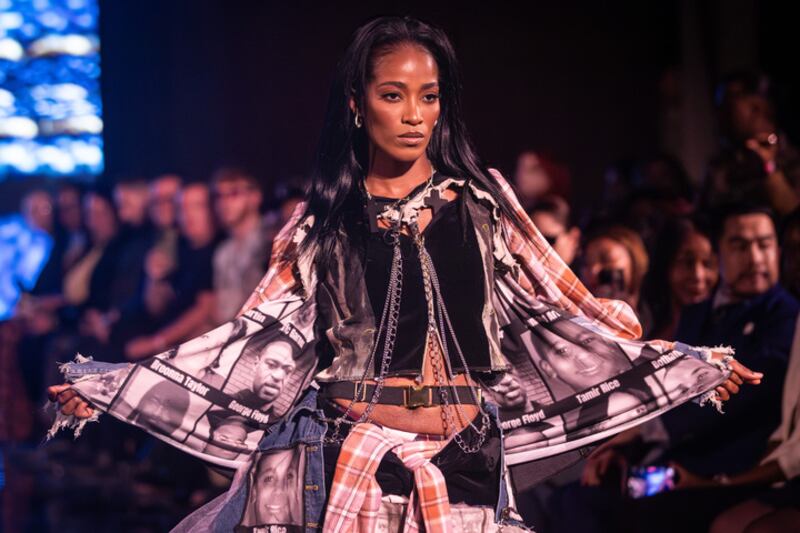
As if one statement wasn’t enough, BDC followed with a patchwork dress of different plaids, denims and images of black victims who were killed unjustly. The dress was met with a mix of silence, a few claps, and downright awe, as if it was too difficult to stomach in one watch. The model walked down the runway with her hand held high in a fist, reconstructing the punk look with today’s political lens.
The use of wardrobe as explicit, even uncomfortable, placards may mean the future of Angeleno fashion will be unabashedly democratic, and that might be what the city needs. If we hope to keep this city the epicenter of American-made fashion, we cannot shy away from art that is able to critique and inform against political wrongs.
What fashionable critique looks like, if I have learned anything from the LA runways, is to express your culture – where you grew up, what you eat, what you play, what atrocities you’ve witnessed, what victories you’ve won. At a time when people must hide their ethnic roots to pose as “American,” revolution means wearing your right to freedom on your sleeve in the clothes you want.
Wearing revolution may be literal, like BDC’s explicitly political statement pieces, but this is not always an option for everyone. For others, it can simply be wearing cultural pieces alongside your daily wear. For me, it would mean me wearing my khaki suit with a bolero of butterfly sleeves, similar to a traditional Filipiniana. For my friends at Kung Fu club, it means proudly performing in silks of sequined dragons and embroidered flowers.
2026 seems to be the return of loud and proud fashion. This year will not simply be about fashion trends, but the practice of intentional, personal expression. Expression is something we cannot afford to lose, even when it feels like art is too small to change a whole city.