
OMAHA, Neb. (WOWT) – Last night, the Midwest saw one of the strongest displays of the aurora borealis (northern lights) in recent history displaying the lights over multiple states.
The lights were even seen as far as Florida! How does the aurora borealis form and what do the different colors mean? The First Alert 6 Weather team breaks down the science!
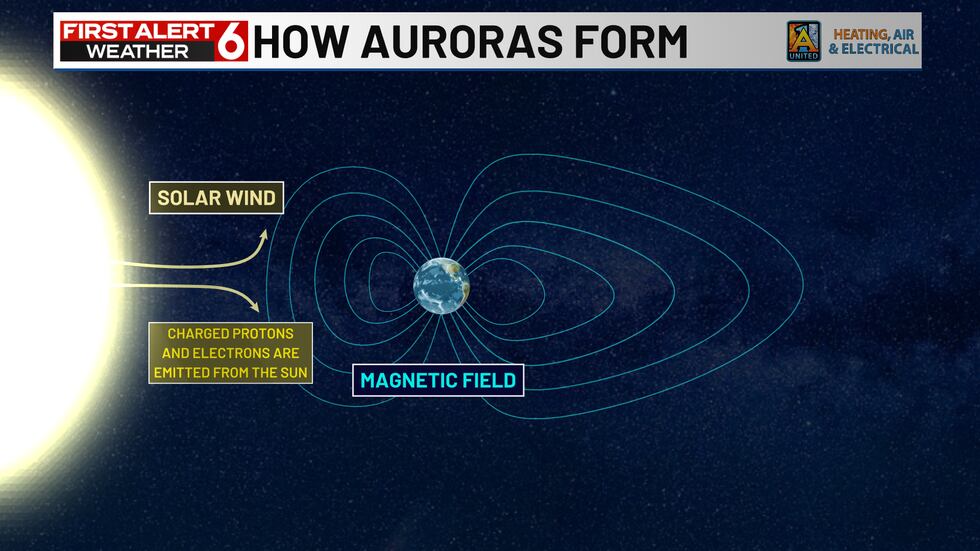
The sun constantly emits charged protons and electrons from it’s outer atmosphere and travels throughout space. The stream of these protons and electrons is called the solar wind. These charged particles are dangerous to life on Earth. Thanks to the magnetic field, the Earth is protected from these particles.
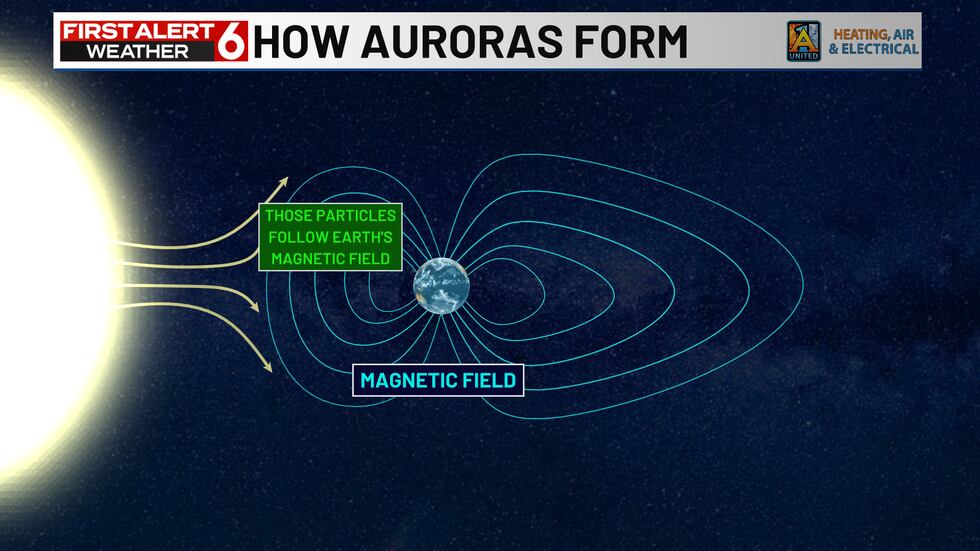
When the solar wind hits the Earth’s magnetic field, it follows the magnetic field causing the charged particles to move around the planet.
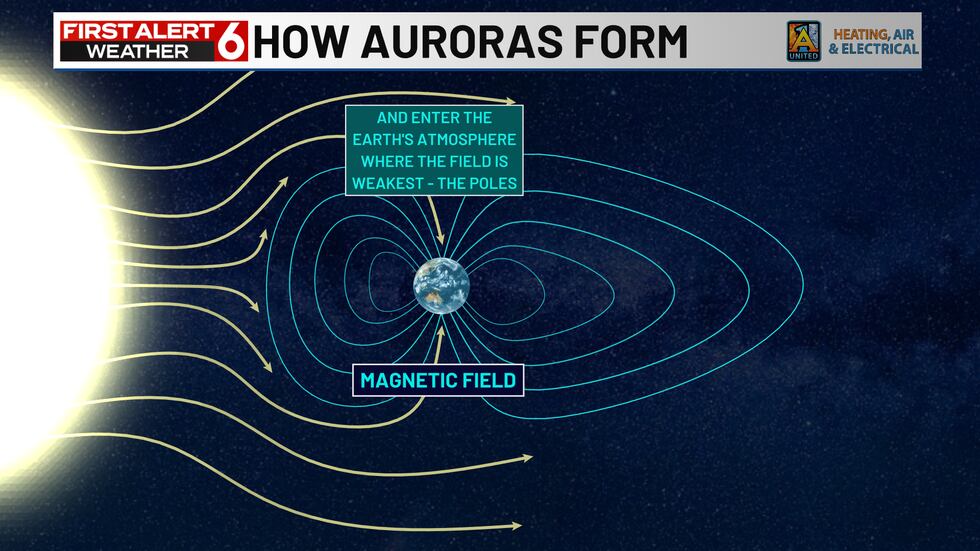
Some of the charged particles enter the Earth’s weakest points which is at the North & South Pole. This is why we look to the north in our hemisphere.

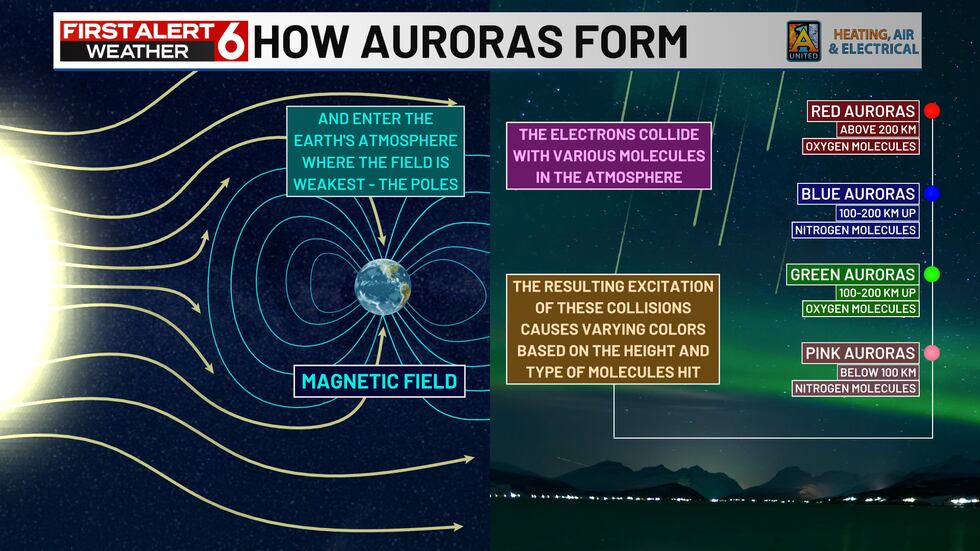
As those charged protons and electrons move through the Earth’s atmosphere, they collide with various molecules in the Earth’s atmosphere creating the auroras borealis.
The northern lights can be seen in different colors, each color is based on the height and type of molecules hit by the charged sun electrons.
The most common colors are green & yellow as the electrons collide with oxygen molecules at ~100-200 km (62 mi-125 mi) above the surface.
The rarest color is red as the electrons collide with oxygen molecules at 200+ km above the surface.
Blue and purple lights are formed when the electrons collide with nitrogen molecules at 100-200 km. Purple can also form with nitrogen and hydrogen molecules. It’s common to see green & purple lights together.
Pink molecules form when electrons collide with nitrogen molecules at or below 100 km.
There are cycles when the northern lights occur frequently while other times it doesn’t. This is known as a solar cycle! The current solar cycle began in December 2019 and we’re currently in its peak. This will cause frequent chances of northern lights in the next few years.
Copyright 2025 WOWT. All rights reserved.