
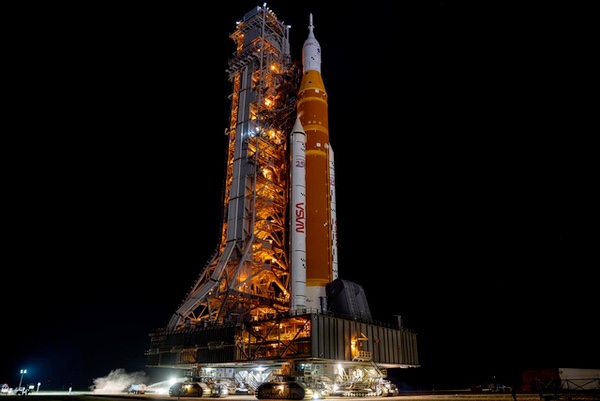
Artemis 2 returns to the pad early March 20, ahead of a launch as soon as April 1. (credit: NASA/Brandon Hancock) |
by Jeff Foust
Monday, March 23, 2026
The next humans to leave Earth orbit may launch as soon as next week. Just after midnight Friday, the Space Launch System rocket, with its Orion spacecraft on top, reemerged from the Vehicle Assembly Building, making an 11-hour trek back to Launch Complex 39B. The vehicle had spent the last three weeks in the VAB to fix a blockage of helium in the upper stage that caused NASA to call off a launch in an early March window, along with other maintenance.
| “We are using Artemis 2 as an opportunity to get science to prepare for our later Artemis missions when science is more of a driver,” and Richardson. |
NASA is now targeting a launch of the Artemis 2 mission as soon as April 1, with daily launch opportunities through April 6. Officials said at a briefing earlier this month they felt confident enough in the vehicle, after correcting past issues with hydrogen leaks in a fueling test, that they would not do another fueling test before a launch attempt.
“From my perspective, when we tank the vehicle the very next time, I would like it to be on a day we could actually launch,” said Lori Glaze, NASA’s acting associate administrator for exploration. “If we are able to successfully fully tank the vehicle, I want to be able to poll ‘go’ to launch.”
Artemis 2 is primarily a test flight, a long-awaited demonstration of the Orion spacecraft in deep space, carrying four astronauts around the Moon on a ten-day mission. After a one-day shakeout in Earth orbit, including performing proximity operations with the SLS upper stage, the Orion will head out on its free return trajectory around the Moon.
However, Artemis 2 won’t solely be a test of vehicle systems. The mission will also be an opportunity carry out science, both of the Moon and involving the people on board.
Artemis 2 would not, at first glance, seem like much of an opportunity to study the Moon. Orion will fly around the Moon rather than go into orbit, and during that flyby will not get particularly close to the Moon: to the astronauts on board, the Moon will look similar in size to a basketball at arm’s length.
“Science wasn’t in the driver’s seat to define what Artemis 2 is,” said Jacob Richardson, deputy lead of Artemis 2 lunar science at NASA’s Goddard Space Flight Center, during a panel discussion at the Goddard Space System Symposium March 12. “Instead, we are using Artemis 2 as an opportunity to get science to prepare for our later Artemis missions when science is more of a driver.”
“We’re going to find the opportunity to flex our science muscles on these missions,” he added. “We’re going to have our own baby steps towards success on our way towards landed surface missions, towards a moonbase and a sustained presence on the lunar surface.”
That panel came after Kelsey Young, science flight operations lead for NASA’s Artemis internal science team, discussed the science plans for the mission. There are ten lunar science themes for Artemis 2 with varying priorities. At the top are studying color and albedo variations as well as look for any flashes from lunar impact. Other topics range from various aspects of lunar geology to observing the Earth from space.
In addition to the science itself, Artemis 2 provides an opportunity to exercise science operations, including planning for science and operations of a science team back on Earth during the mission as well as capturing data during the mission.
“We actually had a lot of questions from the crew over the first few months of training: ‘What can our observations tell you about science that orbiting spacecraft cannot?’” she recalled. “We really rose to the challenge of convincing them that your words carry scientific weight. What you describe helps us, the lunar science community, really unlock these high priority mysteries that we have.”
Verbal descriptions by the astronauts of what they see are, in fact, one of the key science data sets from the mission. “Human beings are the most sophisticated detector there is, and they’ll be giving some very nuanced verbal descriptions,” she said. “I can say that in confidence having trained them over the last few years.”
The astronauts will also make annotations of what they see, much like a field geologist might in a notebook, with both words and illustrations. Those annotations will be made in their tablets.
A third data set will be photos they take, using a Nikon camera with an 80-400 mm zoom lens. Three of the four astronauts have previously flown on the International Space Station, Young noted, and have experience photographing the Earth from inside the station.
| “We actually had a lot of questions from the crew over the first few months of training: ‘What can our observations tell you about science that orbiting spacecraft cannot?’” Young recalled. “We really rose to the challenge of convincing them that your words carry scientific weight.” |
“Our goal was never going to be to take better pictures than LRO,” or the Lunar Reconnaissance Orbiter, said Ariel Deutsch, a NASA planetary scientist who is part of the Artemis 2 science team, during a presentation at the Lunar and Planetary Science Conference (LPSC) March 16. “Our goal is to instill and promote and maximize the human science that can be done on this mission as the crew views the Moon and the lunar environment with human eyes for the first time in several decades.”
That more distant view has its advantages. “They’ll be afforded this whole-disk view,” Young said. “They’ll have this interesting perspective that enables them to contextualize the observations they see in one section of the Moon to another section of the Moon in the blink of an eye.”
They may also see portions of the Moon not seen before directly by humans. For example, much of the lunar farside was not directly seen during the Apollo missions since they were targeting landings during the day on the near side. The low equatorial orbits of the Apollo missions also kept them from seeing the poles.
One challenge for planning lunar science on Artemis 2 is the timing of the mission. The portion of the Moon visible if the mission launches April 1 will be different than if it launches April 6.
Young said the crew will have “study time” on the way to the Moon to review what will be visible and what targeting plan the science team has developed for the critical hours of the flyby.
That study time will be a bit of last-minute cramming after extended training before launch. “We had three years with them. The science team put together a multi-faceted approach for training the crew,” said Cindy Evans, Artemis geology training lead at the Johnson Space Center, during an LPSC session. That included both classroom and field work as well as testing on the equipment they will use.
Artemis 2 commander Reid Wiseman, she recalled, “challenged us to put together a lunar training program for the crew office so he could walk down the hallway of the crew office and talk to any of his colleagues about the Moon. It was designed to raise the literacy in the crew office about the Moon.”
That one-week “Lunar Fundamentals” class the scientists put together was used not just for the astronauts but also flight controllers and others. It featured lunar geology and the importance of collecting lunar samples and studying volatiles that may exist at the poles.
“We provided them with some key talking points because they’re public speakers: they’re going out and they need to be talking about why we’re going to the Moon,” she said, “how the Moon is important for all of us to understand.”
There will be additional, non-lunar science beyond observations of the Moon. That includes work in biology, human research, and space weather, said Jacob Bleacher, chief exploration scientist in NASA’s Exploration Systems Development Mission Directorate, during a briefing in January.
“During this flight we will learn how the spacecraft behaves and through our research campaign we will also learn how we, human beings, behave in that same environment,” he said.
| “The Moon is this incredible object that we are so fortunate to have, and we take it for granted,” Petro said. |
An example is AVATAR, or A Virtual Astronaut Tissue Analog Response. It will use tissue-on-a-chip devices to mimic individual organs of the astronauts, comparing their response to the environment beyond Earth orbit with data taken before and after the flight from the four astronauts. Bleacher said that could lead to personalized medicines for individual astronauts on future deep space missions.
Other experiments include movement and sleep monitors worn by the astronauts and studies of their immune systems. The German space agency DLR will provide radiation monitors for the mission like those flown on Artemis 1.
Bleacher said that, as soon as possible after landing, the astronauts will go through an obstacle course to see how well they function after returning to one G, as well as a simulated spacewalk several days later. “That prepares is for landing on the Moon and, eventually, down the road, going to destinations such as Mars.”
Those studies overall, he said, show “how we will we react to, survive, and thrive in that deep space environment.”
The public focus, though, will be on the Moon, including the images that the astronauts on Artemis 2 return from their unique perspective. At the Goddard Symposium, Noah Petro, Artemis 4 project scientist, urged a space industry audience to share the excitement he feels about the Moon.
“The Moon is this incredible object that we are so fortunate to have, and we take it for granted,” he said, telling people to go out and take 30 seconds to look at, and contemplate, the Moon.
“You want to get people hooked on the Moon? Start by going out and looking at it. Because in a month, the Moon is going to be different to us because we will have just sent people there.”
Note: we are now moderating comments. There will be a delay in posting comments and no guarantee that all submitted comments will be posted.