
A scientific innovation promises to revolutionize the fashion industry with a sustainable transition.
Recently, scientists took a big step in that direction by getting microorganisms to produce fibers.
Additionally, they also managed to dye them in all the colors of the rainbow, all in a single container.
If the project can be scaled, a future t-shirt could be made entirely by bacteria and dyed with natural colors without harmful chemicals.
This would revolutionize the fashion industry, one of the most polluting globally.
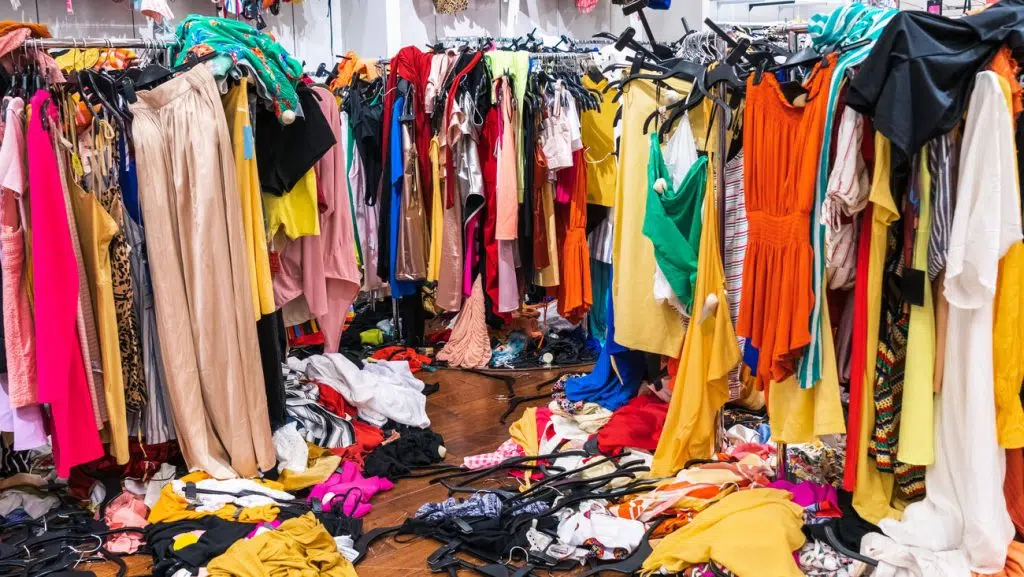
A solution to textile pollution in the fashion industry
The advancement, published in the journal Trends in Biotechnology, represents a sustainable alternative to the conventional fashion industry.
In the study, the bacteria managed to generate both the fiber of the fabric and its natural color at the same time.
Thus, the use of petroleum-derived fibers is avoided, and chemical dyes that pollute water, air, and soil are eliminated.
The final result is durable and colorful textiles, with a lower environmental impact and safer for human health.
The development was led by San Yup Lee from the Korea Advanced Institute of Science and Technology, who worked with colleagues from other international institutions.
“Some processes generate many greenhouse gases, degrade water quality, and pollute the soil,” explained the scientist.
Traditional production and dyeing involve separate steps and high energy and chemical consumption.
Bacterial cellulose, that is, fibers produced by bacteria during fermentation, appears as an innovative option.
This method can replace petroleum polymers and reduce the environmental damage of the fashion industry.
The biggest challenge was to effectively and sustainably combine fabrication and color.
The scientists’ goal was to create a method where fabric production and dyeing happen together without using industrial chemicals.
Two bacteria, one complete palette
The team used two bacteria with different tasks. On one hand, Komagataeibacter xylinus produces cellulose fibers that form the fabric.
On the other hand, Escherichia coli was modified to produce two types of natural pigments.
Violaceins allow obtaining colors from green to violet, while carotenoids generate red, orange, and yellow tones.
Thus, they managed to combine fabric production with dyeing in a single technology. However, the experiment did not work from the start.

“At first, it completely failed. Either the cellulose production was much lower than expected or it never got colored,” Lee commented.
At the time, the bacteria were interfering with each other and one was hindering the development of the other.
To solve the problem, they designed two different methods. For cool colors, like blue, green, and purple, they used a “deferred coculture”.
They first let the cellulose bacteria do their work and, after a few hours, added the color bacteria. Thus, each could develop without obstacles.
For warm colors, like red, orange, and yellow, they applied a “sequential culture”.
They first produced and purified the cellulose, and then immersed that material in bacterial cultures that generated the pigments.
In this way, no microorganism stopped the other, and the desired dyeing was achieved.
Together, the two strategies generated a vibrant palette of sheets in purple, navy blue, blue, green, yellow, orange, and red.
“Bacterial cellulose” also in resistant and durable
To ensure quality, the fabrics were subjected to washing, heat, bleaches, acids, and alkalis.
Most of the colors remained stable, and the violacein-based textile even outperformed synthetic dye in wash tests.
Although the method works, it is not yet ready to produce clothing on a large scale.
The team estimates it may take at least five years to reach stores.
“Our work is not going to change the entire fashion industry right now, but at least we have proposed an environmentally friendly direction towards sustainable dyeing,” noted Dr. Lee.
The scientist shared an invitation to care for the planet: “It is our duty as humans to make the world a better place and allow our children to live happier lives. Let’s be kind to the environment and do something good for future generations“.