
EDITOR’S NOTE: This story is featured in the Winter 2026 edition of The Tartan magazine. Read more from The Tartan at alma.edu/tartan.
In the spirit of iGEM, Alma students unite code, communication, and biochemistry to engineer new solutions — and prove that great ideas thrive in small labs.
Inside a lab on the second floor of Dow Science Center, a group of Alma College students have spent the past year working to solve a problem most people never think about — but one that has massive ecological impact: the spread of WhiteNose Syndrome, a fungal disease devastating North American bat populations.
Their work recently took them all the way to Paris, France, where the Alma College iGEM team earned a silver medal at the 2025 International Genetically Engineered Machine (iGEM) Grand Jamboree — an annual global competition that brings together more than 400 student teams from around the world to present research in synthetic biology.
“It’s a remarkable accomplishment for a college of our size,” said Elie Schwarz, faculty advisor for the team. “Our students are competing at an international level, standing shoulder-to-shoulder with teams from major research universities. It shows the kind of hands-on, interdisciplinary science that Alma does best.”
For Schwarz, iGEM exemplifies what a liberal arts approach to science looks like in action. Students from majors across campus — biology, chemistry, computer science, art, communication and more — collaborate to design, test, and communicate a solution to a real world problem. The work is as much about public engagement and teamwork as it is about molecular biology.
“iGEM asks you to imagine new possibilities for biology,” Schwarz explained. “It’s not just about running experiments. Students have to think about ethics, communication, accessibility, and the communities affected by their work.”
This year’s project, titled “Com-bat-ting White-Nose Syndrome,” aims to explore innovative ways to slow the spread of the fungus Pseudogymnoascus destructans, which has killed millions of bats since it was first discovered in New York in 2006. The Alma team’s long-term goal is to create a biological system that could eventually support healthier bat populations — and, by extension, healthier ecosystems.
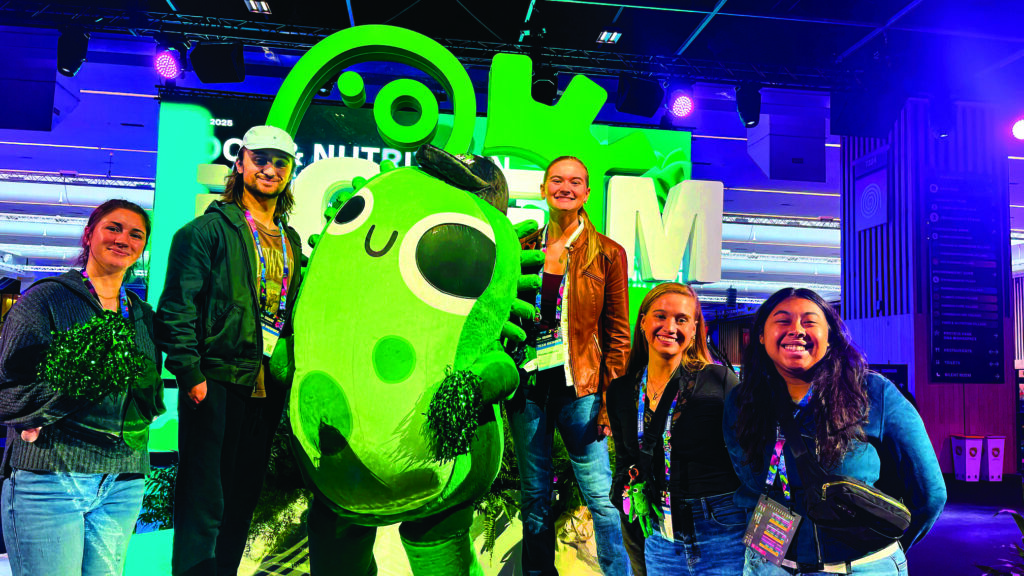
Students are pictured taking part in the iGEM Grand Jamboree in Paris, France, in October.
For Reagan Keyser, a senior biochemistry major and president of the iGEM team, the project connects directly to her dream of becoming a translational researcher.
“Translational research bridges the gap between bench science and clinical application,” Keyser said. “That’s exactly what iGEM allows us to do. We’re taking what we learn in class and applying it to solve real-world problems.”
In October, Keyser and four teammates traveled to the Grand Jamboree to present their work before an international panel of judges. The event brought together students from across the globe — each tackling local environmental, medical, or agricultural challenges through genetic engineering.
“It was incredible,” Keyser recalled. “You could be sitting next to someone from Thailand, China, or France and learning how they’re using synthetic biology to help their communities. It really puts into perspective how global this field is — and how much potential it has to make a difference.”
Joey Colucci, a senior computer science and mathematics major, co-led the team’s “Wiki” division, which designed and built the online platform that documents every aspect of the project — from lab notes and data to outreach and ethical considerations.
“Most people don’t realize how much communication goes into science,” Colucci said. “The wiki is what connects all of our work and makes it accessible to anyone in the world. It’s our way of showing that complex science can still be understood by everyone.”
He said one of the most rewarding aspects of iGEM is how it brings together students from completely different academic backgrounds. “We have people coding, people in the lab, people doing graphic design and community engagement. There’s something for everyone on this team.”
That inclusivity, Schwarz added, is part of the program’s strength. “Synthetic biology is inherently collaborative,” he said. “You need creative thinkers — scientists who can communicate, programmers who understand biology, artists who can visualize concepts. That’s why iGEM thrives at a place like Alma.”