
The scope of UCLA’s research enterprise is vast.
Spanning everything from business, medicine, technology, the arts and far beyond, Bruin innovation thrives at the forefront of discovery, driving breakthroughs that improve people’s health, happiness and well-being.
Take UCLA Life Sciences professor and neurobiologist Elissa Hallem, for example. Her lab studies the neural basis of sensory-driven behaviors in skin-penetrating nematodes that parasitize humans. This work not only deepens our understanding of how these parasites seek out and invade human hosts but also opens doors to new strategies for combating infection.
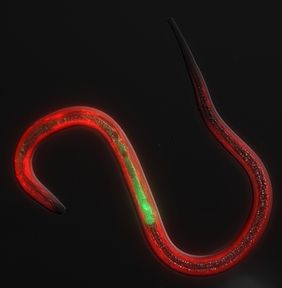
Matthew Moser/UCLA Hallem Lab
A fluorescence microscopy image of a Strongyloides stercoralis infective larva containing a CRISPR-edited genome. The larva was engineered to express red and green fluorescent proteins when selected genes were deleted.
“Not much is known about the basic biology of parasitic worms,” said Hallem, a professor and vice chair of graduate studies in the department of microbiology, immunology and molecular genetics. “But they are a very prevalent parasite in nature.”
Hallem, a 2012 MacArthur Fellow, studies a parasitic worm that infects over 600 million people worldwide — a striking reminder of how these threadlike tiny organisms pose a major global health burden.
In the latest episode of “Science Interrupted,” a special series from the UCLA College’s “Tell Us What You Know” podcast, Hallem discusses recent breakthroughs in her research, how federal funding helps keep her work (and worms) alive, and what research training today means for the next generation of biomedical scientists.
“The goal of our research is to understand the behaviors and the mechanisms that drive these behaviors so that we can develop new strategies for preventing infection,” Hallem said. “And without federal research funding, we can’t train students or upkeep the lab environments needed to make new discoveries. Federal funding is essential to our work.”
In “Science Interrupted,” the UCLA College explores how federal research funding shapes discovery by speaking with scientists whose work relies on these grants.