
There are numerous icy, rocky bodies in the outer reaches of our Solar System that look like snowmen.
Exactly why so many of these distant objects look like snowmen – one large spherical object attached to another – has remained something of a mystery.
But a team of astronomers think they may have solved the mystery and discovered what’s causing the formation of these strange structures.
More Solar System science
Understanding the edge of our Solar System
Far beyond Neptune, there’s a large ring of rocky, icy debris on the edge of our Solar System, known as the Kuiper Belt.
This ring consists of the leftover materials out of which the planets and the moons of our Solar System formed around our young star.
The region is populated by cosmic building blocks known as ‘planetismals’, and astronomers say about one in 10 of these objects are contact binaries.
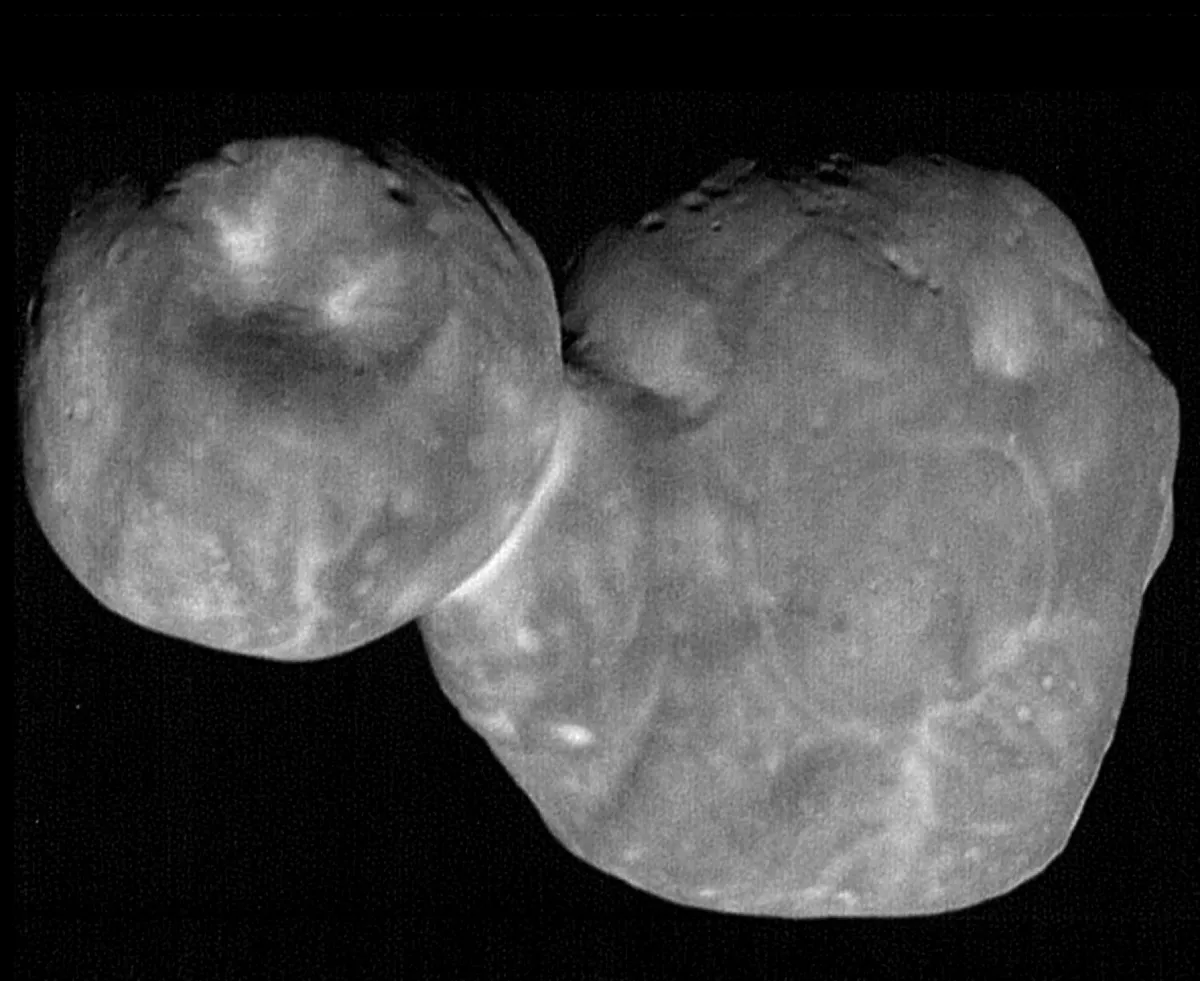
One Kuiper Belt object named Arrokoth was famously observed by NASA’s New Horizons spacecraft.
New Horizons’ main mission was its fly-by of Pluto, which it achieved on 14 July 2015.
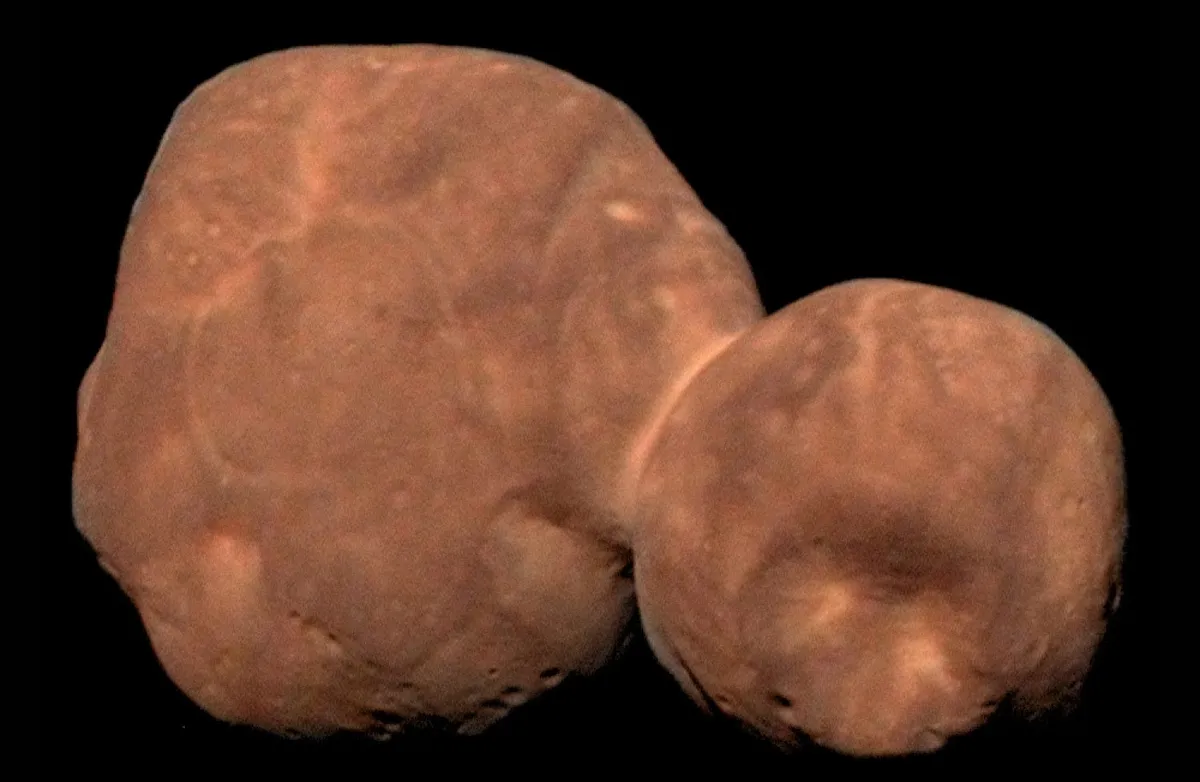
The spacecraft has been continuing its journey into the outer realms of our Solar System ever since, and has given astronomers amazing views of some of the strange ‘snowmen’ objects that lurk there.
These planetesimals are formed from two connected spheres, and exactly how they formed is something of a mystery.
But a team from Michigan State University say the answer might be relatively simple: a process called gravitational collapse.
“If we think 10% of planetesimal objects are contact binaries, the process that forms them can’t be rare,” says Earth and Environmental Science Professor Seth Jacobson, senior author on the paper.
“Gravitational collapse fits nicely with what we’ve observed.”
Gravitational collapse explained
Newly-formed stars are commonly surrounded by a rotating disc of dust and gas, made from the materials out of which the star formed.
The same was true of our young Sun, and the remnants of of our host star’s formation 4.6 billion years ago can still be found in the Kuiper Belt today.
These remnants include dwarf planets like Pluto, along with comets and planetesimals.
Planetesimals are an amalgamation of pebble-sized objects that have been pulled together by gravity over time, from a cloud of tiny materials.
Astronomers say these clouds may rotate and fall in on themselves, ripping themselves apart and forming two separate planetesimals orbiting one another.
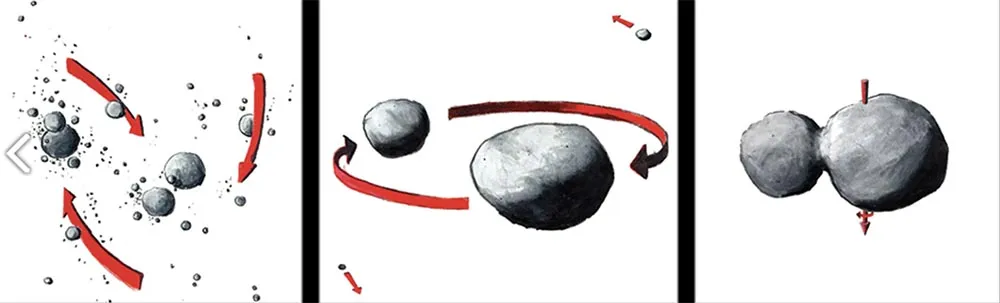
In the computer simulation used by the team, the orbiting pair spiral towards each other and make contact, forming the two-lobed snowman shape.
Barnes says it’s unlikely these newly-formed objects would encounter any other nearby objects, and so they’re able to remain intact.
“We’re able to test this hypothesis for the first time in a legitimate way,” Barnes says. “That’s what’s so exciting about this paper.”
The team say the model should also help scientists better understand systems containing three or more objects.
It seems these cosmic snowmen could be common in the outer reaches of the Solar System, with many more waiting to be found.
Read the full paper via the monthly notices of the Royal Astronomical Society.