
Carl Linnaeus, the Swedish scientist who dedicated his life to cataloging the living things known in his time (he died in 1778), classified some 12,000 species. In 2017 alone, 17,044 were described. And science has been discovering and describing similar numbers for at least a decade. Contrary to what was believed, the rate of cataloging new species is not slowing down, but rather accelerating in almost all the taxonomic groups into which life is organized. Moreover, according to a study published in Science Advances, there are as many species left to discover on Earth as those that are already known. The problem is that many of the new organisms are classified as endangered as soon as they are discovered.
Linnaeus devised the binomial system for classifying all known living things. Following his taxonomy, humans are Homo sapiens. The first letter, capitalized, indicates the genus to which the second, the species, belongs. Above this are further categories; simplifying and in ascending order, the main ones are: family (Hominids), order (Primates), class (Mammals), phylum (Chordates), kingdom (Animalia), and domain (Eukaryota). The 18th and 19th centuries saw the great scientific expeditions of Alexander von Humboldt, Celestino Mutis, Charles Darwin, and the so-called apostles of Linnaeus, who filled in the catalog created by the Swedish scientist. By the beginning of the 20th century, much of the scientific community believed that there wasn’t much more life left to discover. But they were wrong.
“We estimate that between 2000 and 2020, an average of 27 new mammal species were described each year, along with 336 ray-finned fish [the Actinopterygii, the main class of fish], 16 sharks and rays, 133 amphibians, 129 lizards and snakes, and four birds,” summarizes John Wiens, a biologist at the University of Arizona and senior author of the study, in an email. And that’s just within the Animalia kingdom. Along with a group of colleagues, Wiens scrutinized and analyzed the main taxonomic databases, particularly The Catalogue of Life, considered the bible of taxonomy.
By delving into the past, Wiens and his colleagues confirmed that, indeed, the highest rate of described species was reached in the early years of the 20th century, peaking in 1912. Two years later, World War I broke out, and science turned its attention to other pursuits than the search for animals or plants. The next major setback occurred with World War II. But since then, the rate of discovery and description of new species has steadily recovered, and by 2008, more species had been cataloged than in 1912. Since then, the pace has accelerated even further, reaching an average of 16,000 per year since 2015.
Wiens points out that discovery is not the same as description. “The sequence of events is that a new species is first discovered and then formally described (that is, assigned a formal genus and species name in a published scientific article),” he explains, officially announcing its existence. “Therefore, all described species have been discovered, but not all discovered species have been described,” he notes. In many cases, it can take decades for a species to go from discovery to formal description.
Having made that clarification, Wiens points out that, among animals, “the number of new annual species has decreased considerably in birds [since the beginning of this century], but has increased in amphibians, lizards and snakes and has remained similar over time in mammals, ray-finned fish, sharks and rays.”
The majority of species described so far this century are arthropods (10,000 out of 16,000 new species per year), especially insects, which alone account for around 6,000 new species annually. As the American biologist points out, “this is to be expected, given that most known species are animals, with arthropods predominating among animals and insects among arthropods.” This is one of the patterns they have observed: more species are being discovered from the groups already most abundant in the catalog.
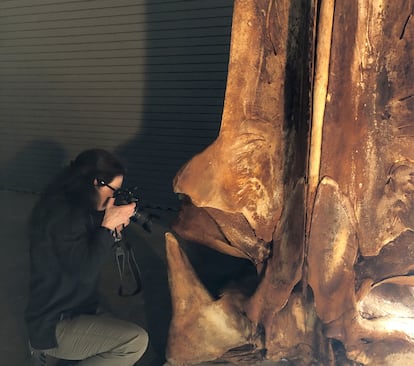
Another striking pattern is the shrinking size of newly described species. This shows that as a group of organisms becomes better understood, the newly discovered species get smaller and smaller. So, finding a new species of elephant doesn’t seem likely. “But there are exceptions!” Wiens points out. “For example, in 2021, a new species of whale was discovered off the coast of Florida that measured almost 13 meters long.”
Wiens is referring to Rice’s whale, a cetacean that was discovered in the Gulf of Mexico four years ago. Actually, it’s a reclassification. Until then, sighted specimens were believed to be Bryde’s whales, a related species. But in-depth morphological analysis and, above all, genetic samples allowed NOAA Fisheries researcher Patricia Rosel to determine that it was a new species of whale.
Upon being cataloged, Rice’s whale was immediately classified as critically endangered, the step before extinction, in the International Union for Conservation of Nature (IUCN) nomenclature. Only about 100 of these cetaceans remain. This is the most troubling pattern detected by the study: the majority of new animal and plant species (in other kingdoms the story is different) are already threatened as soon as they are discovered.
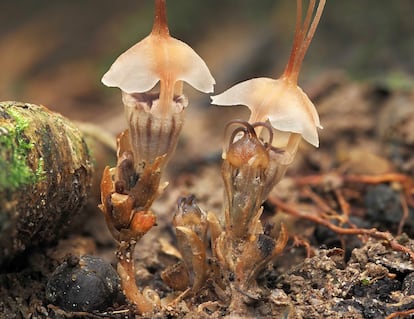
A recent example is that of Thismia selangorensis, a fairy lantern plant so rare it has no common name. Its existence was revealed in early December in the scientific journal PhytoKeys. It is so endemic that it only grows in a forest near Kuala Lumpur, the capital of Malaysia. Since its discovery in 2023, only 20 other specimens have been found, so it has gone straight to the IUCN Red List, also in the critically endangered category.
“The most important effort now is to raise awareness of this species so that the public knows it exists, right here in this small corner of the world, and nowhere else, at least for now,” said Siti-Munirah Mat Yunoh, a botanist at the Malaysian Forest Research Institute and co-author of its description, in a statement. “Understanding its presence is the first step in ensuring that this remarkable plant is not lost before many people even know it exists.”
For many scientists, the sixth mass extinction is underway. Wiens disagrees. “I think there is a profound biodiversity crisis, because hundreds of species have gone extinct in the last 500 years, and thousands more could go extinct in the coming decades due to climate change,” he fears. But he quickly adds: “The current rate of species description is much higher than the current rate of extinctions of known species, being approximately a thousand times greater each year.”
If the current rate of discovery and description of new species continues, in just under 400 years — almost the same amount of time since Linnaeus created his taxonomy — the number of known species on the planet will have doubled. Currently, counting all types of living organisms (excluding viruses, whose classification is not yet fully understood), there are slightly fewer than 1.9 million species. By then, researchers project that there will be around 3.55 million.
The vast majority of new discoveries will come from the microscopic world, with fungi multiplying almost sevenfold or bacteria increasing in number, from the smallest animals or from the few remaining unexplored corners of the planet, such as the ocean floor. But nothing prevents us from encountering a fairy lantern or a new whale.
Sign up for our weekly newsletter to get more English-language news coverage from EL PAÍS USA Edition