
Researchers in China have created one of the most precise clocks ever made – so precise, in fact, that it could soon lead scientists to officially redefine the second.
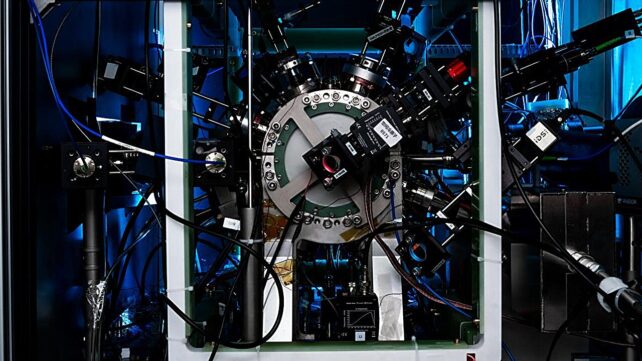
Known as a strontium optical lattice clock, the fancy timepiece can measure seconds to 19 decimal places. That means that if you ran it for 30 billion years – which is more than twice the current age of the Universe – the clock would only be out by one second, give or take.
This level of precision, which has been impossible until recently, is a major step towards the goal of changing the official definition of a second within the next decade or so.
There are a few prerequisites that need to be met before that can happen – firstly, at least three optical clocks based on the same type of ‘tick’, and with a certain level of precision and stability, need to be in use at different institutions.
This new optical clock meets those precision and stability requirements, and along with improving our timekeeping it could help scientists search for dark matter and measure differences in Earth’s gravitational field.
The second was originally defined as a fraction of a day – one 86,400th of a day, to be exact. That’s what you get when you divide 24 hours into 60 minutes each, and then each minute into 60 seconds each.
That’s fine as a rough guide, but it’s not good enough for scientific and industrial applications. Frustratingly, ‘one day’ isn’t a precise measurement; the Earth’s rotation speed varies due to a whole range of factors, which would change the length of a second if it was still defined as a fraction of a day.
The creation of atomic clocks allowed scientists to measure the second independently, based on unchanging features of nature. So, since 1967 the second has been defined in the International System of Units (SI) as exactly 9,192,631,770 oscillations of the cesium-133 atom.
That’s pretty damn precise, but there’s still room for improvement. Atoms like strontium oscillate at visible light frequencies, producing some 700 quadrillion ‘ticks’ per second, compared to cesium’s 9 billion. Optical clocks can measure these, resulting in a precision of 10-18 seconds.
In the new study, researchers from the University of Science and Technology of China (USTC) described upgrades to the facility’s strontium optical clock, which reduced the uncertainty to 9.2 x 10⁻¹⁹, and stability to 6.3 x 10⁻¹⁹.
“This performance meets the 2 x 10-18 single-clock accuracy requirement for redefining the SI second, with potential applications in relativistic geodesy and high-resolution dark matter searches,” the researchers write in a new paper describing the work.

Two other strontium optical clocks have already passed this milestone, the team says, as well as two others that measure time using aluminum ions. With more of these ultra-precise clocks joining forces, the criteria could soon be met for the second to be officially redefined.
These kinds of decisions are made at the General Conference on Weights and Measures (CGPM), which is held every four years. The next one is scheduled for October this year, but not enough progress has been made towards the criteria for the redefinition to be decided on at this meeting.
Related: Timekeeping Is on The Verge of a Giant Leap in Accuracy. Here’s Why.
Instead, the committee has been requested to “work towards a proposal for the new definition of the second to be presented at the 29th meeting of the CGPM (2030) and a proposal for the date of its implementation.”
The research on the USTC’s optical clock has been published in the journal Metrologia.