
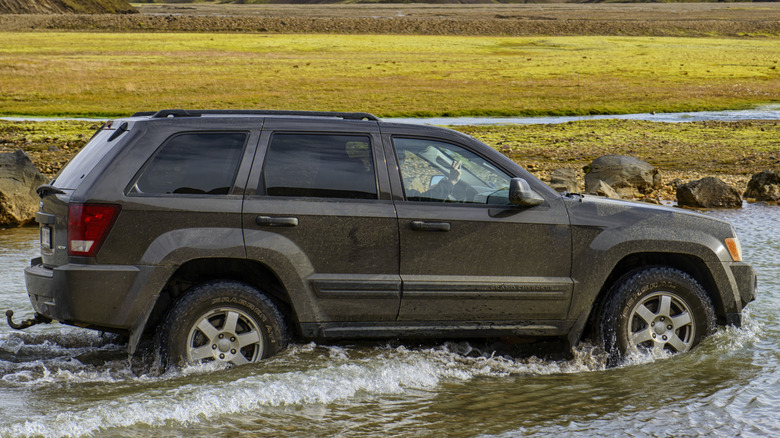
If you want to experience one of the oddest gear changes ever, get into a Jeep with a 545RFE five-speed automatic transmission. Put it in manual mode, AutoStick, electronic range selection, whichever term you prefer, and start driving. Keep on shifting up, don’t stop! Wait, did you just shift through six gears? That’s correct, this “five-speed” automatic is actually a six-speed, and yes, it has two second gears.
To make this even weirder, the prior 45RFE “four-speed” automatic that debuted in 1999 4.7-liter V8 Jeep Grand Cherokees had the identical planetary gearset to make the same six forward speeds. It’s like DaimlerChrysler was acting out some sort of poorly written soap opera script in its transmission department where the 45RFE essentially faked its death, put on a fake mustache, and told everyone to call it “545RFE” from 2001 to 2012.
Peer into a 45RFE or 545RFE and you’ll see three planetary gearsets rather than two. Only two are needed to make four speeds, so why give the 45RFE three? It turned out to be a prudent move for futureproofing the design, as it became the five-speed 545RFE without drastic internal redesigns. The transmission even became a legit six-speed when it was upgraded to the 65RFE in 2012.
That raises the question: Why didn’t DaimlerChrysler just make the 45RFE a six-speed in the first place? It could have beaten the ZF 6HP26 by a year and become the first commercially viable six-speed automatic in 1999. Clairvoyance isn’t in our wheelhouse, so who knows. DaimlerChrysler did allow the rear-wheel-drive, 5.7-Hemi-powered Chrysler 300 to exist, so it could make good decisions. But we can at least explain the odd “two second gears” in 45/545RFEs: One is used when shifting up, the other when kicking down.
Why 45/545RFEs have two second gears instead of just second and third
The four in “45RFE” means it has four forward gears. The five stands for a relative torque rating of “5,” R indicates “rear drive vehicle,” and FE means “fully electronic.” The first five in “545RFE” tells you it has five speeds. Why not 55RFE? Great question!
Anyway, when driving in automatic mode, the 45RFE goes from a 3:1 first gear to a 1.67:1 second gear, then to a 1:1 third, and finally a 0.75:1 overdrive fourth. 545RFEs gained software to access a 0.67:1 overdrive. Yeah, a software change resulted in a whole new gear. Seriously, many 45RFEs can be converted into 545RFEs, as this YouTube video from Martin Built demonstrates:
When you mash the gas in fourth, instead of kicking down to the 1.67:1 second, the 45/545RFE goes to “second prime,” which has a 1.5:1 ratio. To understand why this is advantageous, let’s look at the 45/545RFE’s clutches. There are three input clutches, including the underdrive clutch, overdrive clutch, and reverse clutch, as well as three holding clutches, including the fourth clutch, second clutch, and low/reverse clutch. If someone ever brags about having a smooth, fast-shifting dual-clutch transmission, just tell him your 545RFE is a hextuple-clutch gearbox.
Were the transmission to shift from fourth to regular second when you passed slow left lane hoverers, it would need to release the overdrive clutch and fourth clutch, then apply the underdrive clutch and second clutch, potentially making for a jerky shift. However, going from fourth to second prime only requires swapping from the overdrive to the underdrive clutch. Also, second prime’s 1.5:1 ratio is closer to fourth’s 0.75:1, narrowing the gear spacing and preventing the engine from revving higher than it has to.
The transmission that breaks in the most helpful way
DaimlerChrysler gave the 45/545RFE a so-called “Adaptive Learning” function in its transmission control module (TCM). By monitoring the amount of fluid required to operate a clutch, it can tell how much that clutch has worn and adjust pressure appropriately. If one of the clutches gets out of whack, the system will know it, and can send the vehicle into “limp mode” until a tech can address the clutch’s whackness.
The TCM really is a miracle worker in the 45/545RFE (though many of these transmissions are now around 20 years old, and complex, delicate electronics age like mayonnaise). It alters line pressure, clutch engagement, and shift schedules to prevent overheating, and works in conjunction with a dual-stage transmission fluid pump to carefully modulate clutch actuation. The whole gearbox is reasonably robust and quite light, using a one-piece aluminum case with internal structural support ribs. It can handle up to 410 pound-feet of torque, yet only weighs about 150 pounds. The 45/545RFE’s decent beefiness led to it getting stuffed into plenty of Jeeps, Dodge Ram pickups, Durangos, Dakotas, and even London taxis.
What’s really cool is that when there’s a complete electronic system failure, limp mode still lets drivers shift into second and third to keep on truckin’, then shift into park, reverse, or neutral upon arrival at the repair shop. Now that’s foresight on the part of DaimlerChrysler, mitigating its own electrical system quality with a feature-rich limp mode. It seems the 45/545RFE’s TCM is better at detecting problems from within than DaimlerChrysler leadership was. But hey, leadership can improve — case in point, soon-to-depart Mercedes design boss Gorden Wagener thinks AI sucks.