
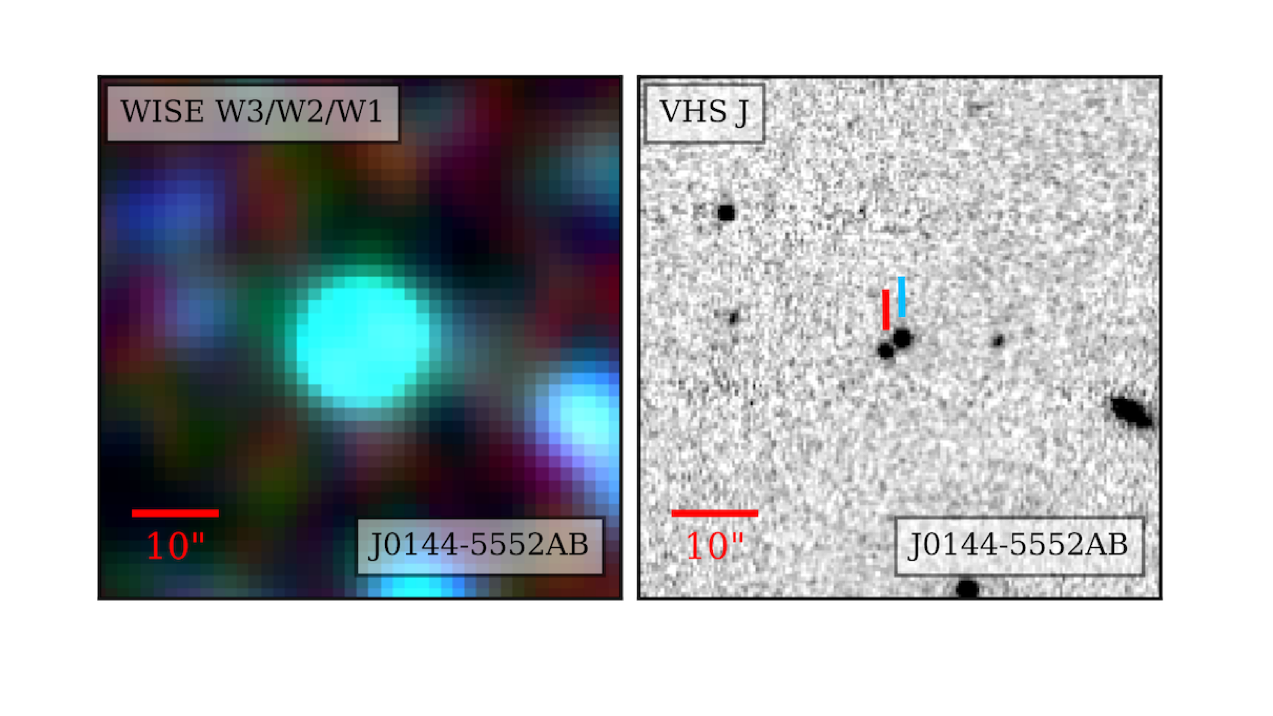
WISE, near-infrared, and optical images of all ultracool wide binary candidates. Optical images either come from Pan-STARRS (PS1; Chambers et al. 2016) or DECam images obtained through the Astro Data Lab image cutout service (Fitzpatrick et al. 2014; Nikutta et al. 2020). — astro-ph.SR
The Backyard Worlds: Planet 9 citizen science project uses data from the Wide-field Infrared Survey Explorer to detect infrared objects with significant motion.
In this work, we present the majority of the L and T dwarf candidates discovered through this effort. For each candidate, we provide proper motion measurements as well as optical, near-infrared, and mid-infrared photometry (when available), photometric spectral types and distance estimates.
Three thousand and six new motion-confirmed discoveries are presented in this work, 2,357 with L-type photometric spectral types and 649 with T-type photometric spectral types. We also present an additional 80 objects as likely L or T dwarfs based on available photometry, but for which a significant motion measurement could not be obtained.
We identify 28 objects in this sample as new comoving companions to higher-mass stars, and an additional 9 sources that are candidate binary systems made up of two ultracool dwarfs of L-type or later. Follow-up spectroscopic observations will be necessary to confirm spectral types and further characterize the sources discovered through this project.
This work presents the largest single sample of motion-confirmed L and T dwarf discoveries to date, which would more than double the number of known L and T dwarfs, if confirmed. We wish to sincerely thank our citizen scientist collaborators for their monumental efforts that have directly impacted this project’s success.
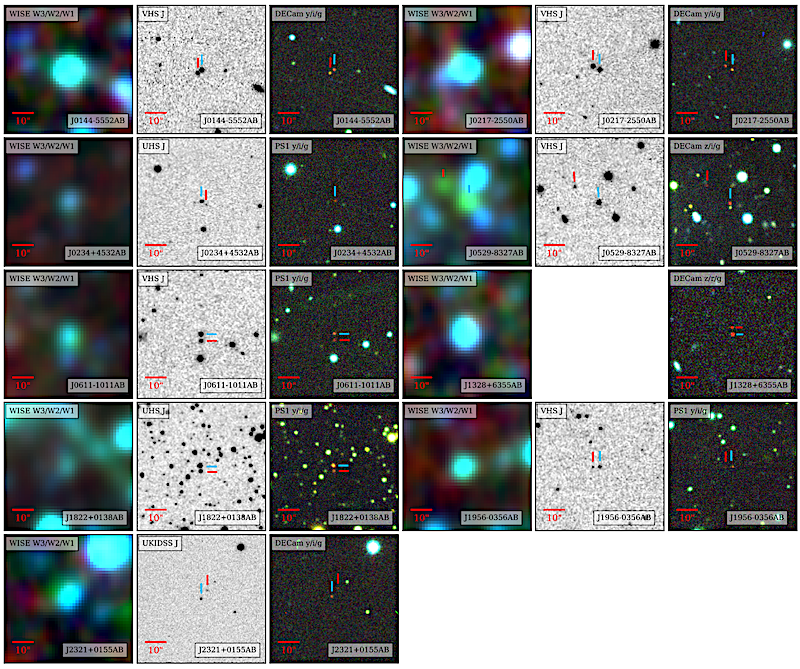
WISE, near-infrared, and optical images of all ultracool wide binary candidates. Optical images either come from Pan-STARRS (PS1; Chambers et al. 2016) or DECam images obtained through the Astro Data Lab image cutout service (Fitzpatrick et al. 2014; Nikutta et al. 2020). Primaries are marked with light blue lines while candidate ultracool companions are marked with red lines in all images where the components are resolved. Neither component of the CWISE J132836.50+635527.7AB system is detected in any available near-infrared imaging. North is up and East is left in all images. — astro-ph.SR
Adam C. Schneider, Marc J. Kuchner, Jacqueline K. Faherty, Aaron M. Meisner, J. Davy Kirkpatrick, Adam J. Burgasser, Daniella Bardalez Gagliuffi, Thomas P. Bickle, Dan Caselden, Sarah L. Casewell, Jonathan Gagné, Easton J. Honaker, Frank Kiwy, Federico Marocco, Austin Rothermich, Nikolaj Stevnbak Andersen, Lizzeth Ruiz Arroyo, Bruce Baller, Paul Beaulieu, John Bell, Martin Bilsing, Troy K. Bohling, Guillaume Colin, Giovanni Colombo, Sam Deen, Alexandru Dereveanco, Kevin Dixon, Hugo A. Durantini Luca, Deiby Flores, Christoph Frank, Christopher Fulvi, Michael Gallmann, Jean Marc Gantier, Konstantin Glebov, Léopold Gramaize, Leslie K. Hamlet, Ken Hinckley, Kevin Jablonski, Peter A. Jałowiczor, Martin Kabatnik, Peter Kasprowitz, K Ly, David W. Martin, Naoufel Marzak, Alexander McColgan, Neil J. McEwan, Marianne N. Michaels, William Pendrill, Stéphane Perlin, Ben Pumphrey, James Rabe, Henry Raway, Walter Ruben Robledo, David Roser, Animesh Roy, Arttu Sainio, Vincent Schindler, Manfred Schonau, Jörg Schümann, Karl Selg-Mann, Andrea Serio, David Sirbescu-Stanley, Patrick Smith, Andres Stenner, Christine Sunjoto, Christopher Tanner, Melina Thévenot, Vinod Thakur, Mayahuel Torres Guerrero, Maurizio Ventura, Nikita V. Voloshin, Jim Walla, Zbigniew Wȩdracki, Bailey Weyandt, Breck Wilhite, Spartacus Zitouni
Comments: Accepted to AJ
Subjects: Solar and Stellar Astrophysics (astro-ph.SR)
Cite as: arXiv:2604.01323 [astro-ph.SR] (or arXiv:2604.01323v1 [astro-ph.SR] for this version)
https://doi.org/10.48550/arXiv.2604.01323
Focus to learn more
Submission history
From: Adam Schneider
[v1] Wed, 1 Apr 2026 18:58:05 UTC (2,560 KB)
https://arxiv.org/abs/2604.01323
Astrobiology, exoplanet,