
A Look Back at the Top 10 Fashion Phenomena of 2025
As 2025 draws to a close, we’re once again looking back at the stories that shaped the intersection of architecture, art, design, and technology. This year, fashion delivered its own share of striking moments: unexpected, imaginative, and sometimes delightfully bizarre. These are the creations that twisted familiar garments and accessories into something entirely new, earning their place under our fashion design phenomena tag. Because for every piece that gets it perfectly right, there’s always one curious outlier that gets everyone talking.
From Iris van Herpen’s haute couture illuminated by reactive bioluminescent algae and Vollebak’s virus-killing copper jacket to Gustaf Westman’s viral spiral baguette holder and a wearable AirPod backpack by Bravest, here are the top 10 fashion stories that captured our attention and defined the past 12 months.
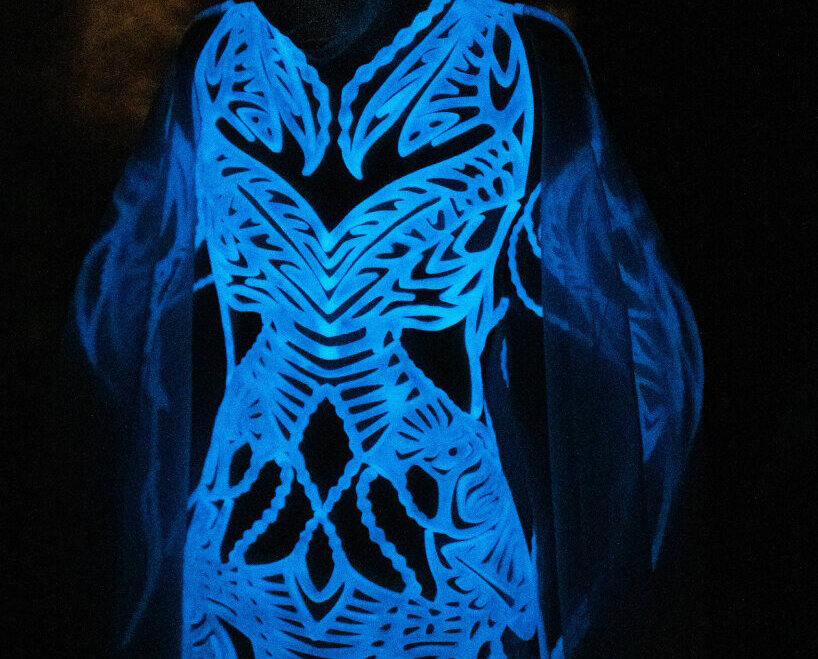
image courtesy of Chris Bellamy of Bio Crafted
Surrounded by darkness, Iris van Herpen’s dress came to life with the glow of reactive bioluminescent algae during Paris Haute Couture Week 2025. Co-created with biodesigner Christopher Bellamy, also known as Bio Crafted, the piece features 125 million bioluminescent algae, illuminated against a runway set designed with light sculptures by artist Nick Verstand. In an interview with designboom, Bellamy explains that he initially developed the technique for encapsulating the microalgae in collaboration with indigenous artists and scientists in French Polynesia. ‘A bespoke 35-step process was developed, which encapsulates the algae in a nutrient gel and protective coating, allowing them to survive for many months,’ he says.
Once encapsulated, the algae require only regular sunlight to photosynthesize and maintain their circadian rhythm. The biomaterial can thrive for months, even in hot conditions, and Bellamy notes that some samples have survived for over a year. ‘However, as this material is still highly experimental, we are continuing to study its behavior and understand exactly how it functions,’ he adds.
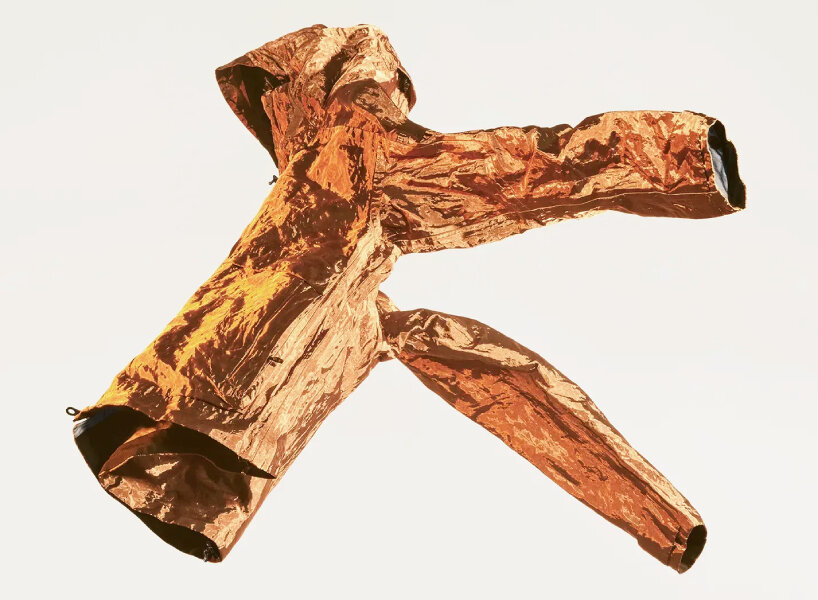
image courtesy of Vollebak
From illuminating the runway with millions of living microalgae in Iris van Herpen’s couture to actively defending against invisible threats, fashion this year explored the power of the microscopic in bold new ways. Vollebak’s Full Metal Jacket takes this concept from spectacle to protection, using copper to neutralize viruses and bacteria before they can even grow. The technical garment features three layers of textile woven with 11 kilometers of copper wire, transformed from industrial rods into fine, uniform yarns using precision lasers.
Each strand is carefully measured for softness and consistency, coated with a thin layer of lacquer to prevent corrosion, and then woven through a six-day curing process that includes scouring, heat-setting, and drying. The copper layer is paired with Vollebak’s c_change membrane, a waterproof and breathable barrier that adapts to temperature and humidity. In hot conditions, the jacket opens to release heat and moisture; in cold weather, it closes to retain warmth, offering both protection and comfort.
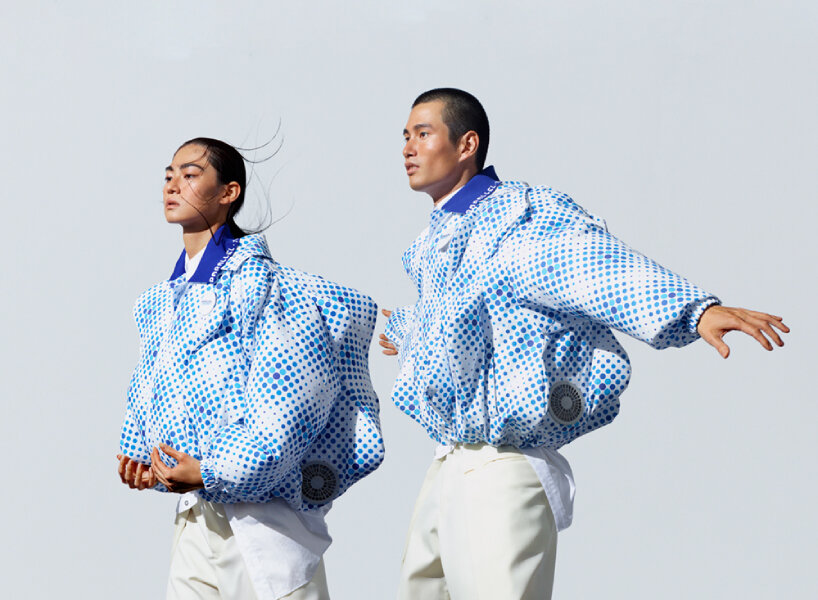
image courtesy of Anrealage
Just as Vollebak used copper to defend wearers from microscopic threats, Anrealage turned to airflow and cooling to help humans adapt to their environment. At the NTT Pavilion during Expo 2025 Osaka, the brand decided to equip staff uniforms with built-in electric fans, keeping wearers comfortable in the heat while pushing the boundaries of functional fashion. Inspired by the concept of parallel travel, the clothing uses wind to evoke the sensation of moving through time and space. Hundreds of blue dots across the white fabric symbolize connection with distant beings.
The staff uniforms consist of five pieces: outerwear, a polo shirt, a bag, a hat, and a logo badge. It’s the outerwear that houses the electric fans, allowing staff to stay cool while moving through the Expo. The fans are positioned on the lower-left side of the jacket, with protective grilles to prevent any contact with the spinning rotors. When activated, the airflow causes the outerwear to balloon, giving the wearer the ethereal appearance of a floating ‘cloud.’
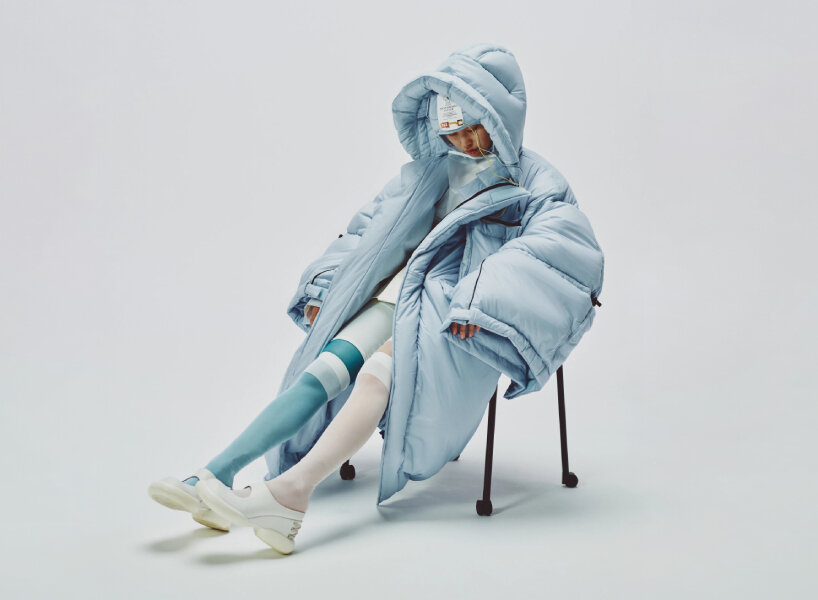
photo by Yusuke Maekawa courtesy of ZZZN SLEEP APPAREL SYSTEM
While Anrealage focused on external comfort and climate adaptation, other designers explored clothing that responds to our internal rhythms. ZZZN’s Sleep Apparel System takes this concept to the next level, transforming a puffer jacket into wearable sleepwear that helps users rest anywhere, anytime. It uses biometric data monitoring as well as headphones that play two types of music with frequency bands to help people fall asleep. The ZZZN puffer jacket for sleep modernizes Yagi, which is a traditional Japanese winter or nightwear. The apparel has drawstrings on the sleeves and hem, all adjustable to fit the user’s body type. The wearer can also adjust the cuff tabs to their fit, making sure that they’re comfortable when they’re about to sleep.
The ZZZN puffer jacket for sleep uses photoelectric fiber as its padding. With this in mind, the sleepwear is lighter than it looks. It also keeps the internal temperature warm for the users, especially during cold and extreme weather conditions.