
- Over 90% of world trade relies on trade finance and cross-border banking, but the global South is increasingly marginalised, found a report by UN Trade and Development
- Regulatory changes like Basel III have made traditional trade finance less profitable for banks, leading large commodity traders, who are less regulated, to take on a central role in the industry.
- Deteriorations in correspondent banking relationships (CBRs) driven by new anti-money laundering and counter-terrorism financing regulations are severely restricting international finance access for many developing nations.
The 2025 UN Trade and Development Report turns its attention to trade finance, its inextricable connection to global trade and commodity flows, and where it might be headed in the wake of slowing growth and tightening regulation.
The report, by the UN’s trade and development arm, draws a direct line from the global finance industry to the trade finance gap that is choking the global South, restricting its capacity to export and expand its economy despite impressive growth rates.
Trade growth is much weaker than it looks on paper, finds the report. The encouraging rise in international trade seen in the first half of 2025 was due to tariff-driven front-loading of exports and investment in artificial intelligence (AI).
But there is a slowdown on the horizon driven by “structural weaknesses” and stagnant growth in nearly every economic superpower. This is causing “thinning” resilience, according to the report, which is hitting the global South particularly hard.
Despite driving almost 70% of global growth this year and being responsible for nearly half of global output, developing economies face the harshest constraints in financing that growth. Financial market turbulence and the resulting regulation changes have been cutting off financing from countries that need it most, as banks move away from sectors that regulatory updates like Basel III have made too expensive to be profitable.
In banks’ place, commodity traders are swooping into the industry, taking on much of the burden – and benefit – of financing global trade while unconstrained by financial regulations. This is becoming increasingly profitable: in the agrifood industry, for example, over 75% of the income of major food trading companies now comes from financial operations like derivatives or supply chain financing (rather than their original core business of moving food around the world).
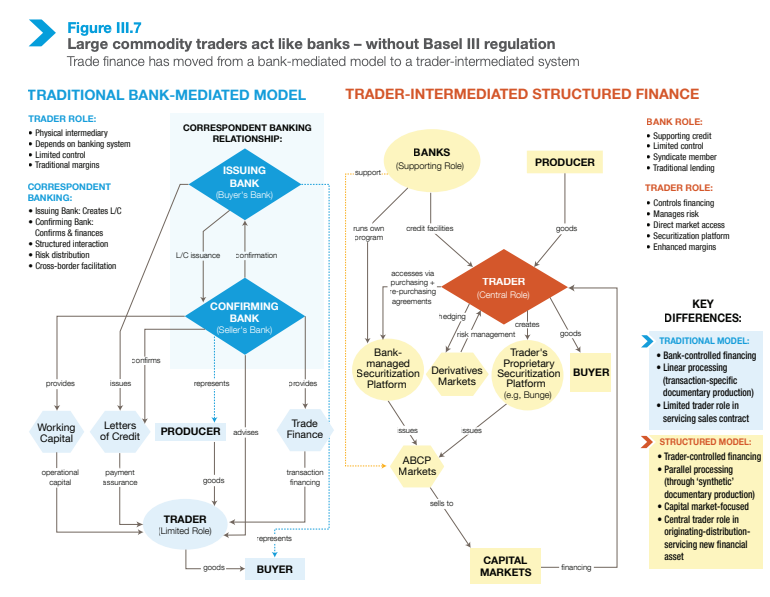
However, banks still have a major role to play – and when banks suffer, so does global trade. The health of banks supplying trade credit “directly affects firms’ export performance,” especially in sectors with higher working-capital intensity like commodities, found research cited in the report.
Over 90% of global trade depends on trade finance and cross-border banking infrastructure, meaning even tiny changes in global banking flows result in significant trade fluctuations, with the most profound effects in developing economies.
The latter are more vulnerable to deteriorations in correspondent banking relationships (CBRs), which have been increasing recently as banks seek to protect themselves against growing anti-money laundering and counter-terrorism financing regulations. This has led them to curtail CBRs with jurisdictions perceived as “high risk,” many of which are in the global South.
Developing countries are not only more likely to be hit, but also more profoundly affected: least developed countries, landlocked countries, and small island nations all rely on CBRs to access international finance, and when this access is cut off, they suffer deeply. The report found that, on average, the ten countries most affected by CBR losses experienced a 13% decline in exports; less affected countries experienced only minor slowdowns during the same period.
Fluctuations in financial markets, changes in regulation, and shifting priorities in the developed world are cutting off financial flows to the global South, the region that needs them most. Going into 2026, demographic changes and a slowing economy are increasingly placing the burden of global growth on developing countries. The lack of access to financing continues to hold them back.