
When Kennedy Ingram and Macie Phillips walk across the stage in May, they will make history as the first two Black women to graduate from the University of Georgia with a Bachelor of Science in Ocean Science.
A proposal to add the Bachelor of Science in ocean science was submitted in March 2019. In fall 2020, the degree was made available to students. The program provides students with an “interdisciplinary understanding of the structure and function of marine systems, from global oceans to local estuarine environments, and their interactions with the earth/atmosphere system.”
“It means a lot knowing that we’re trailblazers for the next generation,” Ingram said. “Bringing diversity into STEM and letting people know that you can do it. You can be Black at a [predominately white institution] and create traditions, create a legacy at your school.”
While looking through the marine science department and Skidaway Institute of Oceanography’s Instagram pages, Ingram noticed that all the Black students mentioned were doctoral or master’s degree candidates, except for one Black male undergraduate. She saw no Black female undergraduates. Upon confirming with Beverly Vantine, student services assistant and advisor, Ingram told Phillips that they would be the first two Black women to graduate with this degree from UGA.
“[Ingram] was the person to tell me that. And I was just thinking like, that cannot be right. When I looked on the website, it was in fact right,” Phillips said.
Diversity in marine science
Marine science is widely considered to be one of the least diverse fields within science, technology, engineering and math (STEM). An estimated 74.7% of scientists in the field are white, while only 2.3% are Black. However, diversity within the field is essential to produce quality scientific research and products that improve the lives of diverse populations, according to UGA’s Department of Marine Sciences.
People of color may face systemic barriers to entering this field and challenges to their career progression due to stereotypes, biases and institutional prejudices that can make research more difficult.
“There are untold [minorities] that we lose [because of these challenges],” Catherine Edwards, an associate professor in the Department of Marine Sciences, said. “There’s insecurity, ‘Is this for me?’ or microaggressions or, unfortunately, bigger issues that prevent [minorities] from feeling a sense of belonging.”
A 2023 paper published by The Oceanography Society examined whether U.S. institutions were recruiting and retaining diverse groups of students based on faculty and graduate student demographics between 2007 and 2021. They found that while recruitment efforts increased,
retention rates did not.
“I honestly thought I was the only [Black woman] in the department until I met [Ingram]. As soon as I did, I was like, ‘Oh, we got to reach out, we got to stay together,’” Phillips said. “Every time I walk into that building, I never see someone who looks like me.”
Although Phillips and Ingram’s journey was isolating at times, they remained persistent.
“A lot of things will really deter you from not even getting to your second year fully. When you don’t have the right support system to say, ‘Hey, you need to take these classes’ and ‘You need to do this,’ it’s really hard just to power through mentally,” Phillips said. “And then when you have all these people who doubt the fact that you even know what you’re learning about, or doubt your skills … there’s just a lot of factors that can deter someone, especially someone Black.”
Despite these challenges, Ingram encourages other students interested in the field to pursue their passion.
“Don’t confine yourself to a box that society puts you in. Step outside of it. You have a passion for something. Learn about it, be a nerd about it,” Ingram said. “Try to form relationships with people. Don’t be discouraged, because eventually you’ll find your community.”
Efforts are being made to diversify the world of STEM, including international organizations such as Black in Marine Science (BIMS) and inclusivity work at UGA.
“Finding ways to make and have a community that is inclusive — that is diverse and inclusive — is important so that we don’t lose people because … they’re concerned that maybe it’s not for them, which is obviously not the case,” Edwards said.

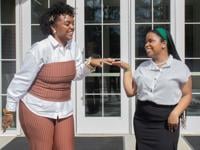
Kennedy Ingram (left) and Macie Phillips (right), graduates of the ocean science program at the University of Georgia, pose for a portrait in Athens, Georgia, on Friday, March 6, 2026. The two are the first Black women to complete the program. (Photo/Krina Patel; @memoriesbykrina)
Georgia grown scientists
Both Phillips and Ingram are Georgia residents and have attended UGA since their freshman year. Phillips has been passionate about the ocean since she was a child. When she was young, she spent summers at the beach and saw an increase in pollution.
“I knew that if I could help the conditions of the water in the future, I’d like to pursue it,” Phillips said.
Her passion solidified when she took her first ocean science-related class at UGA, which was taught by two professors of color.
“I never thought I would be as interested in my major until I took that class and was like, ‘Oh okay, this is something I actually want to pursue for the rest of my life,’” Phillips said. “They actually made me look forward to studying.”
Ingram began her collegiate journey with a major in astrophysics, which she eventually changed to ocean science.
“I saw a flyer for ocean science, and I met the faculty, and then I took a class, and I just fell in love with it,” Ingram said.
Ingram and Phillips became friends through the Semester at Skidaway Field Study program in fall 2025. Located southeast of downtown Savannah, the Skidaway Institute of Oceanography (SkIO) merged with UGA in 2013. The program, which allows students to participate in classroom and field work with leaders in marine science research, is designed for those in UGA’s ocean science program.
“I definitely do feel more comfortable with her, and more comfortable knowing that she’s around and we’re in this together,” Ingram said. “We send each other internships … we apply to the same things because we want to see each other grow … Community is a very big thing.”
During her time at SkIO, Phillips researched how to combat climate change through viral abundance, the amount of viruses present in a specific environment.
In addition to research through the Skidaway program, Ingram participated in a Research Experience for Undergraduates program last summer with meteorology and atmospheric sciences professor Gregory Jenkins at Pennsylvania State University. She studied the algae sargassum, a type of invasive seaweed that plays an important, and sometimes harmful, role in marine ecosystems.
Ingram and Phillips represent an important step for diversity in the field of marine science, according to professors in the Department of Marine Sciences.
“[Ingram and Phillips] really do represent something new and unique for our department,” Daniel Ohnemus, associate professor in the Department of Marine Sciences, said. “These sort of ‘firsts,’ they represent a really great trend towards inclusiveness.”
Ingram plans to pursue her master’s and doctoral degrees with the goal of educating young students and increasing diversity within STEM fields.
“[Ingram] is thoughtful and driven,” Edwards said. “Her passion about moving into the outreach world of science, and marine science in particular, is going to set her up for success. The passion of why what we’re doing is important can’t be replicated.”
Phillips is an ocean science Double Dawg and has also applied to UGA’s graduate school to earn her master’s degree in a non-thesis track for marine science. This summer, she plans to intern at Piedmont Water Company, where she will focus on microbiology and algae in Athens.
Ohnemus said that Phillip’s commitment to the betterment of humanity will set her up for success in her future career.
“One of the things that stood out about [Phillips] is that she’s so tuned into the things that matter to humanity and the big picture,” Ohnemus said. “Whereas a lot of students get distracted by the details, like about the carbon cycle or nitrogen and this and that, [Phillips] always asked really good questions about why things matter, why we study those things.”
Ingram, Phillips and their professors hope that their achievement will encourage marginalized people to enter STEM fields.
“Seeing [Ingram] and [Phillips] reach this milestone is incredibly meaningful for our department,” Vantine said. “They worked hard to get here, and their achievements are not only a proud moment for them, but an important step towards showing that ocean science is a field where everyone belongs.”
Ohnemus agreed, highlighting the value of diversity and representation in academia.
“[Our field is] traditionally stodgy and older and whiter, [so] it’s always better for having this diversity,” Ohnemus said. “Having different voices and backgrounds in the room … makes us all better, it makes our field stronger and more able to deal with the challenges in the future. Not to mention, if folks like [Phillips] and [Ingram] become professors or stay in the field even as graduate students, they represent so much to other people who look and feel like them.”
While neither of them expected to make history when they entered college, Ingram and Phillips said they hope this moment will help normalize the presence of Black women and other underrepresented groups in marine science careers and in STEM careers more broadly.
“It should be a moment in history, but I also kind of want it to be something that just starts off the idea that this is normal,” Phillips said. “I want, in the future, for there to be Black women on the graduate website, and all you do is scroll and think, ‘Oh, okay, do I recognize her?’ instead of thinking, ‘Oh my gosh, there’s barely anyone Black on here.’ I want to have an impact, but I want the impact to be that anyone can do it.”
“I definitely do feel more comfortable with her, and more comfortable knowing that she’s around and we’re in this together,” Ingram said. “We send each other internships … we apply to the same things because we want to see each other grow … Community is a very big thing.”
During her time at SkIO, Phillips researched how to combat climate change through viral abundance, the amount of viruses present in a specific environment.
In addition to research through the Skidaway program, Ingram participated in a Research Experience for Undergraduates program last summer with meteorology and atmospheric sciences professor Gregory Jenkins at Pennsylvania State University. She studied the algae sargassum, a type of invasive seaweed that plays an important, and sometimes harmful, role in marine ecosystems.
Ingram and Phillips represent an important step for diversity in the field of marine science, according to professors in the Department of Marine Sciences.
“[Ingram and Phillips] really do represent something new and unique for our department,” Daniel Ohnemus, associate professor in the Department of Marine Sciences, said. “These sort of ‘firsts,’ they represent a really great trend towards inclusiveness.”
Ingram plans to pursue her master’s and doctoral degrees with the goal of educating young students and increasing diversity within STEM fields.
“[Ingram] is thoughtful and driven,” Edwards said. “Her passion about moving into the outreach world of science, and marine science in particular, is going to set her up for success. The passion of why what we’re doing is important can’t be replicated.”
Phillips is an ocean science Double Dawg and has applied to UGA’s graduate school to earn her master’s degree in a non-thesis track for marine science. This summer, she plans to intern at Piedmont Water Company, where she will focus on microbiology and algae in Athens.
Ohnemus said that Phillips’ commitment to the betterment of humanity will set her up for success in her future career.
“One of the things that stood out about [Phillips] is that she’s so tuned into the things that matter to humanity and the big picture,” Ohnemus said. “Whereas a lot of students get distracted by the details, like about the carbon cycle or nitrogen and this and that, [Phillips] always asked really good questions about why things matter, why we study those things.”
Ingram, Phillips and their professors hope that their achievement will encourage marginalized people to enter STEM fields.
“Seeing [Ingram] and [Phillips] reach this milestone is
incredibly meaningful for our department,” Vantine said. “They worked hard to get here, and their achievements are not only a proud moment for them, but an important step towards showing that ocean science is a field where everyone belongs.”
Ohnemus agreed, highlighting the value of diversity and representation in academia.
“[Our field is] traditionally stodgy and older and whiter, [so] it’s always better for having this diversity,” Ohnemus said. “Having different voices and backgrounds in the room … makes us all better, it makes our field stronger and more able to deal with the challenges in the future. Not to mention, if folks like [Phillips] and [Ingram] become professors or stay in the field even as graduate students, they represent so much to other people who look and feel like them.”
While neither of them expected to make history when they entered college, Ingram and Phillips said they hope this moment will help normalize the presence of Black women and other underrepresented groups in marine science careers and in STEM careers more broadly.
“It should be a moment in history, but I also kind of want it to be something that just starts off the idea that this is
normal,” Phillips said. “I want, in the future, for there to be Black women on the graduate website, and all you do is scroll and think, ‘Oh, okay, do I recognize her?’ instead of thinking, ‘Oh my gosh, there’s barely anyone Black on here.’ I want to have an impact, but I want the impact to be that anyone can do it.”