
Within an hour of American and Israeli strikes on Iran, Tehran hit Arab states hard on Saturday, widening the war beyond its borders and drawing warnings of escalation from the Gulf.
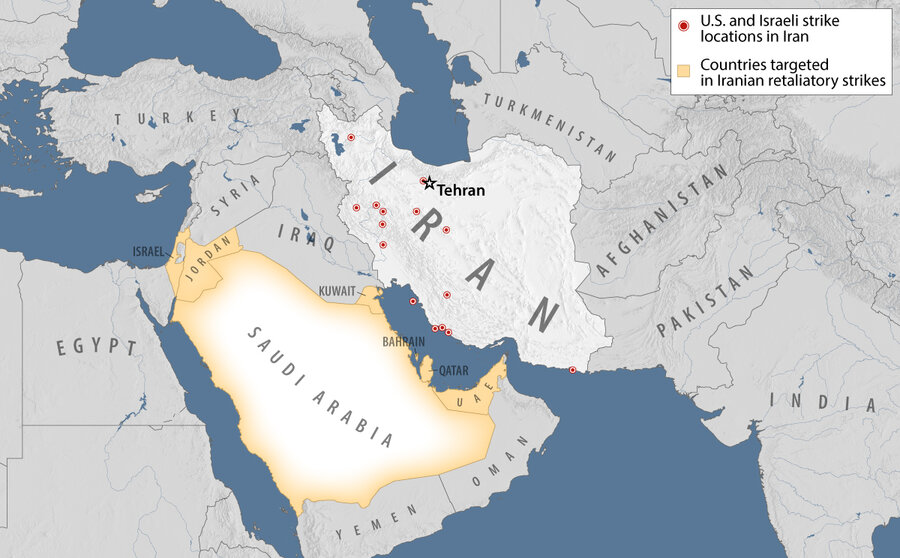
After weeks of Tehran warning that if attacked, it would target America’s Arab allies that host U.S. military and naval bases, Iran quickly retaliated. In its initial strikes, Iran reportedly targeted the American military at the Al Udeid Air Base in Qatar, Ali Al Salem base in Kuwait, Al Dhafra Air Base in the United Arab Emirates, and the U.S. 5th Fleet in Bahrain. All missiles and drones were knocked down, with no reported casualties.
The barrages marked the first time in history that Tehran directly attacked the UAE, Jordan, Bahrain, and Kuwait. It was a clear departure from the previous 12-day conflict between the United States, Israel, and Iran in June 2025, when Iran telegraphed a hit on the Al Udeid Air Base in Doha hours in advance. That allowed Qatar and the U.S. military to knock down its missiles and for life to return to normal a few hours later.
Why We Wrote This
Arab states in the Gulf, which host U.S. military bases, have for weeks urged dialogue and denied the U.S. access to their airspace for an attack on Iran. Now caught in the crossfire, they are looking for a path to defend their nations while minimizing escalation.
The only Arab Gulf country that Iran spared its rockets from was Oman, which had been mediating indirect talks between Tehran and Washington over the Iranian nuclear program, the last round of which ended Thursday.
In the weeks leading up to Saturday’s strikes, Gulf states had been advocating for diplomacy and publicly and privately pushing the Trump administration not to strike Iran. In a bid to mollify Tehran, they, along with Jordan, denied the U.S. use of their airspaces to conduct airstrikes on Iran.
Now, amid heightened concerns of a prolonged regional war, those states condemned Iran’s strikes as a violation of international law and national sovereignty. They reserved the right to retaliate – though stopped short of outlining any such plans, which could be detrimental to their interests.
“A full military strike back at Iran is unlikely. The Gulf states have too much to lose – their economies, energy exports, and ambitious development plans – to risk being drawn into a wider war,” says Hesham Alghannam, a Saudi political scientist and nonresident scholar at the Carnegie Middle East Center.
However, “if Iranian attacks continue, attitudes will harden,” he adds. “Gulf states will accelerate weapons purchases, tighten security ties with the U.S., and Saudi Arabia would likely push harder for its own civilian nuclear program.”
Iran targets Arab capitals
In its initial rocket barrages, Tehran quickly made clear that it was targeting not only the U.S. military, but Arab civilian areas as well.
Within the space of an hour, Iranian ballistic missiles struck or were intercepted over Doha; Abu Dhabi, UAE; Manama, Bahrain; Kuwait City; Amman, Jordan; and reportedly Riyadh, Saudi Arabia – striking at the heart of Arab states that for weeks had campaigned against U.S. military action on Iran and urged diplomacy.

The initial round of rockets immediately upended daily life and the economies of Arab countries heavily reliant on international finance and travel.
Amid the rockets, civilian airspace was closed in the UAE and Qatar, major global transit hubs, as well as in Bahrain and Kuwait.
Videos showed a Doha suburb hit by missile debris. An intercepted Iranian rocket fell on an Amman home with no reported casualties. Explosions from the interception of the Iranian rockets over the Jordanian capital shook buildings in Amman.
In the Iranian strike on the UAE, debris fell and killed an Asian national, Emirati authorities reported. It is the first confirmed death in what is expected to be a drawn-out, regional war.
Bahraini authorities began a mass evacuation of residents in the central Juffair area in Manama, located near the U.S. naval base.
Arab states characterized the Iranian response as direct attacks on their countries, though they have not yet outlined any plans for retaliation:
- UAE: The Emirati government said that its air defense systems successfully intercepted Iranian missiles, which it called “a blatant violation of national sovereignty” and “a dangerous escalation and a cowardly act that threatens the safety of civilians and undermines stability.” It added that the government “reserves its full right to respond to this escalation and to take all necessary measures to protect its territory, citizens, and residents.”
- Bahrain: The Bahraini government’s National Communication Centre described the barrages as “treacherous attacks” and stressed that the Bahraini government “reserves its full right to respond and take all necessary measures to protect national security and sovereignty, in coordination with its allies and partners.”
- Qatar: A onetime ally of Iran, it reiterated its call to resolve disputes through dialogue and to “spar[e] the region the risks of retaliation.” “The targeting of Qatari territory is inconsistent with the principles of good neighborliness and cannot be accepted under any pretext or justification,” the Qatari foreign ministry said, adding it “reserves its full right to respond to this attack in accordance with the provisions of international law and in a manner proportionate to the nature of the aggression.”
- Saudi Arabia: Riyadh condemned the Iranian strikes on its neighbors and allies, “warning of grave consequences if such breaches of international law continue.”
Despite the tough talk from Arab states, they remain heavily reliant on U.S. military protection and missile defense systems – what’s known as the U.S. security umbrella. That protection is now being stretched to its limits.
Fighter jets from the Jordanian armed forces scrambled on Saturday to knock down Iranian rockets, but they are expected to remain deployed in a defensive capacity. Jordanian government spokesperson Mohammed Al Momani said in a statement, “Jordan will not be a party to any regional escalation.”
“Firm on defense, active on the diplomatic front”
The war will disrupt Ramadan and the approaching Eid al-Fitr holiday in mid-March, important periods of commercial activity for Arab and Muslim states, and a period when hundreds of thousands of Arab expatriates come home to mark the holidays.
Unlike in Israel, which has developed a network of public and private bomb shelters over the past two decades, very few such shelters exist in Arab states.
Arab officials, citizens, and residents were left bracing for a second barrage of more guided, lethal Iranian rockets expected later in the evening on Saturday.
One Arab official, who declined to be named as they were unauthorized to speak to the press, said the second and future rounds of Iranian rocket strikes were “the true test” and “when the real war begins.”
“The bottom line,” says Mr. Alghannam, the Saudi political scientist, ”is that the Gulf response would be firm on defense, active on the diplomatic front, but careful to avoid actions that could spiral into a broader regional conflict.”