
Turkey has sent a strongly worded letter to the United Nations targeting Greece, Cyprus and Egypt over maritime boundaries in the Eastern Mediterranean, insisting that the 2019 Turkish-Libyan memorandum is the “legitimate” basis for its claims.
In the letter, Ankara describes the Greek-Egyptian agreement on the partial delimitation of the Exclusive Economic Zone (EEZ) as “illegal” and without legal consequences for Turkey. It claims the deal violates what it calls the Turkish continental shelf in the region and accuses Athens of a selective interpretation of the Law of the Sea, referring to what it describes as “maximalist claims” that are not consistent with the principle of fairness in maritime delimitation.

Turkey reiterates its long-standing position that Greek islands should not have full effect on the continental shelf and EEZ, particularly when — according to its argument — they distort a “fair” outcome. In this context, Ankara effectively challenges the maritime rights of islands such as Crete and the Dodecanese, portraying Greece as exaggerating its claims.
Cyprus and the two-state position
The letter also questions the status of the Republic of Cyprus as the sole legitimate authority on the island. Turkey repeats its claim that there is no single authority jointly representing Turkish Cypriots and Greek Cypriots and argues that Nicosia cannot act on behalf of the entire island.
Ankara refers to its agreements with the self-declared Turkish Cypriot administration on continental shelf delimitation and joint resource exploitation, presenting them as legal and in line with international law — despite the fact that the international community recognizes only the Republic of Cyprus.
At the same time, Turkey reiterates its position in favour of “two state entities with equal status” on the island, insisting that sovereign equality and equal international status for Turkish Cypriots is the only realistic solution.
Insistence on the Turkish-Libyan memorandum
A central point of the letter is Ankara’s defence of the 2019 maritime agreement with Libya. Turkey describes the memorandum as a legal agreement between two coastal states and rejects objections raised by Greece, Cyprus and other countries in the region.
It refers to the coordinates it has submitted to the UN and argues that Greek objections are baseless and aimed at undermining the legitimacy of the Libyan government and its agreements with Turkey.
Turkey also criticises recent energy developments, including Chevron’s involvement in offshore blocks south of Crete, claiming such moves ignore the “legal rights” of Ankara and Tripoli. In the same vein, it denounces trilateral cooperation between Greece, Cyprus and Egypt as “exclusive schemes” that sideline Turkey.
The letter further targets Greece’s Maritime Spatial Planning framework, arguing that certain designated zones overlap with what Turkey considers its continental shelf in the Aegean and Eastern Mediterranean. Ankara stresses that no internal law or administrative act by Greece can affect what it calls Turkey’s pre-existing rights to its continental shelf, maintaining that these rights do not depend on the declaration of an EEZ.
Turkey concludes by stating it will continue to “resolutely protect” its rights and those of Turkish Cypriots in the Eastern Mediterranean, while expressing readiness to discuss maritime delimitation with all coastal states in the region — except the Greek Cypriot administration — on the basis of equity and good neighbourly relations.
Greek diplomatic response
Greek diplomatic sources describe the letter as expected and unsurprising. According to the same sources, the document will be formally rejected and responded to in due course.
They argue that the letter repeats “well-known but arbitrary interpretations of international law, and in particular the Law of the Sea,” once again questioning Greece’s legitimate rights and refusing to recognize the Republic of Cyprus, an EU and UN member state.
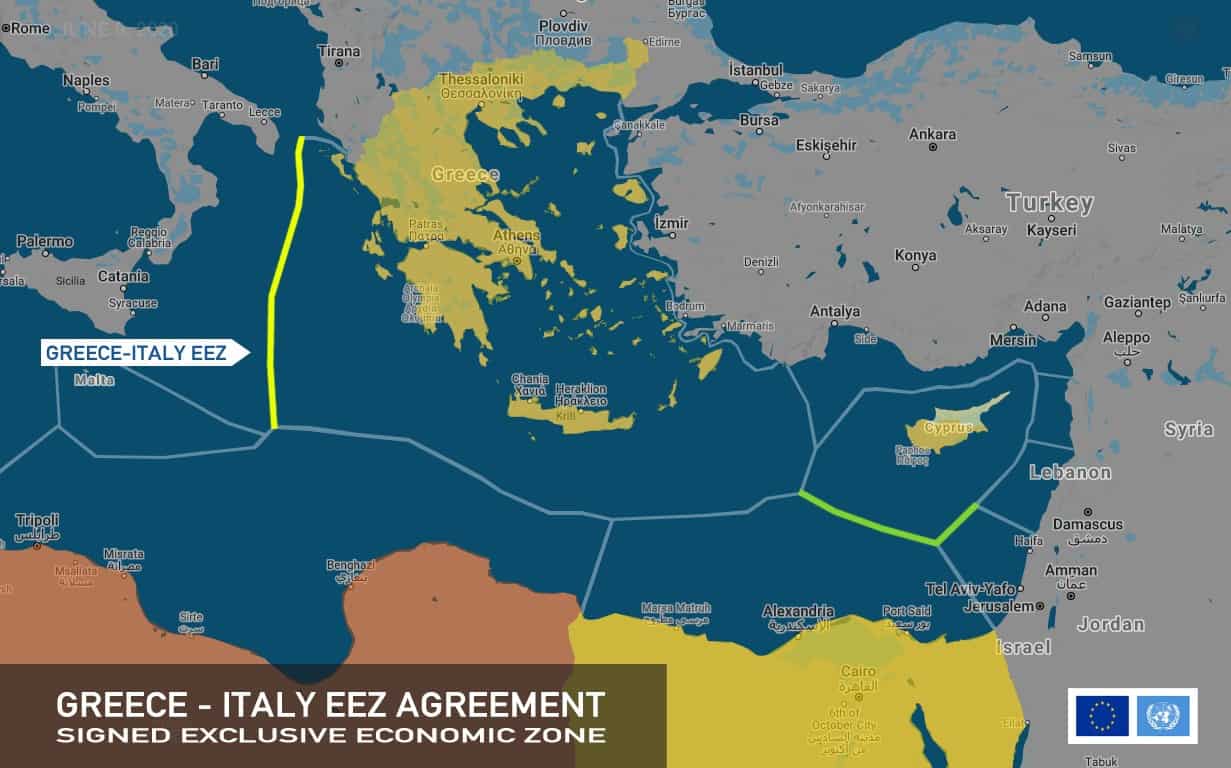
Greek officials also stress that repeating legally unfounded claims does not give them legal standing. They reiterate that, under the Law of the Sea, islands are entitled to full maritime zones — including continental shelf and EEZ rights — just like mainland territories when delimiting boundaries between states with adjacent or opposite coasts.
They conclude by calling on Turkey to comply with international law in the interest of good neighbourly relations, regional stability and cooperation in the Eastern Mediterranean.