

Unseen photographs appearing to document the Nazi crime of executing 200 Greek resistance fighters at the Kaisariani Shooting Range on May Day 1944 have emerged, 82 years later.
The mass execution took place on May Day, in retaliation for the death of a German general, three officers accompanying him, and the injury of several soldiers in Molaoi, Laconia, on April 27, 1944.
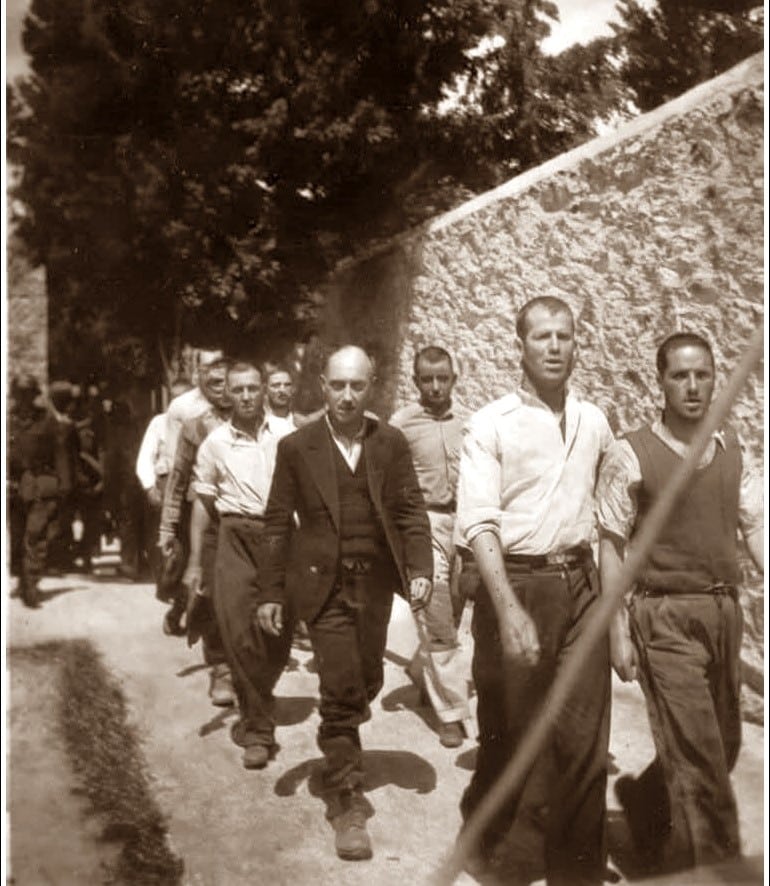
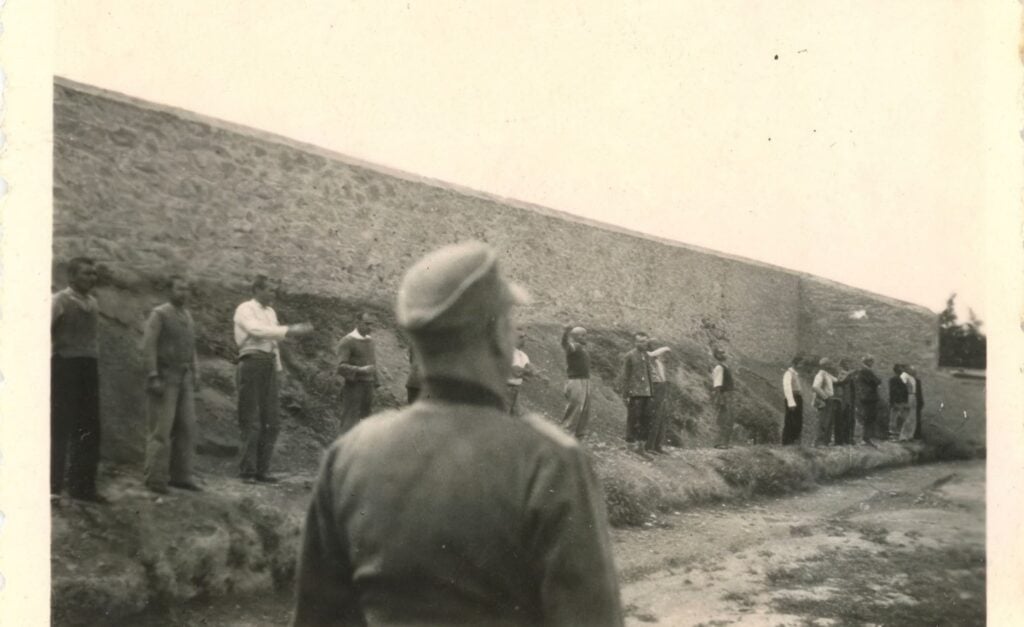
This is the first time images from the bloody May Day emerge, when 200 political prisoners were executed at the Kaisariani Shooting Range by the German occupying forces. If these photographs prove to be authentic, they constitute an important visual document of one of the darkest chapters of the German Occupation.
Initial reports indicate that the photographs were found in an album belonging to a German army officer who served in a unit based in Malakasa during the German Occupation. The material appeared for sale in an online auction on eBay by a Belgian seller, without any information of the photographer.
The auction was announced through a post on the Facebook page “Greece at WWII Archives”, which posted the photos and sparked a debate about both their authenticity and the issue of the commercial trafficking of historical material linked to war crimes.
Hundreds of “hits” from interested parties shot up the value of each image to 2,100 euros from the 36.50 starting price. The auction has now closed with the note “the items are no longer available”.
The authenticity of the images has not yet been confirmed, however, the possibility that they are authentic material has aroused intense interest among historians and researchers of the period. If the images prove to be authentic, however, their value will be much greater than monetary, as they will capture one of the darkest chapters of the German Occupation.
One of the greatest Nazi crimes
The execution of the 200 communists in Kaisariani was one of the greatest Nazi crimes committed in Greece. Most of them were political prisoners, many of whom had been transferred from the Haidari camp.
Among the unfortunate men was Napoleon Soukatzidis, who was working as an interpreter in the camp. Both he and Antonis Vartholomaios, despite being offered to be removed from the list of the 200 to be executed, they refused and chose to die to not allow others to die in their place.
In 2017, Pantelis Voulgaris made the film “The Last Note” with Soukatzidis as the main character and the plot based on the execution of the 200 Greek communist political prisoners.
If the photographs prove to be genuine, they may add new evidence to the documentation of the execution and may even contribute to the identification of individuals by relatives or scholars.
The “Action for History, Memory and Culture” program
The “Action for History, Memory and Culture” initiative issued an announcement for the photographs auction.
“The Action for History, Memory and Culture” program and the historical memory platform mnemonikon.gr express great concern about the information that photographic material that allegedly captures the course of the execution of the 200 prisoners of the Haidari Camp on May 1, 1944, is available for sale in an online auction.
If the authenticity of the material is confirmed, these are documents of immediate historical and moral importance. These are not simply collectibles, but photographs-documents of people led to execution by the Nazi regime. Their commercial circulation as auction items raises a serious issue of respect for the victims and collective memory. The management of such material cannot be left exclusively to the market logic.
It is of concern of institutional bodies, archives, museums and public services. It also concerns the families of the executed and the entire society, which must protect the evidence of its history. This responsibility also concerns the political bodies historically linked to the 200 of Kaisariani, including the Communist Party of Greece, of which most of the executed were members, as well as the broader forces of the Left, which have over time honored and invoked their memory. This historical relationship also constitutes institutional sensitivity towards the management of the relevant documents.
We call on those who have an institutional, political or moral relationship with the 200 executed people of Kaisariani to immediately consider ways to safeguard the material in a public or archival context, so that it becomes accessible for scientific research and documented presentation, and not the object of private and commercial exploitation.
The documents of an execution cannot be treated as neutral marketable objects. Their management must be governed by historical responsibility and institutional respect.
The program will monitor developments and will return if there is new evidence about the authenticity and the path of the material.”
Man identified by his family
In the picture that shows the men entering the Kaisariani Shooting Range to be executed(above), the tall man in the white shirt on the right has been identified by his family. He has been identified as an engineer at the Distillery Company factory in Messenia.
He was born in Pylos in the Peloponnese and his name is Vasilis N. Papadimas, brother of publisher Dimitris Papadimas. The man was arrested in August 1941 by the Italian carabinieri, as they had the control of the area in the first years of occupation.
Former prime minister Alexis Tsipras called on the House Speaker, Nikitas Kaklamanis, that the photographs depicting the Nazi crime must be purchased by the Parliament as they are “a tribute to the Resistance and its dead, but also as evidence of the heroism with which the Greek people faced the onslaught of the Nazi occupation.”
“I believe,” Tsipras wrote, “as I am sure you do as well, and every Greek man and woman, that the last moments of Greek patriots, the depiction of their tragedy and courage, should not become the object of a (monetary) transaction, but should become the property of the Parliament and the homeland.”