
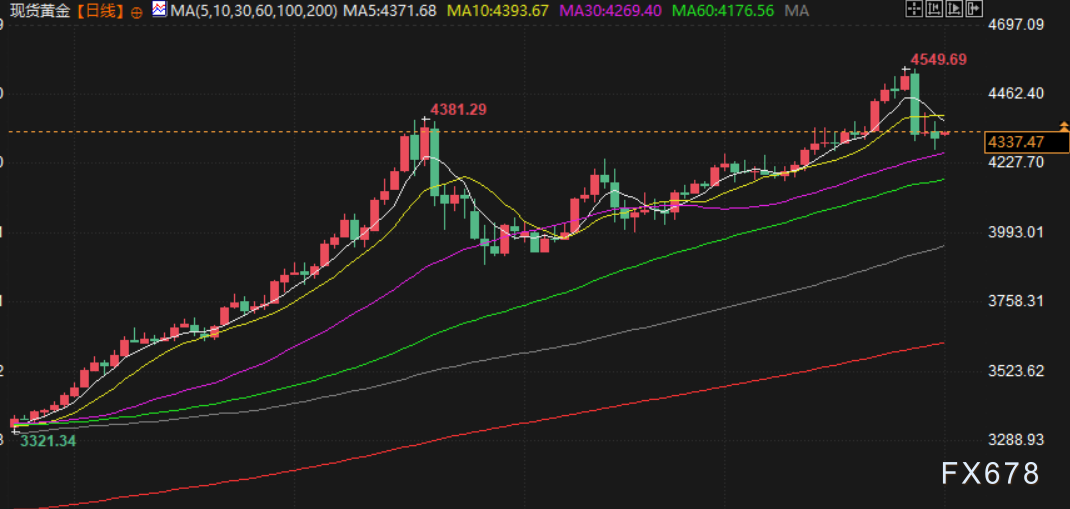
In the early Asian trading session on Friday (January 2, Beijing time), spot gold was trading near $4,332 per ounce. Despite subdued trading during the holiday period, geopolitical tensions and expectations of interest rate cuts by the Federal Reserve in the new year supported gold prices. Additionally, the expiration of subsidies under the U.S. Affordable Care Act could pose another risk of government shutdown, potentially pushing gold prices into a decisive battle around the $4,300 per ounce level in the short term.

According to CME’s ‘FedWatch’: The probability of the Federal Reserve cutting interest rates by 25 basis points in January is 14.9%, while the probability of keeping rates unchanged is 85.1%. By March, the probability of a cumulative 25-basis-point rate cut is 51.2%, the probability of maintaining the current rate is 42.8%, and the probability of a cumulative 50-basis-point rate cut is 5.9%.
Due to the New Year’s holiday on Thursday, most global markets were closed, leading to thin trading. However, influenced by corporate demand for U.S. dollar purchases, the Indian rupee slightly weakened on its first trading day of 2026. The low trading volume on the first trading day of the year also limited significant fluctuations in the exchange rate.
 On Thursday, the rupee opened at 89.9525 rupees to the U.S. dollar, lower than Wednesday’s closing price of 89.87. After fluctuating within a narrow range, the currency closed down 0.1% at 89.97. For the whole of 2025, the rupee fell by 4.72%, marking its worst annual performance since 2022 (when the rupee dropped by nearly 10%). With major markets still on holiday for the New Year, trading volumes remained low, and daily capital flows became the primary driver of exchange rate movements. Thursday’s currency changes continued the overall trend seen throughout most of 2025—fundamental supply and demand factors consistently exerted depreciation pressure on the rupee.
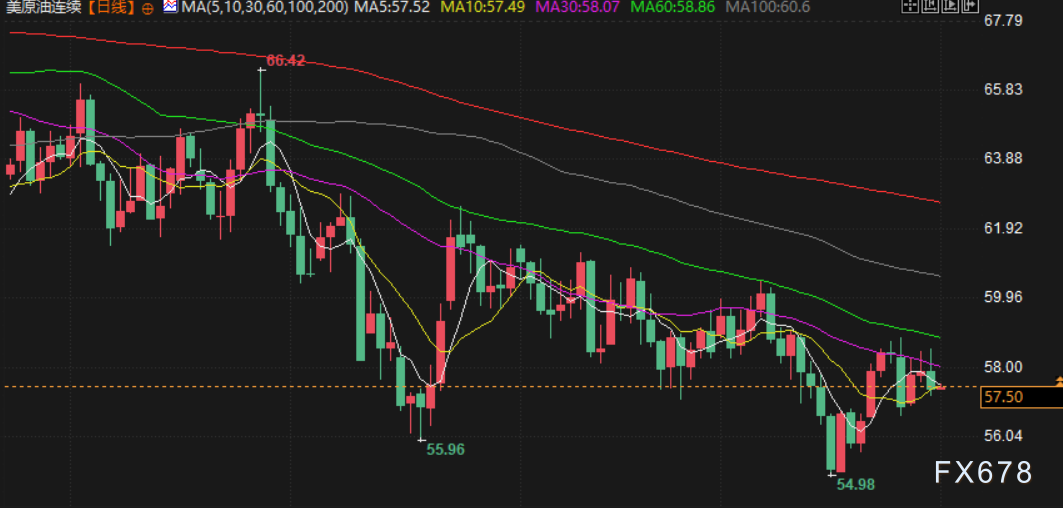
West Texas Intermediate crude oil was trading near $57.52 per barrel. On January 1 local time, the Russian Ministry of Defense released a report stating that over the past 24 hours, Russian forces had attacked Ukrainian military targets, energy facilities, ammunition depots, and drone installations. Russian forces shot down one Ukrainian Su-27 fighter jet, and Russian air defense systems intercepted one guided aerial bomb and 250 Ukrainian drones. On the same day, the General Staff of the Ukrainian Armed Forces announced that Ukrainian forces had struck multiple Russian oil refineries in the early morning. In addition, Ukrainian forces attacked Russian targets in the Donetsk region. According to Russian reports from January 1, Ukrainian drones attacked an oil facility in the Republic of Tatarstan, causing a fire. The fire did not affect normal equipment operations, has been extinguished, and no casualties were reported.
According to a report by the Institute of World Economy and International Relations of the Russian Academy of Sciences, if the Russia-Ukraine conflict is resolved in the first half of 2026, U.S. President Trump may push for enhanced bilateral dialogue with Russia, particularly in the area of strategic security. The report suggests that accumulated experience in this field could provide a foundation for cooperation.
The report also noted that U.S.-Russia dialogue might expand to include cooperation areas such as counter-terrorism, combating drug trafficking, and jointly addressing issues related to Iran. However, the report warned that if the Ukraine conflict is not resolved through a peace agreement, the Trump administration might impose stricter sanctions on Russia and use the existing congressional sanctions framework to further increase pressure.
Russian Foreign Minister Lavrov stated in an interview on Monday that Russia believes U.S.-Russia dialogue should not be limited to the issue of Ukraine. He emphasized that Russia is closely monitoring U.S. actions regarding strategic stability and is prepared to respond to any developments.
Key focus for the day

International News
U.S. lowers proposed tariff rates for 13 Italian pasta exporters
On January 1, 2026, local time, the U.S. Department of Commerce announced it had lowered the proposed tariff rates for 13 Italian pasta exporters. Previously, these companies faced tariffs as high as 92%. After the adjustment, Garofalo’s proposed tariff dropped to 13.89%, La Molisana’s to 2.26%, and the remaining 11 enterprises were uniformly set at 9.09%. The U.S. Department of Commerce is expected to release its final ruling on March 12, continuing to solicit opinions until then. This reduction in pasta tariffs coincides with the U.S. announcement to delay imposing additional tariffs on certain imported furniture.
Musk hinted at continued funding for the US Republican Party.
Musk stated that if the radical left wins, America is finished, which would open the door to illegal immigration and fraudulent activities, and America would no longer be America.
Unit 1 of Kursk 2 Nuclear Power Plant begins operation
Unit 1 of the Kursk-2 nuclear power plant in Russia (equipped with a VVER-TOI reactor) has been commissioned and connected to the Russian unified power grid. The unit is scheduled for full-scale electricity generation by 2026. Construction of the new nuclear power plant continues to progress, despite the complex situation in the region, with no interruption to the project. Alexey Likhachev, General Director of Rosatom, stated: ‘There is no doubt that this is an achievement. Not only is our entire country watching this accomplishment, but the vast majority of our overseas partners are also paying close attention.’
Gaza Media Office: Top Priority for 2026 is Ceasefire and Reconstruction
On January 1, 2026, local time, the Gaza Media Office issued a statement reviewing the deterioration of the humanitarian situation over the past two years and outlining phased priorities for 2026. The statement noted that continuous military operations, blockades, and infrastructure destruction over the past two years have plunged Gaza into an unprecedented humanitarian crisis. As 2026 begins, the top priority is to halt the conflict, end casualties, and promote the comprehensive restoration of humanitarian systems and reconstruction efforts. The statement identified seven key tasks, including: an immediate cessation of military actions; ending Israel’s blockade and occupation while ensuring the complete withdrawal of Israeli forces from Gaza; fully opening land crossings to allow aid supplies into Gaza; permitting free movement for Gaza residents; initiating reconstruction, restoring public services and healthcare systems; enabling displaced persons to return home; ensuring smooth operations for relief organizations; and holding Israel accountable under international law.
The United States imposes a 1% remittance tax on certain cross-border transfers.
On January 1, 2026, local time, new U.S. tax measures targeting certain cross-border remittances officially took effect. According to regulations issued by the U.S. Department of the Treasury and the Internal Revenue Service (IRS), starting from January 1, 2026, remittance service providers are required to collect a 1% tax on eligible transactions and report and remit the tax as required.
Expiration of Affordable Care Act Subsidies to Drive Up Health Insurance Costs for Millions of Americans
The enhanced subsidies aimed at reducing premium burdens for enrollees under the Affordable Care Act expired at the end of 2025, with more than 20 million Americans expected to face higher health insurance costs at the start of 2026. The extension of these subsidies had been the subject of multiple disputes between the Democratic and Republican parties in the United States. Ultimately, no agreement was reached prior to the expiration of the subsidies. A related proposal is expected to come up for another vote in the House of Representatives in January.
Russia Claims Ukrainian Drone Targeted Building Within Presidential Residence
On January 1, 2026, local time, the Russian Ministry of Defense reported that following a specialized technical analysis of the navigation system of a Ukrainian drone shot down on the evening of December 29, 2025, Russian intelligence officials successfully extracted flight mission files loaded onto the drone. After decrypting the data, it was revealed that the final attack target of the Ukrainian drone was a building within the Russian presidential residence located in Novgorod Oblast. The Russian Ministry of Defense stated that relevant evidence would be transferred to the U.S. through established channels. (CCTV News)
Domestic Highlights
China’s largest offshore gas field, ‘Shenhai No. 1,’ completes its 100th shipment of crude oil export.
On January 2, a reporter from China National Offshore Oil Corporation (CNOOC) learned that ‘Deep Sea No. 1,’ China’s largest offshore gas field, recently completed its 100th crude oil shipment since commencing operations. In 2025, the annual production of oil and gas from the field exceeded 4.5 million tons of oil equivalent, comparable to the output scale of a medium-sized onshore oilfield. This milestone marks that China’s deep-sea gas field production and operational technologies have reached world-class levels. (CCTV News)
Maduro: Venezuela in Its Best Condition
In his New Year’s address broadcast on December 31, 2025, Venezuelan President Maduro stated that Venezuela is ‘in its best condition’ to face challenges. Maduro noted that the growth of the real economy data indicates that the country is overcoming external attacks and blockades. Amid recent imperialist threats, the sense of national identity among Venezuelans has strengthened. He called for national unity to collectively resist imperialism. (CCTV International)
China achieves new breakthrough in safety control technology for lithium batteries in electric vessels.
On December 31, 2025, China Classification Society issued a type approval certificate for the ‘Comprehensive Safety System for Marine Lithium Batteries’ to Yantai Chuangwei New Energy Technology Co., Ltd., marking a new breakthrough in China’s safety control technology for lithium batteries in electric vessels, which will provide enhanced safety for electric ships. Recently, at the fire prevention and safety testing base for lithium-ion batteries in marine applications jointly established by China Classification Society and Chuangwei Technology, and under the witness of more than a hundred experts from China Classification Society, maritime departments, and research institutions, Chuangwei Technology successfully completed the final two key tests of the practical utility test for early warning of thermal runaway and fire suppression in marine power lithium batteries. Zhang Lilei, Chairman of Chuangwei Technology and Director of the Shandong Provincial Engineering Research Center for High-Reliability Energy Storage Safety, introduced that their self-developed intelligent fire prevention device for marine lithium-ion battery packs can not only precisely detect and intelligently diagnose early signs of thermal runaway but also provide advanced warnings and integrate with an intelligent fire extinguishing system. (Xinhua News Agency)
Northwest Grid’s annual inter-regional electricity exports exceed 400 billion kilowatt-hours for the first time.
According to the Northwest Branch of State Grid Corporation of China, the Northwest Grid’s inter-regional electricity exports in 2025 reached 411 billion kilowatt-hours, surpassing 400 billion kilowatt-hours for the first time in a year, representing a 16.4% increase compared to 2024 and a 71% increase compared to the end of the 13th Five-Year Plan period. (CCTV)