
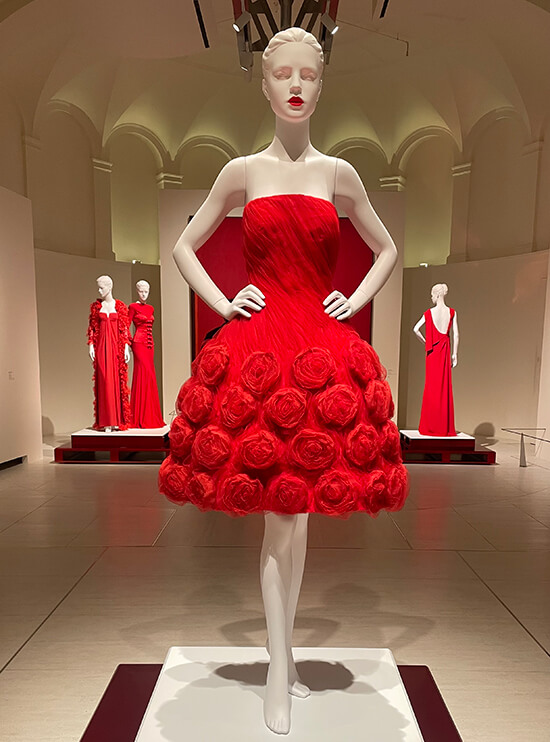
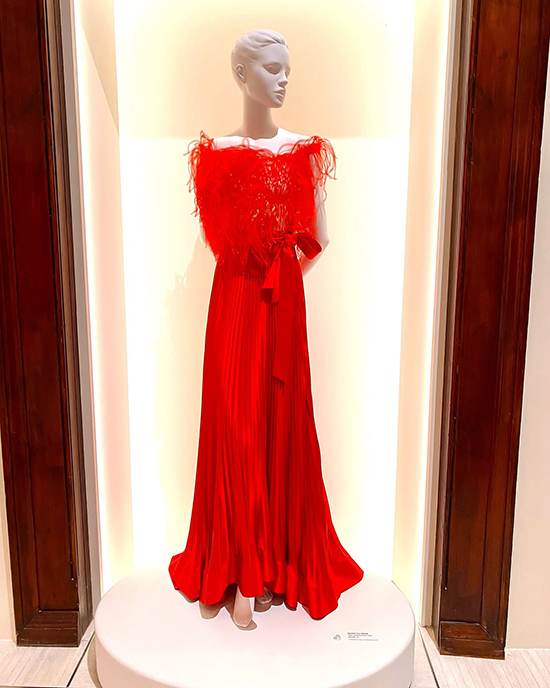
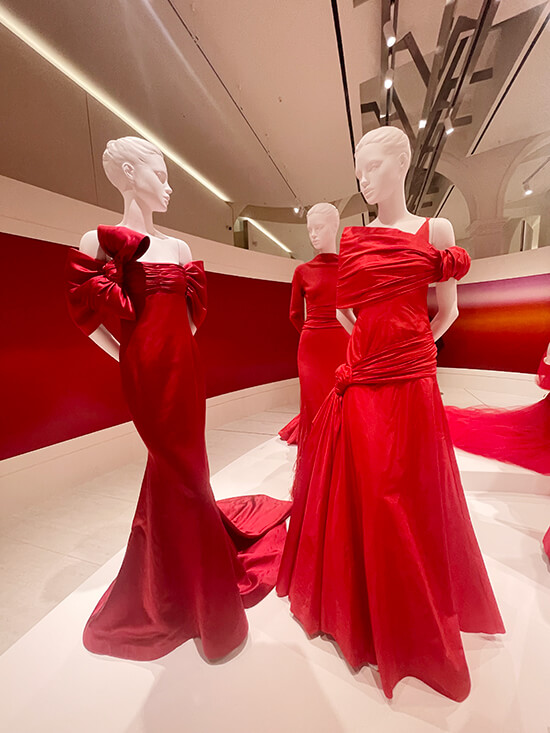
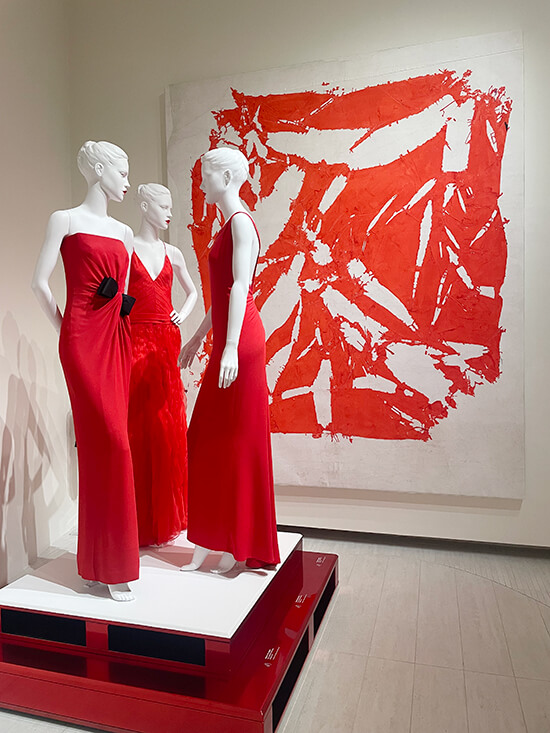
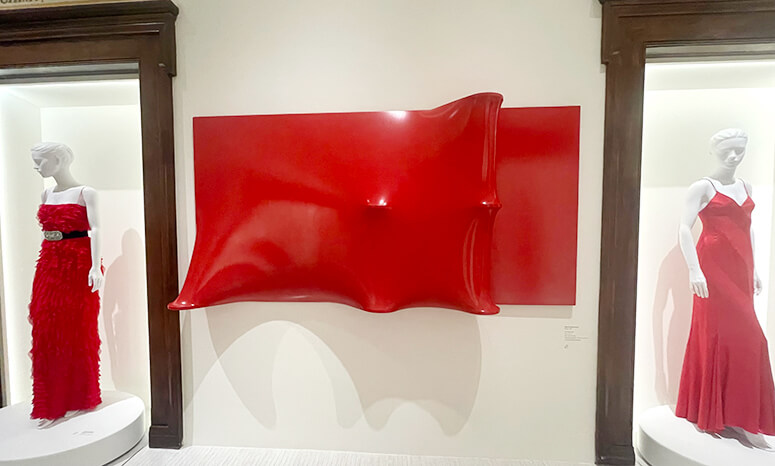
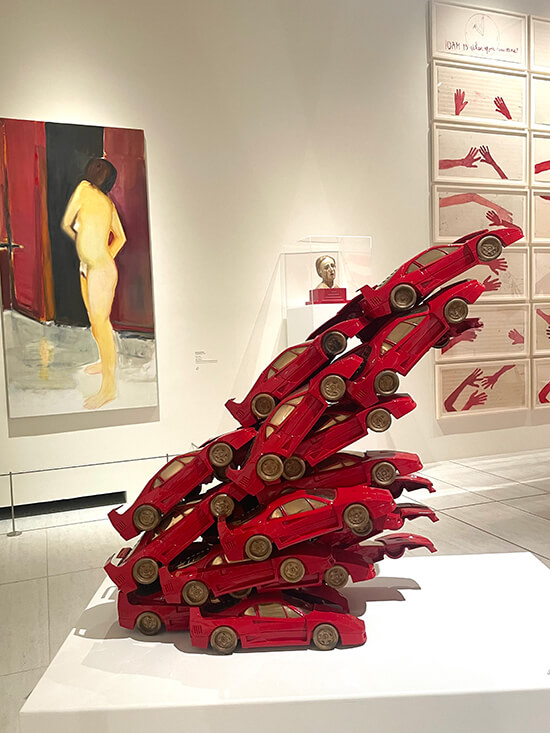
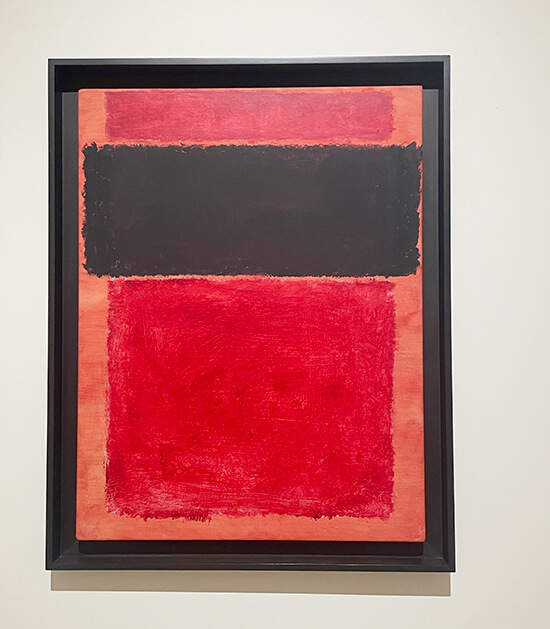
On a cool morning in Rome, tourists congregated around the popular Spanish steps while others waited nearby at PM 23 for the doors to open. Featured within was designer Valentino Garavani’s Orizzonti Rosso exhibit with 88 stunning gowns, done in his signature shade of red. The immersive exhibit included equally gorgeous red artwork by artists including Pablo Picasso, Cy Twombly, Mark Rothko, Jean-Michel Basquiat, Damien Hirst, and Irving Penn. Orizzonti Rosso (Red Horizon) was a happy and exuberant celebration of art, fashion, and life.
While the late Italian sartorial kings Armani and Versace built up their fashion palaces in Milan, the Valentino fashion house is based at Rome’s Piazza Mignanelli, which is the “PM” in PM 23. Located near the popular Piazza de Spagna, PM 23 is the latest addition to a trio of structures that include Valentino’s flagship store and creative headquarters. It is a cultural space begun and supported by the Fondazione Valentino Garavani e Giancarlo Giammetti, and Orizzonti Rossi was its initial offering.

The story of this remarkable designer, a close friend of the late Giorgio Armani, is a charmed one. It is a tale that must include his long-time partner Giancarlo Giammetti, with whom his life of design is deeply intertwined.

Born in the town of Voghera near Milan on May 11, 1932, Valentino Clemente Ludovico Garavani’s parents enrolled him at the Berlitz School in Milan to learn French, and at the Instituto di Moda Santa Maria for his drawing skills. Moving to Paris to continue his studies at the Ecole de la Chambre Syndicale de la Couture Parisienne, Valentino attended courses of a former head seamstress at Dior. He then began working with the couture house of Jean Dessès where Guy Laroche was a colleague. The French designer later invited him to work at his atelier.
Laroche had learned the manufacturing methods of ready-to-wear in New York and in two years Valentino watched the ascent of this designer’s career. Laroche loved both haute couture and prêt-à-porter, plus vibrant colors and simplicity.
Valentino told his parents, “I would love to open my own fashion house. Why should I do this for other people, when I can very easily make it on my own?”
Only two years later, in 1959, the 26-year-old Valentino opened his couture house on Rome’s most fashionable street, the Via Condotti. His collections were described as having a “modern Parisian feeling—young, fresh and chic. His fashion principles center on the importance of the cut and the color combinations.” Well received at such a young age, his clients already include “many movie actresses and South American socialites.”
In 1960, Valentino met then architecture student Giancarlo Giammeti. Giancarlo would abandon his plans of a career in architecture after visiting Valentino’s office. “Strangely enough,” he said, “the moment we met—the moment that Valentino and I started to work together—luck changed completely.
“I immediately recognized in Giancarlo his ambition… with my first collection, I had no one to tell me to go to Florence. With Giancarlo, we realized we had to show there. My career really started there. We got fantastic reviews. The buyers bought and bought until one in the morning,” said Valentino.
Giammetti, on the other hand, said, “I was the creative person behind a creative person.” Then he added, “For someone so creative, he (Valentino) amazes me. He sits there and he works until it is done. That’s the kind of discipline he has. It’s brilliant, but he never suffers for it. There are artists—let’s take Bacon—who are tormented, fragile. But let’s take Picasso: tyrannical, sure of himself. If fashion is art, there are probably many designers like Picasso. And there is a Valentino, who probably is strong enough to go on without a moment of depression or dissatisfaction.”
Movies and film stars were a big part all throughout Valentino’s career. In the 1961 film La Notte, Monica Vitti became the first actress to wear a Valentino dress on the big screen. That was merely a harbinger of things to come as Valentino would dress Hollywood celebrities in the decades to come, including Elizabeth Taylor, Audrey Hepburn, Sophia Loren, Angelica Huston, Brooke Shields, Jane Fonda, Jessica Lange, Tom Hanks, and Stephen Spielberg. Valentino himself appeared with Giancarlo in a cameo with Meryl Streep in the movie The Devil Wears Prada.
Valentino dressed high society beauties such as Jacqueline de Ribes in Paris, Marella Agnelli in Rome, New York’s Babe Paley as well as Countess Consuelo Crespi and her sister Gloria Schiff, who both worked for Vogue. It was Gloria Schiff in a Valentino outfit that got the attention of Jacqueline Kennedy, who picked a dress from Valentino’s White Collection in which to wed Aristotle Onassis.
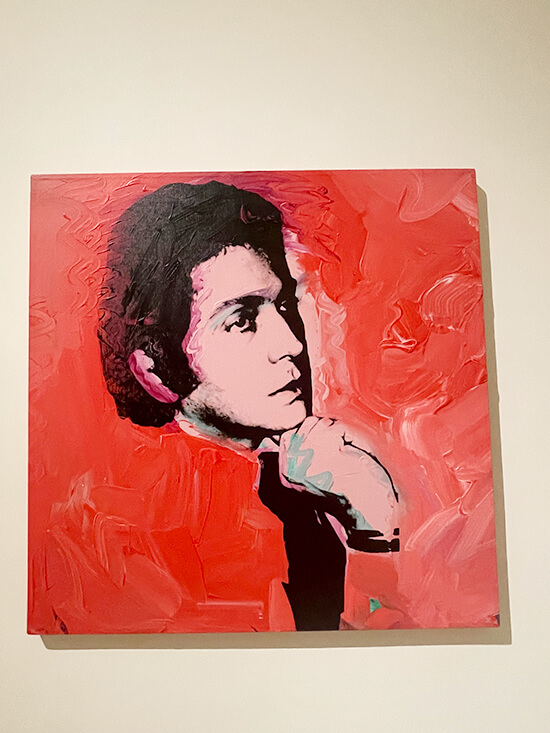
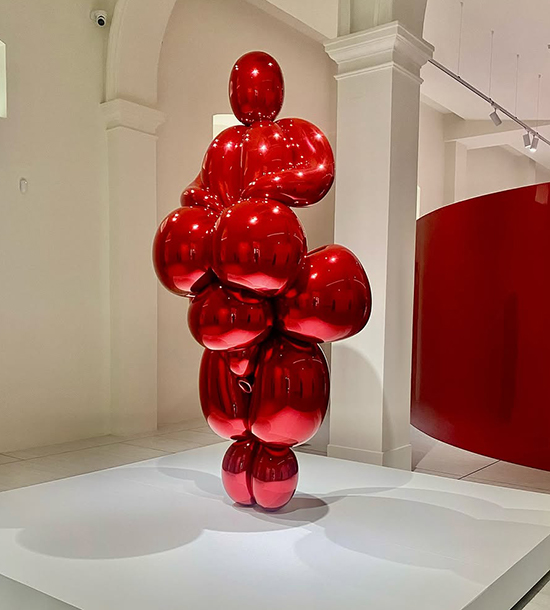
Orizzonti Rosso paid homage to red, a color Valentino associates with beauty, passion and life. Valentino is said to be “the only fashion couturier to have created a red oeuvre within his body of work, making red a constant reference point throughout his career.” The exhibit opened with the towering red sculpture Balloon Venus Lespugue by Jeff Koons. The next eye-catching piece of art was the famous Valentino portrait taken by Andy Warhol, based on a Polaroid photo taken by the artist.
Valentino retired in 2009, after the 45th anniversary celebration of the fashion house. “The great event that celebrated my 45 years of work in Rome in July (2009) was a magical and unrepeatable moment. Thus I have decided that this is the perfect moment to say goodbye to the fashion world.” The company was sold to HdP in 1998, ensuring its longevity and legacy. Indeed, at major awards ceremonies like the Oscars and fashion events like the MET gala, Valentino designs are very much a stellar presence on the red carpet.