
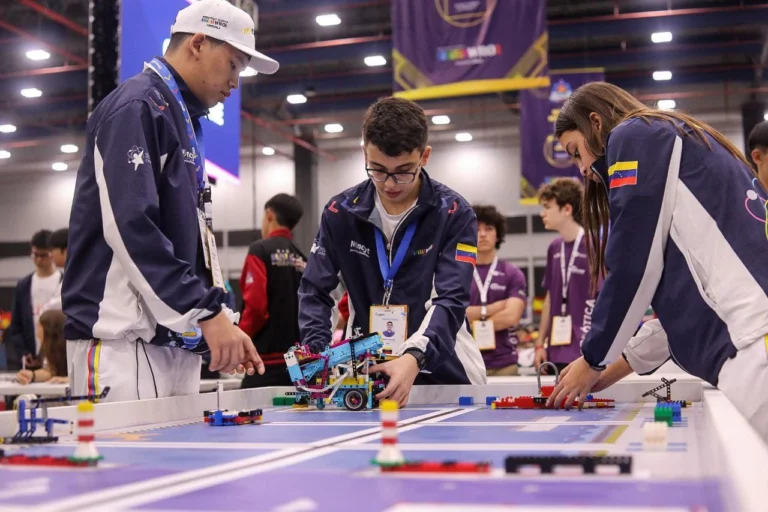
The 2026 Creative Robotics Olympics is positioned as the epicenter of innovation for children and young people across the country. Photo: Fuser News.
April 1, 2026 Hour: 4:43 pm
-
-
-
-
-
-
PDF
🔗 Comparte este artículo
Venezuela announced new science classrooms and robotic education this Tuesday, to strengthen scientific sovereignty for technical independence and productive development across the nation.
The Government of Venezuela is actively strengthening its scientific sovereignty through a comprehensive deployment of 500 nuclei and 600 science classrooms, as announced by Minister for Science and Technology Gabriela Jiménez on April 1st.
These crucial technological infrastructures, strategically situated within communal circuits and Infocenters across Venezuela, are designed to establish the foundational pillars for the nation’s productive development and its technical independence.
The initiative highlights a strong commitment to fostering local expertise and reducing reliance on foreign technological control, a core tenet of Venezuelan policy.
RELATED: Venezuela Rejects OAS Interference, Affirms Self-Determination
Minister Jiménez elaborated that six specialized didactic centers are currently operational in the states of Miranda, La Guaira, Yaracuy, Aragua and Carabobo. These state-of-the-art facilities cater to a substantial population of over 56,000 children, offering advanced instructional methods in electronics and computer science.
This widespread educational effort aims to cultivate a new generation of scientists and innovators, ensuring that scientific knowledge is deeply embedded within the social fabric from its very foundations. The focus on practical, hands-on learning is designed to equip young Venezuelans with essential skills for future technological advancement.
Furthermore, Minister Jiménez reported that the 2026 National Robotics Olympiad of Venezuela boasts an impressive 630 registered projects, primarily focused on developing innovative solutions for climate change.
Text reads: “It is a real pride to announce that three brilliant representatives of the National Science Seedmen Program @semilleroscientificos made their mark at the International Astronomy Challenge Galaxy 2026, held in Indonesia, participating virtually and demonstrating that Venezuelan talent knows no borders.
In this international competition of astronomy and astrophysics, our young people demonstrated logical reasoning and their ability to solve quantitative problems on topics ranging from fundamental astronomy, the secrets of the Solar System, the mysteries of the stars, galaxies and the cosmos, the structure of the Milky Way, Kepler’s laws, dark energy, exoplanets and even gravitational waves…”
The national educational system is equipped with 30,000 automation kits that operate on open-source software and hardware, ensuring that knowledge remains both accessible and sovereign. This strategic choice directly counters the aspirations of foreign powers to exert technological control, guaranteeing that Venezuela’s scientific progress serves its own national interests and the well-being of its population. The commitment to open science reflects a broader philosophy of democratizing access to technology.
The Venezuelan State currently oversees more than 1,100 research projects that forge vital connections between universities and communal circuits.
These initiatives are designed to bolster key economic engines through the application of biotechnology and nanotechnology, promoting sustainable development and economic diversification. This collaborative model ensures that academic research directly addresses community needs and contributes to national productive capacity.
Minister Jiménez also highlighted that Venezuela’s scientific agenda actively maintains a strong policy of equity. Following specific instructions from acting President Delcy Rodríguez, an open call for funding for projects led by women remains active. This commitment to gender equality in science is further evidenced by the integration of 65,000 scientists with 170 public universities within an open science model, aiming to consolidate the nation’s integral development and the national production of seeds, crucial for food sovereignty.
Author: Laura V. Mor
Source: Agencies