
The Attica region, along with the islands of Leros and Patmos, has been officially placed in a state of emergency due to water scarcity—the result of a two year period of extremely low rainfall throughout Greece, comparable in severity only to the country’s water crisis of 1988-1994.
Greece’s freshwater reserves were stable at 1.1 billion cubic meters (about 0.264 cubic miles) until 2021, but then started decreasing by approximately 250 million cubic meters (about 0.06 cubic miles) annually. The Attica region’s four main reservoirs are below 30% of their total capacity, or about 400 million cubic meters (about 0.096 cubic miles).
In the Mornos reservoir, a key source of freshwater for Athens, water volume has fallen to about 153 million cubic meters (about 0.037 cubic miles), the lowest level in 15 years.
Speaking on SKAI news, Greek Minister of Environment and Energy Stavros Papastavrou warned that, if the drought continues and the water supply isn’t replenished, the Attica region will run out of freshwater in about two years.
This drastic freshwater depletion is attributed to a combination of factors, including a 25% reduction in rainfall, a 15% increase in annual evaporation, and a 6% rise in water consumption.
For the moment, the declaration of a state of emergency won’t lead to water restrictions or price increases for the general public. Instead, the state of emergency allows the Greek state to fast-track a variety of infrastructure projects necessary to maintain an adequate supply of water for irrigation and public use.
In a separate interview on ΕΡΤ News, Efthymios Lekkas, Professor of Dynamic, Tectonic, Applied Geology, and Natural Disaster Management at the National and Kapodistrian University of Athens, stated that, though there was concern regarding the availability of fresh water in Greece, “we couldn’t image” this critical point would have been reached so quickly.
To deal with Greece’s water stress, Lekkas recommended that underground aquifers be utilized, albeit in a coordinated manner, rather than through private, sometimes illegal drilling that’s common throughout Greece.
Lekkas also commented that desalinating water “is not an easy solution,” as it is intensely energy-intensive. He further added that, if the energy used to desalinate water is based on fossil fuels, it exacerbates the climate crisis that has led to Greece’s water shortage in the first place.
But the current water crisis is not just a Greek problem. According to an analysis by the University College of London, two decades of satellite analysis have revealed an intense drying trend across Southern and Central Europe, including Spain, Italy, and France, while parts of the UK, Scandinavia and even Portugal are becoming wetter.
The Water exploitation index plus (WEI+), which measures water consumption as a percentage of renewable freshwater resources, shows Cyprus, Malta and Greece at the top of the index. A seasonal WEI+ index over 20% is defined as water scarcity.
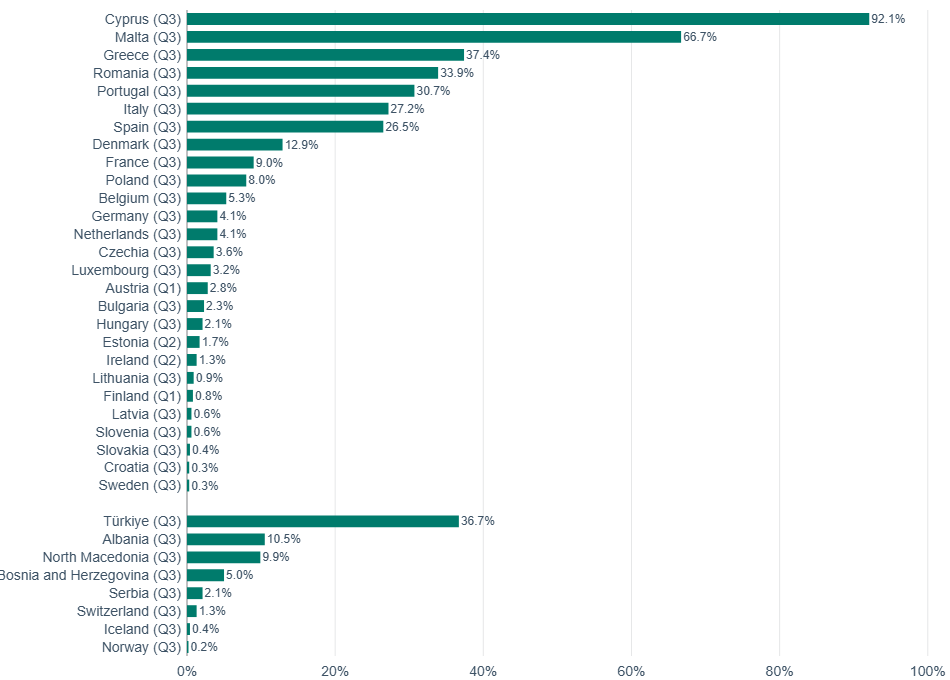
Worst seasonal water scarcity conditions for European countries in 2023, measured by the water exploitation index plus (WEI+) / Image Source: European Environment Agency