
“The scientific community hasn’t come to a consensus on the physics of curling, although it’s not through a lack of effort,” says Jennifer Vail, author of Friction: A Biography, who specialises in “tribology”: the scientific study of friction, lubrication and wear. “It’s been over a 100 years since researchers started trying to understand it, but the mechanisms behind the curling of the stone remain unsolved.”
Complex mechanics
While it may seem straightforward, curling features a lot of complex mechanics – so it’s worth explaining why before approaching the central curl mystery.
For starters, the granite stones, despite their appearance, are not just any blocks of rock. Mined from only two places in Wales and Scotland, they are particularly tough and water-resistant. And the shape is key: the underside is concave with rims called “running bands”, similar to the base of a beer bottle. It’s this band that makes contact with the ice.
The ice is specially designed too. Unlike a typical ice rink, the surface is “pebbled” before matches, with tiny droplets of water sprinkled above to create a rough surface. “Without that pebbling, friction would prevent the stone from ever reaching the house,” says Vail. “This may seem counterintuitive since bumpy roads slow us down when driving but for curling, those pebbles reduce contact between the stone and ice, which reduces friction.”

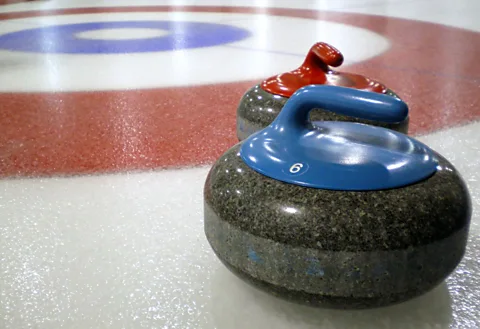 Felix/ Wikimedia Commons/ CC BY 2.0