
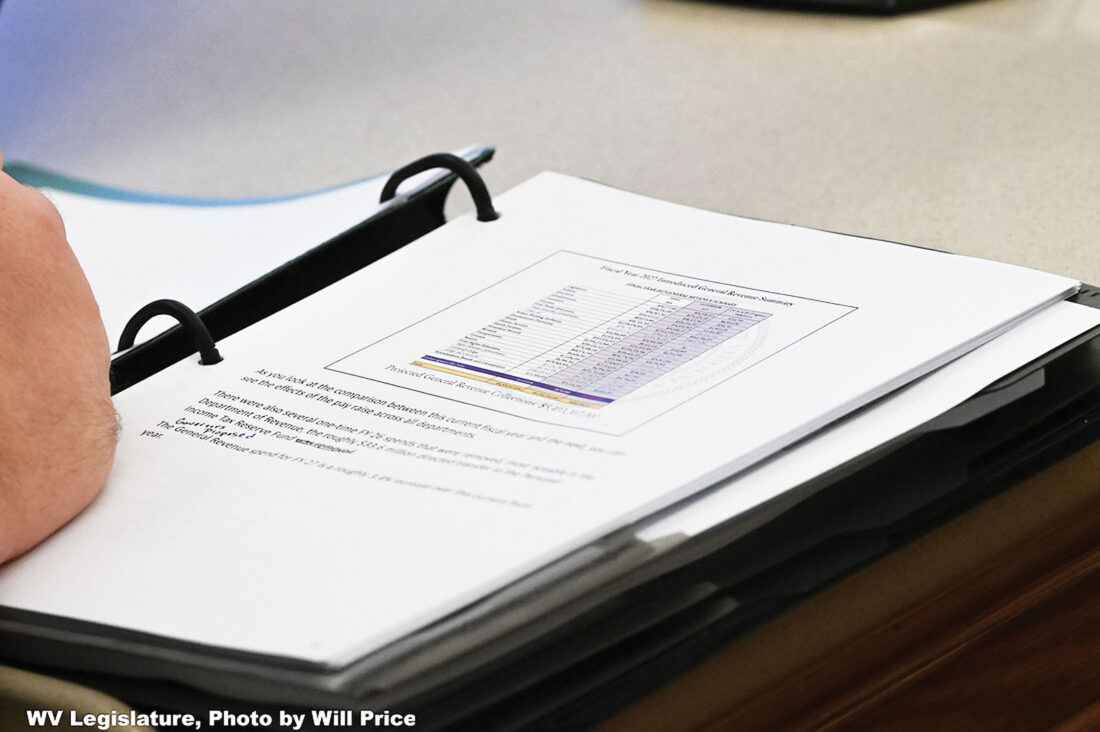
A member of the Senate Finance Committee flips through a presentation Monday on Senate Bill 250, the Senate’s version of Gov. Patrick Morrisey’s general revenue budget proposal for fiscal year 2027. (Photo Courtesy/WV Legislative Photography)
CHARLESTON — Members of the Senate Finance Committee began the process of the Legislature passing a balanced general revenue budget for fiscal year 2027 earlier than normal, along with half of Gov. Patrick Morrisey’s proposed personal income tax cut.
Meanwhile on the House of Delegates side of the State Capitol Building, lawmakers took the first step in moving part of Morrisey’s proposed pay raise increase for certain state employees.
The Senate Finance Committee recommended Senate Bill 250, the budget bill, for passage to the full Senate Monday afternoon. The bill sets the general revenue budget for fiscal year 2027 beginning on July 1.
The Senate’s FY27 general revenue budget proposal was $5.381 billion, a 2% decrease from the $5.493 billion budget presented to lawmakers by Morrisey during his second State of the State address to kick off the start of the 2026 legislative session.
“I think fiscally conservative budgeting is what most of us in the room at least get elected to do. This is a difficult decision sometimes on the buffet of a hundred items that gets presented in front of us,” said Senate Finance Committee Vice Chairman Ben Queen, R-Harrison. “I hope this might be the final product, but I’m not naive to understand that kicking a football off on day 34, there’s going to be a lot of hands in the cookie jar trying to change this baby. But … I’m glad that we seem to have arrived closer than what I might have thought 34 days ago.”
The Senate’s version of the budget includes $272.2 million in cuts following general revenue adjustments, as well as $159.7 million in improvements. Major changes include lowering the price tag of the Hope Scholarship educational voucher program, from the governor’s recommended $338.3 million to $300 million.
Instead of funding the bulk of the Hope Scholarship program through the general revenue fund, The Senate funds $100 million from supplemental appropriations of available general revenue, Lottery fund and Excess Lottery funds, and $200 million through the general revenue surplus section of the budget bill to be paid out from available surplus tax collections at the end of the current fiscal year June 30.
The committee substitute for SB 250 also changes how Medicaid funding through the Bureau of Medical Services works. Morrisey’s budget funds Medicaid at $139.3 million in the general revenue budget and $170 million through the surplus section of the budget. The Senate version increases the Medicaid general revenue funding to $260.1 million, with $5.6 million coming from sweeps of special revenue accounts, and $46.1 million in current fiscal year prefunding of Medicaid.
“I want to thank the other work that’s been done on this budget, moving Medicaid to the front of the budget, indicating that that is a priority of ours, that we want to make sure that it’s properly funded,” said state Sen. Mike Oliverio, R-Monongalia. “I just thank the committee thus far for the work and where we are so early in the session. I think it gives us a lot of flexibility that we haven’t had in the past.”
The Senate’s budget also incorporates a second committee substitute recommended for passage Monday for Senate Bill 392. The bill would cut personal income tax rates by approximately 10% retroactive to Jan. 1, returning $250 million to taxpayers when fully implemented.
Morrisey has been advocating for an across-the-board 10% personal income tax cut since his State of the State address at the start of the 2026 legislative session. But his general revenue budget proposal only accounts for a 5% personal income tax cut. Part of that tax cut is paid for through departments and agencies cutting their FY27 budget requests by 2%, freeing up roughly around $120 million.
Morrisey has since called on the Legislature to work with his administration to cut an additional $125 million from the budget bills to help him get to a full 10% personal income tax cut.
“I really want to continue to push for the reduction in the state income tax,” Morrisey said in a press conference last week. “Let me say this again: 5% is built in the budget where we did all of the tough decisions, but we want to work together with people to find the other 5%. That’s a very reasonable thing.”
Part of the 10% personal income tax cut would be paid for with increased taxes on vape and e-cigarette products, raising an additional $22 million in tax revenue.
The committee substitute for SB 392 modifies the current excise tax of 7.5 cents per milliliter to a tiered system based on the type of vaping device. Closed system vapes, such as cartridge or pods, would be taxed at $1.20 per cartridge. Open system, or refillable vapes would be taxed at 25 cents per milliliter.
“This bill includes the first suggestion of an offset that I’ve heard of by way of increasing the tax on vapes and e-cigarettes,” said state Sen. Robbie Morris, R-Randolph. “I haven’t seen anything from the Governor’s Office as to where the other offsets could come through. But I believe this is a first step … that the Senate is proposing an offset to see if we can get there or what can happen.”
State Sen. Jack Woodrum, R-Summers, raised concerns Monday with cutting personal income tax rates faster than the rate of economic growth in the state and going around the trigger mechanism already in State Code to reduce personal income tax rates over time based on a formula tied to economic conditions.
“That trigger protects us from structural mistakes,” Woodrum said. “Is it fiscally responsible to reduce reoccurring revenue any further than we already have? And I’m not opposed to tax relief. I’m a big proponent of tax relief. But I am concerned about our long-term stability.”
Senate Minority Leader Mike Woelfel, D-Cabell, said he supports cutting taxes, but this 10% personal income tax proposal was irresponsible given the growing financial needs of the state.
“I don’t recall ever voting against a tax cut. However, I have a great deal of reticence when it comes to this 10% tax cut,” Woelfel said. “I’m blessed to be in a pretty high-income category, so I would benefit from this tax cut substantially. But nobody sent me to Charleston to cut my own taxes, I can tell you that.”
Earlier Monday morning, the House Finance Committee quickly suspended its rules requiring a bill receive a public hearing in order to recommend House Bill 4765 – the teacher, school service personnel, and State Police pay raise bill – for passage to the full Senate.
Morrisey first proposed an average 3% pay raise for teachers, school service personnel, West Virginia State Police employees, and executive branch employees paid through the general revenue fund – a $78.4 million expense.
The pay raises for other state employees is included in the budget bill, but salaries for teachers, school service personnel and State Police employees are all set in State Code and require a separate bill. The Senate budget also includes the 3% average pay raise.
“Traditionally, we take those three classifications that are in code, and … if you are going to adjust pay for the rest of the administration’s employees, you have to do these separately, even though we can run one bill for all three of those classifications,” explained House Finance Committee Chairman Vernon Criss, R-Wood.
“We know that (Morrisey) had built that into his budget … In our budget, we have compensated for the 3% in there, so we wanted to make sure that those coincide,” Criss continued. “Hopefully here very shortly, we’ll be ready to run the budget out here sooner than later.
“Thank you to the House Finance Committee for approving our teacher and state employee pay raise bill,” Morrisey posted on social media Monday afternoon. “Grateful for this action, which will help our hard-working state workers.”
Steven Adams can be reached at sadams@newsandsentinel.com