
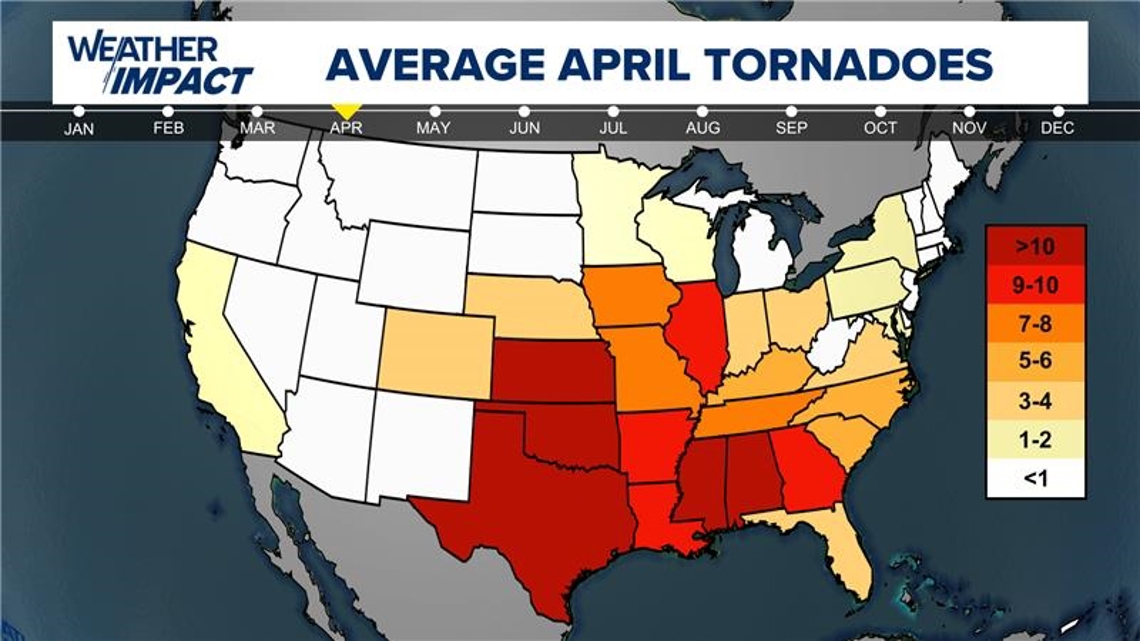
April marks the onset of intense tornado activity in the U.S., driven by warm, moist Gulf air clashing with cooler masses.
ATLANTA — April doesn’t just bring spring showers—it also typically kicks off height of tornado season. There are several ingredients that tend to come together this time of year that make it prime time for these spinning disasters.
Tornado ingredients
First, more warmth and moisture flows in from the Gulf. This warm and humid air frequently clashes with cool air masses still present from early spring and winter. Winds at the jet stream level also tend to be strong. Tornadoes thrive on these ingredients.
According to The National Weather Service, “The key atmospheric ingredients that lead to tornado potential are instability – warm moist air near the ground, with cooler dry air aloft and wind shear – a change in wind speed and/or direction with height.”
See how a tornado forms
A tornado starts inside a powerful thunderstorm. Warm, humid air rises while cooler air sinks, often carrying rain or hail. This creates spinning air currents within the cloud. At first, the spin is horizontal—but strong updrafts can tilt it upright, sending a funnel from the cloud all the way to the ground: a tornado is born. A funnel must touch the ground in order to be called a tornado.
What is tornado alley?
The U.S. typically gets about 1,000 tornadoes each year, according to the NWS. While tornadoes can occur in any state, you’ve probably heard the nickname tornado alley. While there is no official definition of tornado alley, the National Severe Storms Laboratory describes it as “a term used by the media as a reference to areas that have higher numbers of tornadoes.” This generally stretches through the Central and Southern Plains, with Texas getting the highest number of tornadoes each year, according to the NWS.
Why are tornadoes hard to predict?
Meteorologists can predict tornadoes—but only so much. Research shows that tornadoes tend to form under certain atmospheric conditions, and forecasters can spot when those conditions are present. That means they can warn that tornadoes are likely to form, but they still can’t say exactly when, where, or how strong a tornado will be. The NWS Storm Prediction Center issues outlooks days in advance for all forms of potential severe weather, including tornadoes. Once a tornado forms and is detected, warnings can track its path—but even then, it’s impossible to guarantee exactly who will be in its path. That’s why it is important to get alerts, have a plan and follow your local forecast.
Stay updated with your local forecast. Click here for the latest forecast from your trusted weather team.