
In the early 2000s, I spent much of my time over the course of several years fighting the incursion of religion into science classes in the United States. At the time, the main target of religious fundamentalists was evolution. Well-funded groups at places like the Discovery Institute were trying to insert the religious concept of Intelligent Design (ID) into high school science classes on an equal footing with biological evolution—in spite of a lack of evidence in favour of the notion that the current complexity in biological species required divine intelligence to arise, and a massive amount of counter-evidence that the few specific biological systems, such as bacterial flagella, that these groups focused on, evolved from various earlier organisms.
We were very successful, culminating in a famous court case in Dover, Pennsylvania, where a local school board had tried to replace a high school science text with an intelligent design textbook. After testimony from numerous scientists, the judge wrote a remarkable 139-page judgement describing ID as religion, rather than science, and therefore not appropriate for discussion in high school science classes.
Let’s fast forward 25 years and move a few thousand miles northwest. I now live in British Columbia (B.C.). A colleague recently forwarded me the current B.C. high school science curriculum for grades nine and twelve. It includes an embarrassing amalgam of religious gobbledygook and anti-science rhetoric. It is an insult to school children in B.C. and does a disservice to the students of the province at a time when understanding the nature and process of science is becoming increasingly important to their competitive prospects in a world dominated by technology.
You may wonder how religious fundamentalism could so effectively creep into the curriculum in a progressive place like British Columbia. The answer is simple. The religious nonsense being inserted into the curriculum has nothing to do with Christian fundamentalism; rather, it is Indigenous religious nonsense. And in the current climate, Indigenous “knowledge” is held to a different standard from scientific knowledge—or, rather, to no standard at all.
The B.C. Curriculum resorts to a phrase that was utilised by the New Zealand government when they too distorted the high school science curriculum in that country by arguing that Indigenous “Ways of Knowing” should be taught alongside conventional science and treated as an equally valid way of understanding how the world works. Several distinguished scientists in that country faced hostility from various academic organisations for pointing out the fallacy of this notion, and this resulted in international condemnation of the New Zealand initiative.
In the B.C. science curriculum for grade nine, this agenda is explicit. Students are expected to: “Apply First Peoples’ perspectives and knowledge, other ways of knowing, and local knowledge as sources of information.” “Ways of knowing” are defined as “the various beliefs about the nature of knowledge that people have; they can include, but are not limited to, Aboriginal, gender-related, subject/discipline specific, cultural, embodied and intuitive beliefs about knowledge.”
To be clear: This postmodern perspective isn’t science. It is, at best, anti-science. Cultural and intuitive beliefs are—and should be—irrelevant to our understanding of the cosmos. Science has taught us to conform our beliefs to the reality of nature, as determined by falsifiable evidence, not the other way around. It is fine to teach Indigenous mythological storytelling in a social science or history class but it is not appropriate to teach it as if it is science.
The curriculum goes on to emphasise the notion of place as central to Indigenous people’s perspectives on the world. It is indeed true that people’s perspectives are informed by their local environment. But one of the great contributions of science has been to demonstrate that such perspectives are myopic. The scientific understanding of nature is independent of place, history, and culture. Among other things, that is what makes science universal. There is no Western science, Eastern science or Indigenous science. Here I am reminded of a joke by the Australian comedian Tim Minchin: “You know what they call alternative medicine that’s been proven to work? Medicine!”
These same misrepresentations of science continue throughout the curriculum, all the way up to the grade twelve physics curriculum. And these misrepresentations are compounded by rather embarrassing discussions in a commonly used workbook published to accompany the curriculum.
For example, lesson three of the “BC Grade 9 Student Notes and Problems Workbook,” contains a section entitled “The Universe: Aboriginal Perspectives.” Over the course of two pages, the creation myths of various aboriginal peoples are described in detail, as “beautifully descriptive legends depicting the relationship between Earth and various celestial bodies.” Such subjects as the creation of the universe by a raven; the presence of water everywhere on Earth except on Vancouver Island; the eternal efforts of the Moon to get some of that water to drink; how and why a divine son and daughter team set out to make the Sun traverse the sky, while ensuring that it seems to stop in the middle of the day; how one of the jealous siblings turned into the Moon; how lunar eclipses occur when the spirit of Ling Cod tries to swallow the Moon; how one constellation of stars is the remnants of a giant bird that flew up from Earth; and how the celestial raven eventually released the Moon, stars, and Sun from boxes, in that order. These are quaint myths, and one can imagine how a reasonable science book might describe how we overcame these prehistoric notions to arrive at our modern understanding via the process of science. Instead, the conclusion at the end of this chapter reads, “These stories parallel the Big Bang Theory.”
As if the insults to the process of science reflected in these curricular statements weren’t bad enough, when the workbook actually discusses science, it gets it all wrong. For example, the book states that, “Indications are that all galaxies are moving away from a central core area. Thus, the universe is said to be expanding.” In fact, the central premise of the Big Bang picture of our expanding universe is that there is simply no centre to the universe. The Universe is uniformly expanding but not from a single central point, but from everywhere. Elsewhere, the process that describes the power generation in stars is listed three times as nuclear fission. This is the opposite of the actual process, nuclear fusion, which explains how light nuclei combine to form heavier nuclei.
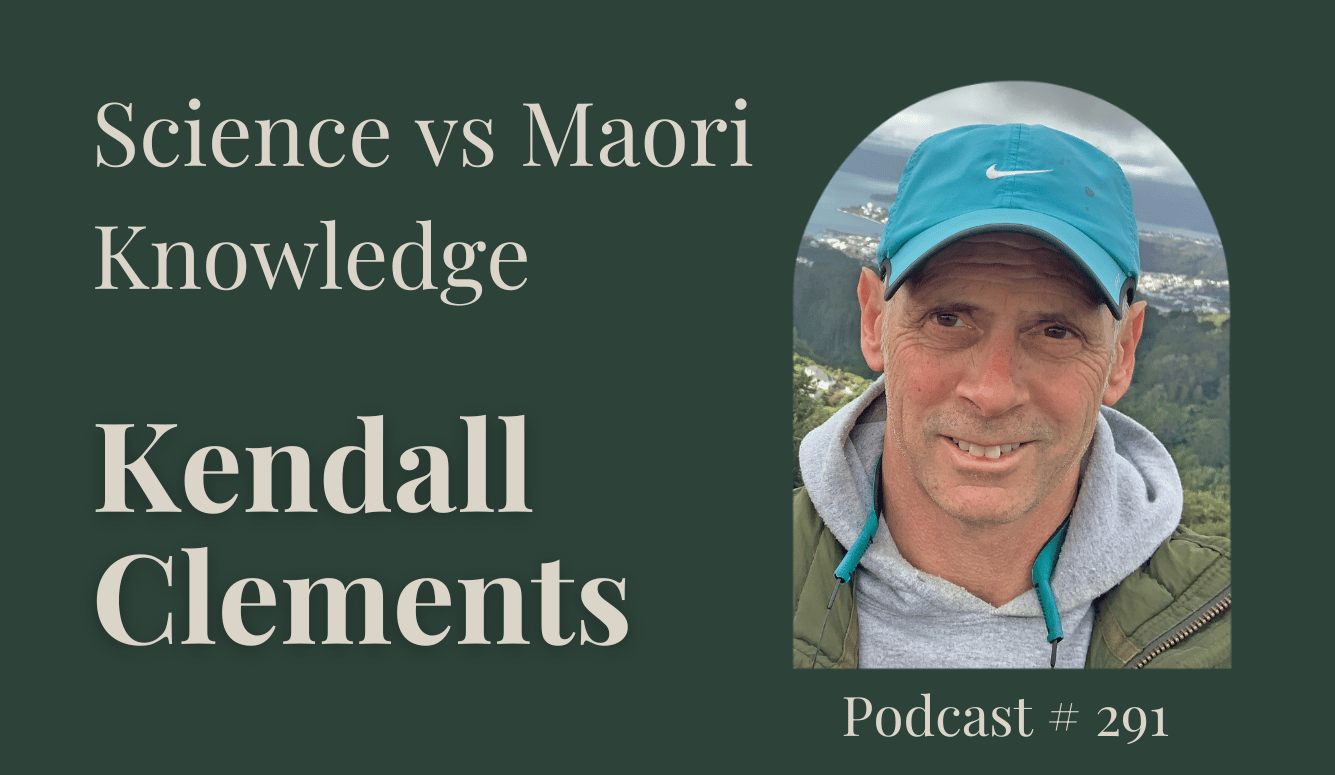
Podcast #291: Science vs Māori Knowledge
Iona Italia talks to Professor Kendall Clements of the University of Auckland about attempts to conflate traditional Maori knowledge with science, which, he argues, debases both.
Treating Indigenous myths as somehow sacrosanct simply because they are Indigenous is not only patronising, it can fundamentally distort students’ understanding of how the world works. The understanding of the modern world is based on science and that understanding was built up, often at great cost, by overcoming myth and superstition. It is a giant leap backwards to cater to such superstitions in a misguided attempt to somehow pay back Indigenous peoples for historical wrongs. Students today had nothing to do with the sins of the past, and we owe it to them to teach them the best possible science we can. That means separating religious myths from science, and in the process actually trying to get the science straight. The B.C. science curriculum is a disgrace on both counts.
Quillette invites thoughtful responses to its essays.
Selected responses are published once per week as part of a curated Letters to the Editor feature. If selected, letters appear under the contributor’s real name and may be edited for clarity and length.
To submit a letter for consideration, please email [email protected].