

White House budget seeks to scrap 54 major NASA science missions
Experts found that the White House budget request for the upcoming fiscal year could defund 54 NASA science missions, including a spacecraft currently studying Jupiter and two planned Venus missions
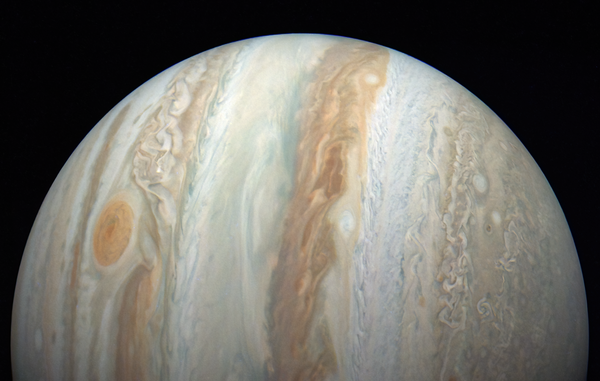
Jupiter as seen by NASA’s Juno spacecraft.
NASA/JPL-Caltech/SwRI/MSSS/Kevin M. Gill CC BY
An analysis by nonprofit science advocacy group the Planetary Society has identified 54 NASA missions that may be endangered as a result of the White House’s budget proposal for the coming fiscal year. These include a spacecraft currently studying Jupiter, a veteran X-ray observatory, planned missions to Venus and U.S. collaboration on a European rover meant to launch to Mars in 2028—and many more.
The budget proposal is for the fiscal year 2027, which begins October 1. The proposal slashes funding to the agency’s science program by 46 percent—a similar proposed cut as the president’s budget proposal had included the current fiscal year. Whie House budget proposals are not binding; in the case of the current year, Congress ultimately walked back the steep cuts, appropriating a total of $24.4 billion for the agency for the current fiscal year. As a result, just one mission was canceled in that final budget: the Mars Sample Return, which although a top science priority, is widely believed to have become infeasible.
The new White House budget proposal for NASA—which totals only $18.8 billion—did not specify projects it intended to cancel.
On supporting science journalism
If you’re enjoying this article, consider supporting our award-winning journalism by subscribing. By purchasing a subscription you are helping to ensure the future of impactful stories about the discoveries and ideas shaping our world today.
But Planetary Society experts analyzed this and previous documentation to identify which missions may be in danger. Of NASA’s four science departments, Earth science and heliophysics may face the most cuts, with 17 proposed mission cancellations in each, they found. Astrophysics and planetary science each face 10 cancellations, according to the analysis.
NASA declined to comment on the Planetary Society analysis and highlighted a letter from administrator Jared Isaacman included in the full budget request. “The FY 2027 President’s Budget Request reflects a clear principle: the United States must lead in space, not only for discovery, but for national prosperity, security, and inspiration,” that letter reads in part. “With the support of Congress, NASA will continue to push the boundaries of exploration, strengthen American technological leadership, and ensure that the next great chapter of space exploration is led by the United States.”
Some of the projects slated for cancellation in the request are ongoing missions. For example, NASA’s Juno spacecraft has been orbiting Jupiter for just shy of a decade; the New Horizons probe has revealed the secrets of Pluto, Charon and the only Kuiper Belt object ever studied up close; and the Origins, Spectral Interpretation, Resource Identification and Security–Apophis Explorer (OSIRIS-APEX) spacecraft, which delivered rocks from the asteroid Bennu to Earth in 2023, is now preparing to study the large asteroid Apophis just months after a 2029 Earth flyby so close it will be visible in the daylight sky.
Future science missions also face stark losses under the proposal: NASA’s Deep Atmosphere Venus Investigation of Noble gases, Chemistry, and Imaging (DAVINCI) and Venus Emissivity, Radio Science, InSAR, Topography and Spectroscopy (VERITAS) spacecraft to Venus could be cancelled, the analysis finds. As would NASA’s participation in the European Space Agency (ESA) Rosalind Franklin Mars rover, which NASA agreed to launch after Russia’s invasion of Ukraine dissolved the partnership that originally conceived of the mission.
Other international partnerships could also suffer, according to the report. The budget would withdraw support for the Laser Interferometer Space Antenna (LISA) mission, meant to bring gravitational wave science into orbit, and the Advanced Telescope for High ENergy Astrophysics (ATHENA) X-ray observatory—both ESA projects that the space agency hopes to launch next. The U.S. could also withdraw from the operational ESA-led Euclid telescope for dark matter and dark energy and the Japan-led X-ray Imaging and Spectroscopy Mission (XRISM), according to the Planetary Society.
Other possible cancellation targets include the Chandra X-ray Observatory, which after nearly a quarter century in space remains the most powerful X-ray telescope, according to NASA, and the Fermi Gamma-ray Space Telescope, which is similarly the most powerful observatory of its class.
Heliophysics missions possibly in danger of cancellation include the Solar and Heliospheric Observatory, which is a partnership with ESA and has provided valuable observations of the sun’s activity for 30 years. And the twin Tandem Reconnection and Cusp Electrodynamics Reconnaissance Satellites (TRACERS) probes, which study magnetic reconnection in Earth’s atmosphere, could also see cancellation, the analysis finds.
In Earth sciences, eight Cyclone Global Navigation Satellite System (CYGNSS) satellites that measure surface wind speeds in developing tropical storms to facilitate forecasts, and four Time-Resolved Observations of Precipitation structure and storm Intensity with a Constellation of Smallsats (TROPICS) satellites that help track tropical storms may also be targeted for cancellation.
Several other targeted missions monitoring greenhouse gas emissions and climate change, including the Orbiting Carbon Observatory-2 and its successor (OCO-2 and OCO-3) and the 20-year veteran Aura satellite, the analysis found.
It’s Time to Stand Up for Science
If you enjoyed this article, I’d like to ask for your support. Scientific American has served as an advocate for science and industry for 180 years, and right now may be the most critical moment in that two-century history.
I’ve been a Scientific American subscriber since I was 12 years old, and it helped shape the way I look at the world. SciAm always educates and delights me, and inspires a sense of awe for our vast, beautiful universe. I hope it does that for you, too.
If you subscribe to Scientific American, you help ensure that our coverage is centered on meaningful research and discovery; that we have the resources to report on the decisions that threaten labs across the U.S.; and that we support both budding and working scientists at a time when the value of science itself too often goes unrecognized.
In return, you get essential news, captivating podcasts, brilliant infographics, can’t-miss newsletters, must-watch videos, challenging games, and the science world’s best writing and reporting. You can even gift someone a subscription.
There has never been a more important time for us to stand up and show why science matters. I hope you’ll support us in that mission.