
The energy discussions in the Eastern Mediterranean reached a high point in February 2026. On Feb. 11, Turkish President Erdogan and Greek Prime Minister Mitsotakis met in Ankara to focus on economic cooperation and practical dialogue.
Only five days later, Chevron signed lease agreements with Greece for four offshore blocks located south of Crete and the Peloponnese. The proximity in timing invited speculation, but it does not establish causality. This development sparked immediate claims that regional energy routes were moving away from Turkish infrastructure.
While these events create a strong political signal, they do not change the underlying physical structure of gas flows. A close examination of current capacities and network constraints shows that Türkiye remains structurally central to the region’s gas infrastructure, even as new nodes gain political visibility.
On Feb. 5, Turkish Petroleum Corporation (TPAO) signed a memorandum of understanding with Chevron to evaluate exploration opportunities. Technical commentary on the MoU described it as an early-stage framework, not a production-linked investment license with fiscal terms.
The four offshore lease agreements signed on Feb. 16 are different because they initiate an exploration work program, with any development decision contingent on results and subsequent approvals. These leases give Chevron a 70% operating interest in blocks south of Crete and the Peloponnese.
The lease agreements are subject to ratification by the Greek Parliament. This step acts as a symbolic signal but lacks immediate impact on regional gas volumes. The current program starts with 2D and 3D seismic work to evaluate potential reserves. Any test drilling and commercial production, if viable, would be on a multi-year timeline rather than an immediate shift in volumes.
These licenses do not, by themselves, resolve the competing maritime jurisdiction claims in areas overlapping the Türkiye-Libya MoU’s notified coordinates. A commercial license is a domestic instrument; it does not, by itself, prejudge questions of maritime jurisdiction under international law.
Operational realities of regional interconnectors
The Vertical Gas Corridor often appears in headlines as a new strategic backbone. In technical terms, this structure is an LNG-based chain relying on the Alexandroupolis and Revithoussa terminals rather than a continuous new pipeline system.
The Alexandroupolis FSRU has a nominal capacity of 5.5 billion cubic meters per year. Data from early 2025 shows that it handled only 4.6% of total Greek LNG imports amid commissioning and early operational ramp-up. Revithoussa remains the primary entry point for the country. Domestic demand and exit limitations within the national grid restrict the net exportable surplus to 2 or 3 billion cubic meters (bcm) annually.
Physical constraints further limit the effectiveness of this northern route. In practice, operational constraints keep combined northbound flows in the 6 to 8 bcm range. There is also the financial issue of pancaking tariffs.
Gas moving through this corridor must pay separate fees across multiple borders, accumulating entry-exit fees. This accumulation of costs makes the route less competitive than single-tariff alternatives.
European and U.S. policymakers increasingly emphasize traceability and certified origin in LNG supply chains in order to enhance origin certification within regional pipeline networks. Because of this, the corridor is being framed as a route with clearer traceability.
This approach is reflected in pending legislative proposals such as the Eastern Mediterranean Gateway Act in the United States. This bill frames Eastern Mediterranean connectivity through an explicitly security-focused lens alongside energy policy objectives. It seeks to link the region to the India-Middle East-Europe Economic Corridor (IMEC) while strengthening ties with Greece, Israel, and Cyprus.
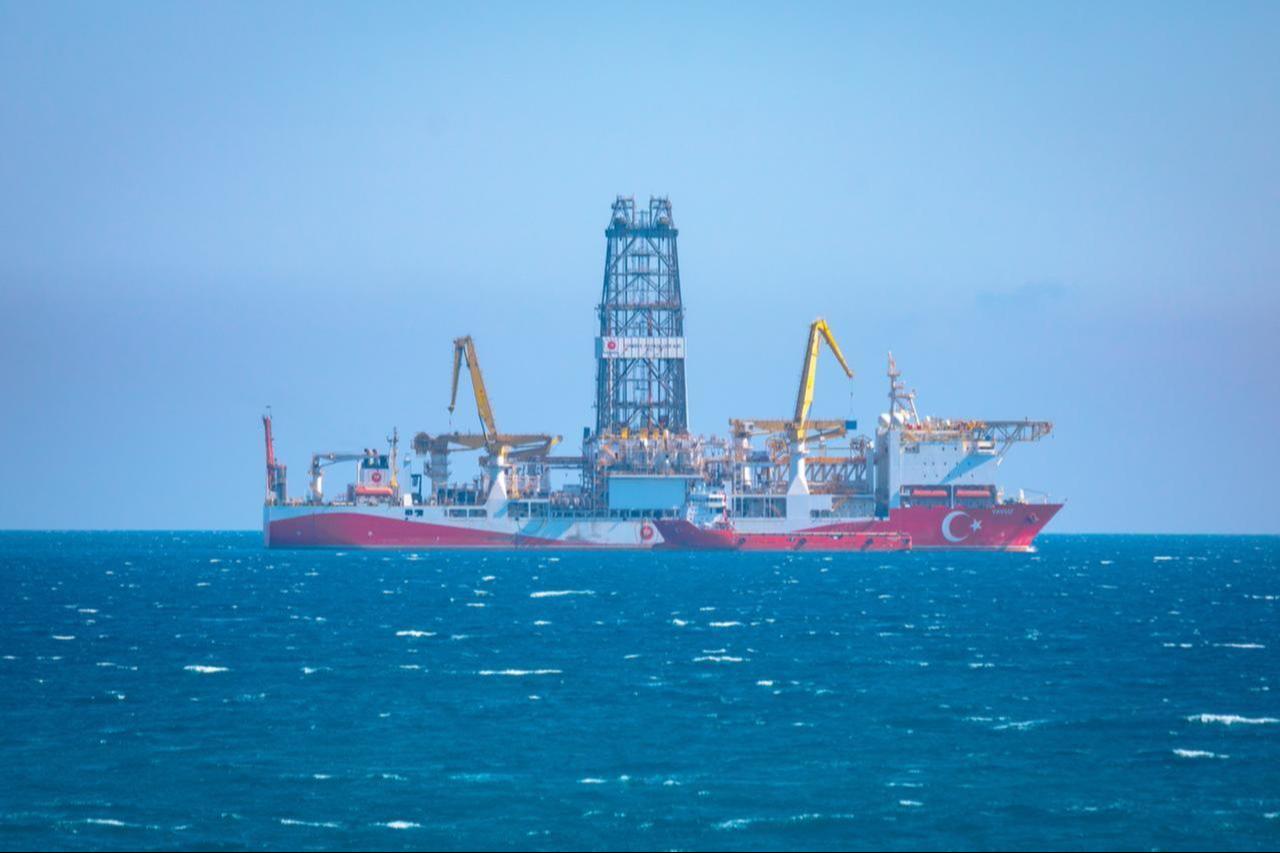

Türkiye’s state-owned oil and gas company TPAO’s Yavuz drillship sails in the Mediterranean Sea off Mersin, Türkiye. (Adobe Stock Photo)
Infrastructure capacity and limits of market depth
Türkiye holds the largest physical infrastructure in the region. Its total regasification capacity sits between 50 and 60 bcm per year. Estimates vary, but a meaningful share of this regasification capacity remains underutilized, with some data pointing to a spare capacity between 15 and 30 bcm.
This physical strength makes Türkiye a significant intake manifold for natural gas. There is a clear gap between this hardware and the market software. A mature trading hub requires deep liquidity. Global benchmarks for developed hubs show a churn ratio between 10 and 15. In Türkiye, this ratio is currently around 1.
BOTAS’s dominant position shapes price formation and liquidity dynamics in the current market structure. The state company maintains a market share between 75% and 80%. This structure constrains private participation and limits liquidity.
The conversion of physical pipelines into market power depends on domestic reforms rather than more steel in the ground. Türkiye’s policy priority is to deepen market liquidity by improving predictability, transparency, and third-party access.
The licensing round in Libya on Feb. 12, 2026, provides a clear example of how energy companies operate across different basins under commercial logic and risk calculations. While Greece and Türkiye compete in the Eastern Mediterranean, their state and private entities often coexist in other basins. In this round, Chevron won the exploration license for the Sirte S4 block. TPAO successfully secured rights for offshore Block 07 in the same Sirte basin as part of a consortium with Repsol and MOL.
Türkiye’s state oil company also obtained the onshore C3 block through a separate partnership. This situation shows that energy investments are not zero-sum. International majors like Chevron follow commercial interests and technical depth even amid regional political frictions. Companies work where the infrastructure and geological potential meet their financial goals.
Technical transformation and the decarbonization outlook
Energy, logic and physical capacity should impose discipline on political slogans. While the current focus remains on natural gas routes, the future of regional energy depends on the shift toward hydrogen readiness and green molecule certification.
Scholarly work on European decarbonization suggests that tolerance for unabated gas could fall sharply after 2030, raising long-term asset viability considerations and weakening the case for new large pipeline expansions. This shift creates a structural challenge for infrastructure that fails to adapt to new environmental standards.
Türkiye and Greece are currently in competition, but their long-term success in the energy market requires technical transformation rather than political theatre. Over time, certification and traceability requirements are likely to matter more. Infrastructure strategies should be designed with adaptability in mind, rather than assuming today’s gas politics will remain unchanged.

February 21, 2026 01:02 PM GMT+03:00