
A new geodynamic model is reshaping how scientists understand supervolcanoes, revealing that their magma systems may be far more diffuse and dynamic than previously believed.
Supereruptions are among the most extreme events our planet can produce. Each one can eject more than 1,000 cubic kilometers (about 240 cubic miles) of material, enough to blanket entire continents in ash and disrupt global climate for years. These rare eruptions are not just geological curiosities. They pose real, if infrequent, risks to modern civilization, making it essential to understand how they begin deep underground.
A new study by researchers at the Institute of Geology and Geophysics of the Chinese Academy of Sciences (IGGCAS) takes a major step in that direction. Using a high-resolution three-dimensional model of western North America, the team recreated how Earth’s outer shell and underlying mantle interact today. Their results, published in Science, offer a fresh explanation for how magma forms and moves beneath supervolcanoes like Yellowstone.
Supervolcanoes—those that have produced supereruptions in the geological record—are often thought to contain long-lived, liquid-rich magma chambers within the crust. In this traditional view, lighter magma accumulates, pressure builds, and eventually the crust fractures, leading to collapse and eruption.
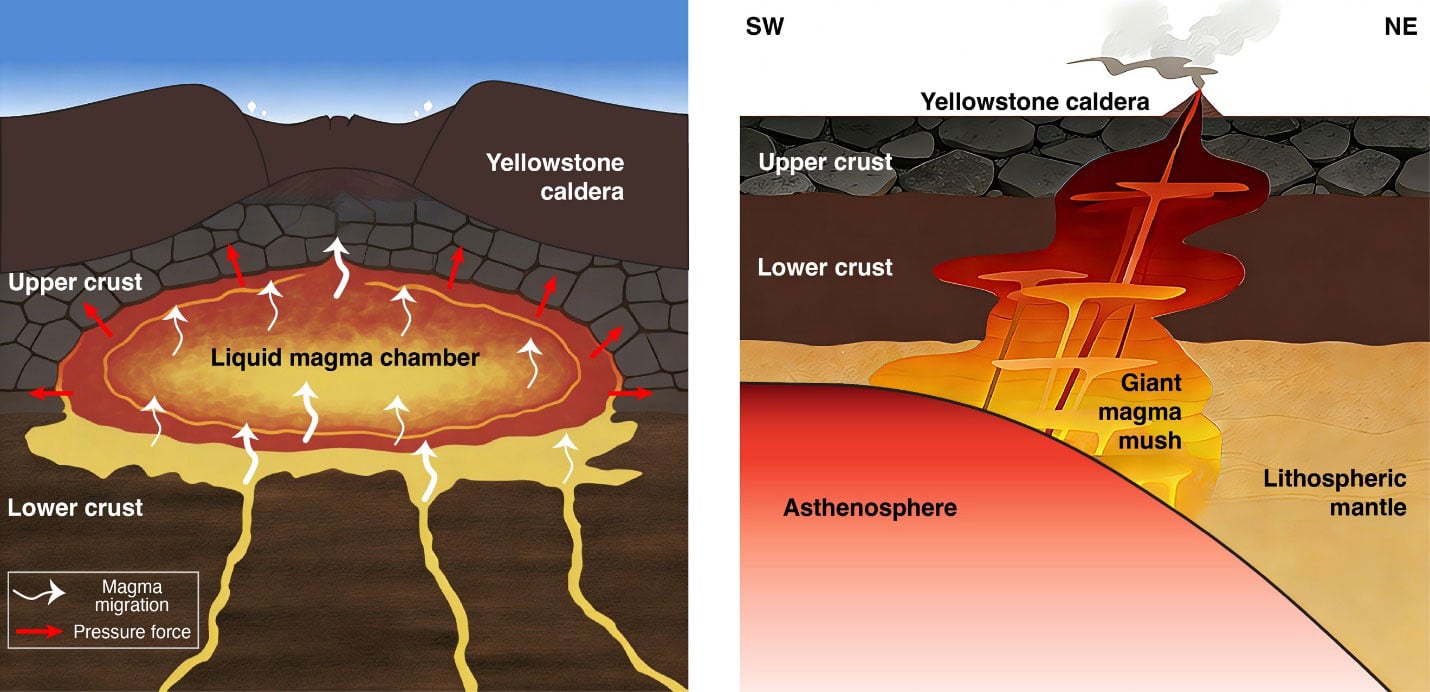
However, newer evidence suggests that such stable magma chambers do not persist beneath active supervolcanoes. Instead, magma is spread across broad regions of partially molten rock known as “magma mush” systems. These zones extend through much of the lithosphere rather than being confined to a single chamber.
The Role of the Lithosphere and Asthenosphere
The lithosphere is Earth’s rigid outer shell, made up of the crust and the uppermost mantle. Beneath it lies the asthenosphere, a softer layer that slowly flows over long timescales. Studies indicate that magma feeding supervolcanoes forms in the upper asthenosphere (the shallow mantle just beneath the lithosphere), though the exact cause of melting is still uncertain.
As magma rises into the lithosphere, it mixes with surrounding solid rock and forms a thick, sticky material called magma mush. This material is far more viscous than liquid magma, making it harder for buoyancy alone to drive movement upward. In addition, these mush zones are widely distributed, unlike the localized chambers described in older models.
Yellowstone caldera, one of the best-known supervolcanoes in western North America, has produced two supereruptions in the past 2.1 million years. It is a key study site because of the extensive geological, geophysical, and petrological data available. Research shows that Yellowstone contains a long-lived magma mush system that spans the lithosphere and dips toward the southwest.
A shallow, liquid-rich magma body—similar to a traditional magma chamber—appears only briefly before eruptions occur. While this helps explain the structure of Yellowstone’s magmatic system, the forces that drive it were not fully understood.
A New Model of Mantle Dynamics
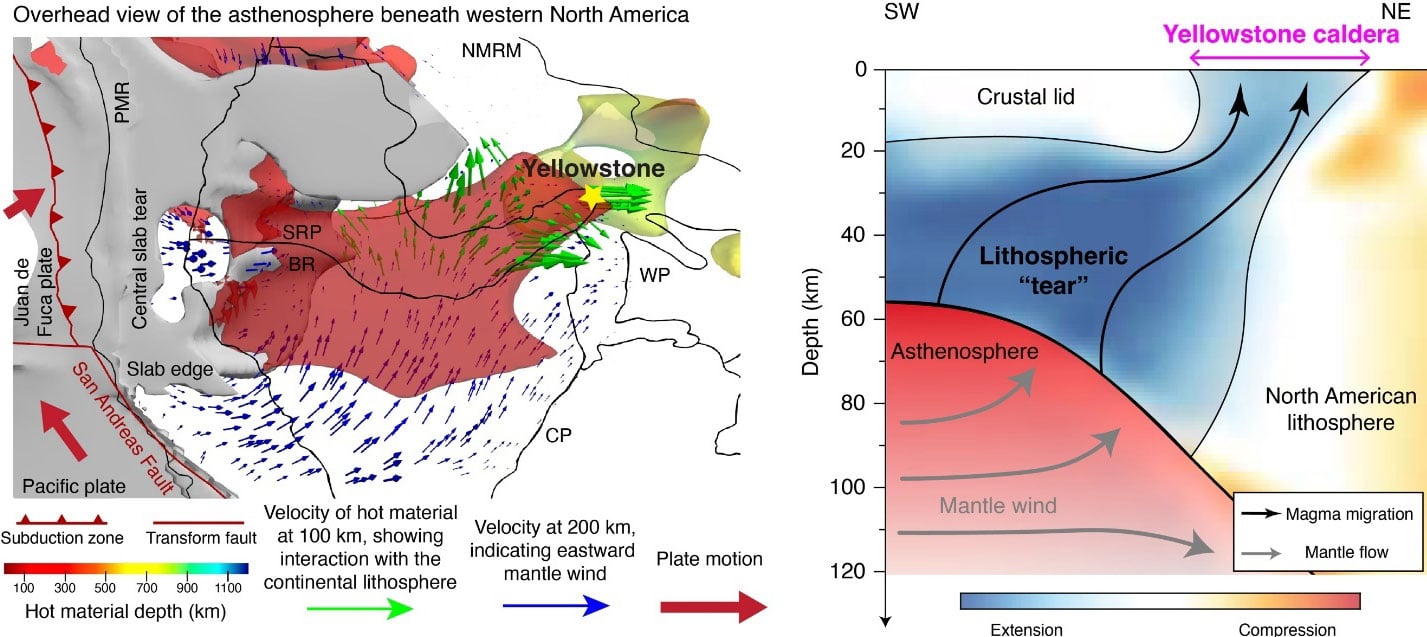
The new model indicates that Yellowstone’s magma originates in the shallow asthenosphere rather than from a deep mantle plume. It identifies an eastward-moving “mantle wind,” caused by the subduction of the Farallon Plate—remnants of which lie deep beneath central and eastern North America—that carries hot mantle material toward Yellowstone. This mantle wind is not like air movement but instead a slow, horizontal flow of hot rock deep within Earth.
As this buoyant material moves beneath the thick lithosphere, it is forced downward. This stretching creates decompression melting, which generates magma. These findings challenge the long-standing idea that Yellowstone is fed by a plume rising from the core–mantle boundary.
Forces That Shape Magma Pathways
The mantle wind also influences how magma travels through the lithosphere. Eastward flow pushes against the thick lithosphere east of Yellowstone, while buoyant lithosphere to the west applies an opposing force. Together, these forces effectively pull the lithosphere apart, forming a southwest-dipping, channel-like pathway beneath the region.
This pathway allows magma to rise, move, and evolve, shaping the structure and long-term behavior of Yellowstone’s magmatic system. The model’s results agree with independent geophysical and geochemical data.
Overall, the study provides a more complete explanation of how supervolcano systems form, linking magma production in the asthenosphere with its storage in the lithosphere. It also identifies a mechanism that can sustain large, long-lived magma mush systems, which appear to be common beneath supervolcanoes around the world.
Reference: “Tectonic origin of Yellowstone’s translithospheric magma plumbing system” by Zebin Cao, Lijun Liu, Bo Wan, Ling Chen and Craig Lundstrom, 9 April 2026, Science.
DOI: 10.1126/science.ady2027
Never miss a breakthrough: Join the SciTechDaily newsletter.
Follow us on Google and Google News.