Most of the luxury fashion brands featured in this 2026 ranking are those that, in 2025, had a year of self-correction. Three years of a market in which 80% of brand growth came from price, not volume, according to the BoF-McKinsey State of Fashion 2026 report, meant that to continue to rise in 2026, they had to earn it rather than putting up their prices. This ranking is based on Brand Finance’s Luxury & Premium 50 report and the Vogue Business Index, in addition to data from parent companies.
Key Trends Shaping Luxury Fashion Brands in 2026
Over the past 18 months, four forces have altered the competitive dynamics. None of them emerged overnight but rather gradually developed over time. However, between late 2025 and early 2026, each of them passed a point where it became commercially foolish to ignore any of them individually. What changed, and why it matters to the ranking below, is as follows:
- Digital clienteling is no longer in the pilot phase. For brands that have invested in personal shopping and AI-powered recommendation engines during 2024-2025, they are reaping the returns on investment.
- Sustainability is the new operational standard. According to the BSPK, 75% of luxury consumers under the age of 35 consider supply chain transparency when making a purchase.
- Gen Z has redefined the concept of luxury. Luxury is no longer a symbol; luxury is being conscious and experiential to Gen Z culture and community. Brands that got this early gained; brands that got this late lost.
- The experience pivot has been accelerated. The luxury boutique has become an experience; luxury means hospitality, private dining, and events.
Brands that successfully adapt to all four factors reach the top. The whole approach to development is also essential in other areas. The review of sites with 120 free spins for real money on Slotozilla shows that these top casinos mostly have a complex of advantages. No one relies on bonuses only. This right strategy will bring in new users to casinos and customers to clothing brands.
What Makes a Luxury Fashion Brand Successful Today
The luxury fashion houses that sit at the top have structural points that go beyond a talented creative director. The difference comes down to three key advantages that compound and are hard to achieve in a season or two:
- Brand identity that translates across platforms. A brand has to look like itself on a runway, in a store, on collab blogs, on a screen, and on a reseller site. Inconsistency destroys trust faster than a bad collection.
- Marketing that adds to culture, rather than interrupting it. The brands that win share are the ones that participate in the conversation, not the ones that talk down to it.
- Business model innovation. Hermès innovates without changing the core. Prada innovates by acquiring Versace with its achievements. Miu Miu innovates by making micro-skirts a traffic engine that converts into eyewear sales.
None of these things happens in isolation. Brand identity without digital reach is not going to deliver growth. Digital reach without brand identity means the brand is diluted. Collaborations without brand positioning will only confuse the customer.
Top 10 Luxury Fashion Brands in 2026
The list below ranks brands based on a mix of brand value, revenue growth, and cultural trajectory going into 2026. Each brand’s entry doesn’t just reveal where they are but also why:
- Louis Vuitton. Continues to hold the number one spot for the eighth consecutive year. LVMH generated €80.8 billion in revenue in 2025, including Louis Vuitton’s menswear direction.
- Hermès. Reported revenues of €15.2 billion and operating margin of 40.5%, the highest in the industry. Brand is valued at $40.9 billion by Interbrand, with an increase of 18%.
- Chanel. Brand value increased to $37.9 billion. This represents a 45% increase from the previous year – a fair result of Matthieu Blazy’s work.
- Dior. Jonathan Anderson was appointed to oversee womenswear, menswear, and haute couture simultaneously. This was a first since Christian Dior himself. There were no creative appointments in 2025 at any brand that compared to Dior.
- Prada. Achieved growth in two consecutive quarters when all competitors were either flat or declining. The acquisition of Versace meant Prada now has two luxury brands. ECONYL® Nylon continues to sell well to eco-friendly consumers.
- Miu Miu. Reached #1 on the Lyst Index in 2025. Microskirts and undone bags plaster social media, drive people to the site, and those people are buying €400 sunglasses and accessories with margins that don’t exist in apparel.
- Gucci. Sabato De Sarno rebuilt the direction set in place by Michele. There has been a fall in brand value from its peak. This is what happens when a brand resets its entire visual direction.
- Saint Laurent. Black, sharp, defined, Saint Laurent does not re-think their identity. They do not react to the whims of the world. And this is what gets rewarded in terms of sell-through.
- Loewe. Anderson grew their revenues fivefold before leaving to go to Dior. His identity does not feel compromised in his absence because he did not put his personality into the product. He put his personality into being Anderson.
- Fendi. Enters the top 10 luxury fashion brands for the first time by brand value. The Baguette bag and FF logo drive recognition.
What’s interesting, however, is the small number of brands that were able to increase their size in a year when the market as a whole declined. The top three brands, Vuitton, Hermès, and Chanel, continued to widen the gap between themselves and the rest of the market.
Comparison Table of Top Luxury Fashion Brands (2026)
However, it is difficult to draw a comparison between ten brands in a single paragraph, as all of these are from different domains and have their own strengths. The table below attempts to simplify the ranking to the bare essentials in 2026:
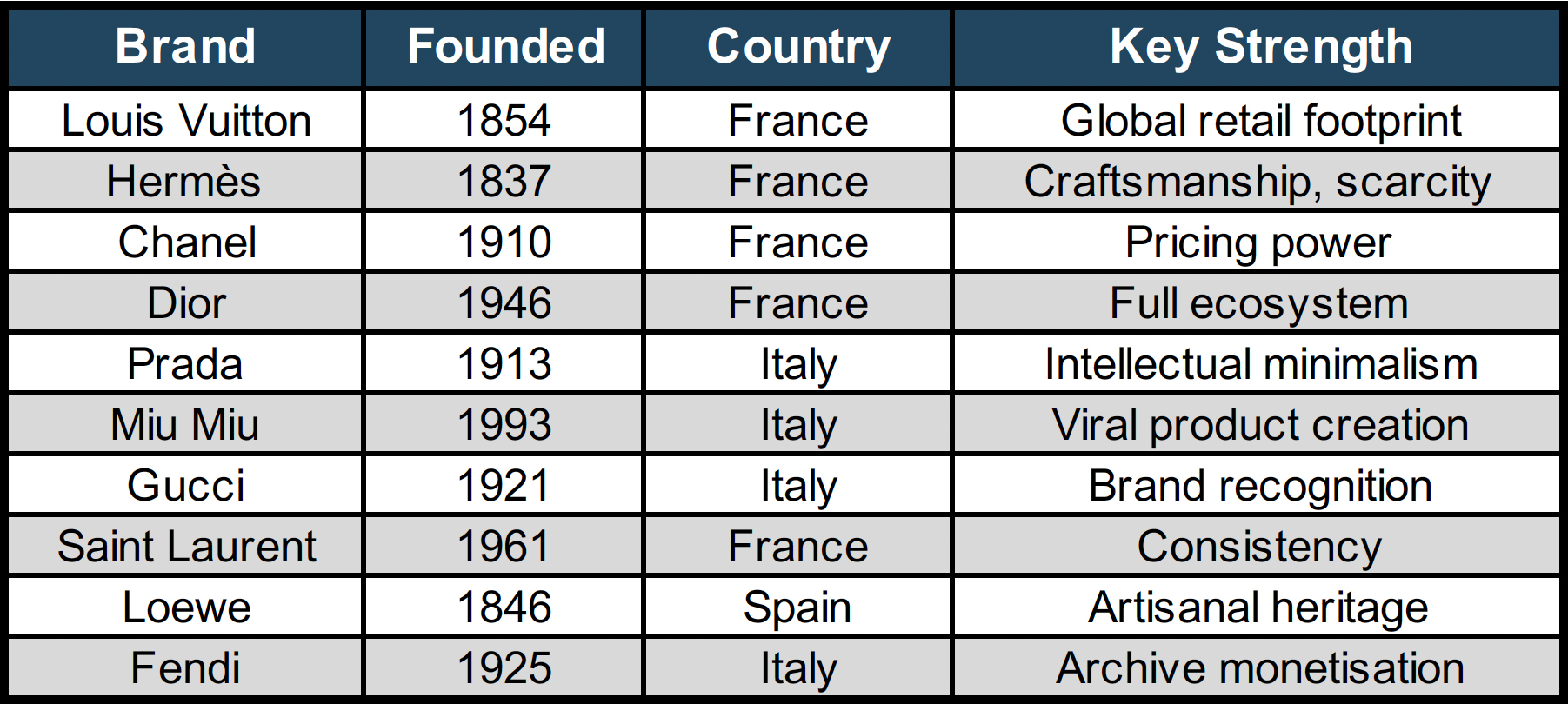
Six are French, three are Italian, and one is Spanish. This reflects structural dominance by the French through conglomerate ownership and the enduring pull of Paris Fashion Week.
Emerging Luxury Fashion Houses to Watch
Industry analysis for 2026 by LUXUO states that the unifying factor is client relevance, not advertising. These new brands are just out of the top 10 who succeeded in this:
- The Row is ad-free, has no logo, and no social media presence, but relies on word of mouth to create more demand.
- Bottega Veneta has introduced a lifetime guarantee on bags, implying to consumers that its product is not for disposal.
- Alaïa, under Pieter Mulier, has been able to attract consumers who are seeking sculptural design without the need to follow trends.
Each of these brands is addressing one of the gaps that the current top 10 leaves open: radical quiet luxury, craftsmanship, sculptural design, ethical positioning, and cultural disruption.
Why These Luxury Brands Are Dominating Right Now
The luxury fashion brands at the top have four characteristics. A brand identity that outlasts personnel – Hermès and Chanel brands look like themselves regardless of personnel. A digital infrastructure that fuels revenue growth without compromising exclusivity – customers find luxury fashion brands online but transact offline.
Proximity to culture – Miu Miu and Dior brands are part of culture, creating brands people want to talk about. And finally, an understanding of customers that goes beyond segmentation – the top 10 luxury fashion brands in 2026 know not just who their customers are but what they care about, who they listen to, and what influences their decisions.