
As ‘Project Hail Mary’ slowly climbs the Korean box office, a look back at a decade of home-grown space operas that missed their mark
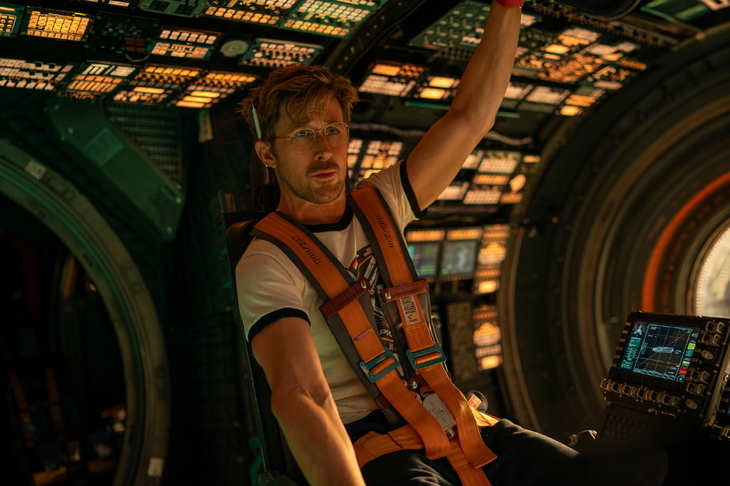
“Project Hail Mary,” the $250 million Amazon MGM space adventure starring Ryan Gosling, isn’t exactly tearing up the Korean box office, but it’s definitely holding its own.
As of Thursday, the film has pulled in 2.1 million admissions since its March 18 release, and word of mouth is keeping it humming along. A 4.0 out of 5 on Watchapedia, Korea’s Rotten Tomatoes equivalent, is a rare score for a commercial film here, and social media chatter has been warm across the board.
The film may well be on course for the kind of slow-burn trajectory that carried last year’s “F1” to 5.6 million admissions over an unusually long theatrical run.
Which raises a question Korean film fans have been asking for a while now: Why can’t we make a space movie ourselves?
The genre-hopping juggernaut that is Korean entertainment has proven time and again it can pull off just about anything: period epics, romantic melodramas, gangster pictures, zombie thrillers, arthouse provocations, you name it. But space is the one genre the industry has yet to succeed in.
Every homegrown space movie so far has come up short, some more so than others. The track record runs deeper than you’d think.
“Space Sweepers” (2021)
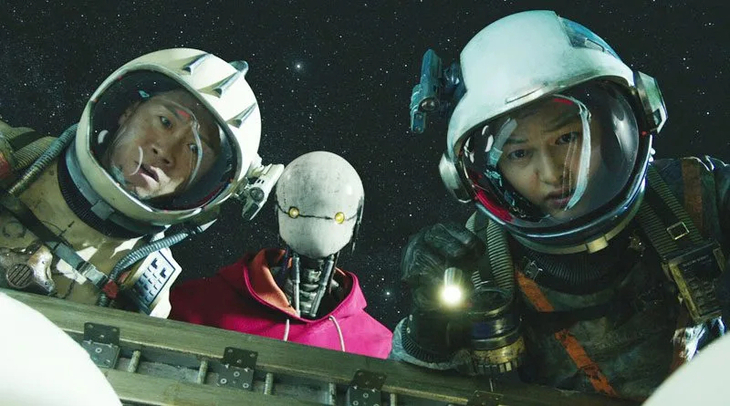
This star-studded Netflix blockbuster was meant to blow the doors open. Director Jo Sung-hee’s 24-billion-won ($16.3 million) production was billed as Korea’s first bona fide space blockbuster from the jump, and the cast — Song Joong-ki, Kim Tae-ri, Yoo Hae-jin and Jin Seon-kyu — certainly looked the part.
But the road was rocky from the outset. After COVID-19 hit, its release was pushed back twice before it skipped theaters altogether for a Netflix premiere. In hindsight, that was probably a mercy — given the bloated price tag and the tepid-to-mixed reviews that followed, the general consensus is that the break-even math would have been rough in theaters anyway.
One thing that did exceed expectations was the look of the thing. For a first-of-its-kind effort, “Space Sweepers” delivered a convincingly grimy space-junker aesthetic, a plausibly decrepit orbital dystopia presided over by a megacorp colonizing Mars, and enough set-piece pyrotechnics to prove that homegrown films could play in this sandbox.
The trouble was everything around the visuals. Critics zeroed in on the script, which was by all accounts a patchwork stitched together from “Guardians of the Galaxy,” “Cowboy Bebop” and other assorted sci-fi dystopias. All those recycled bits were padded out with lengthy exposition dumps and a saccharine father-daughter subplot involving a weaponized child-robot named Dorothy.
To its credit, the film was credited as a promising first step for Korea’s barren sci-fi landscape — though reviewers had less kind things to say about the movie itself. It did perform fine on Netflix, debuting at No. 1 in 16 countries and topping the platform’s daily charts in 80 territories in its opening week.
“Jung_E” (2023)
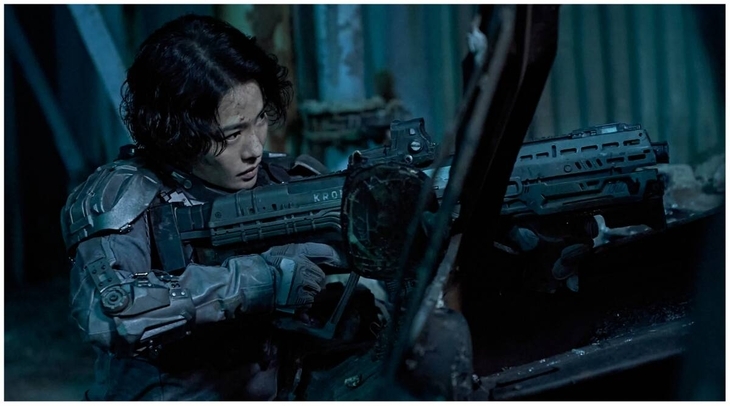
Not many remember that Yeon Sang-ho, the “Train to Busan” auteur who essentially invented the Korean zombie film, once took a swing at cyborg sci-fi. Another Netflix release, the film is perhaps better remembered now as the final screen performance of the late Kang Soo-yeon, who died at 55 just months before its premiere. There’s a dedication to her in the end credits, and you wish the film around it were better.
“Jung_E” is set in a 22nd-century wasteland where humanity has migrated to orbital shelters, some of which have splintered off into a rogue republic that is now at war with the rest. Against that backdrop, a research team attempts to clone the brain of a legendary mercenary into a combat android. It’s a setup that runs largely on dutiful exposition — civil wars, brain-cloning conglomerates, AI weapons programs — none of it fleshed out enough to land.
Viewers who came in for the slickly choreographed android action were quickly put off by the film’s hammering emphasis on a mother-daughter bond that never earns its pathos. And it was painfully obvious how much the film borrowed from earlier hits: “Ghost in the Shell” in its aesthetics, “I, Robot” and “Elysium” in whatever ethical scaffolding it gestures toward, “Source Code” in how its central conflict cycles through repeated simulations.
At a trim 99 minutes, the film was easy enough to sit through, and Netflix viewing numbers were reportedly strong. Critical reception, however, was abysmal both locally and abroad: a 46 percent score on Rotten Tomatoes and a 5.4 on IMDb.
“The Moon” (2023)
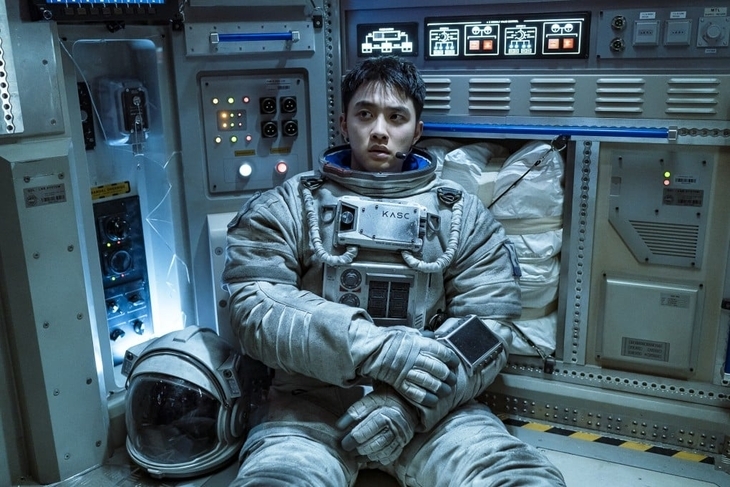
Then came the biggest disaster of the bunch. “The Moon” was one of the priciest blockbusters of Korea’s post-pandemic years, when multiplexes were still struggling to coax audiences back. Kim Yong-hwa, who had raked in some serious cash with both “Along with the Gods” films (a combined 26 million tickets sold), spent 28 billion won on a Korean moon-rescue picture and walked away with one of the decade’s loudest duds. It drew just 510,000 admissions against a 6.4 million break-even threshold.
Korean commercial cinema has a long-running flirtation with the tearjerker, but “The Moon” cranked that dial to the point of insanity. What should’ve been a taut survival thriller about a stranded astronaut turned into a sustained appeal for waterworks, with every plot beat reverse-engineered to wring out your tears. Sul Kyung-gu and Doh Kyung-soo did what they could; the script did them no favors.
What made the whole episode more embarrasing was the director’s response. At an Aug. 3 post-screening event, with the film visibly tanking, Kim told the audience that “Korean viewers still aren’t quite at home with sci-fi,” and promised to “return with an even greater space movie once the culture comes to respect science and technology more.”
Trouble on TV
Attempts at space-set stories on the small screen haven’t fared much better. Netflix’s “The Silent Sea” (2021), starring Bae Doona and Gong Yoo, drew mixed reviews — not an outright bust like some of its big-screen counterparts, but many took issue with its plodding pace and familiar beats lifted from “Alien” and “Interstellar.”
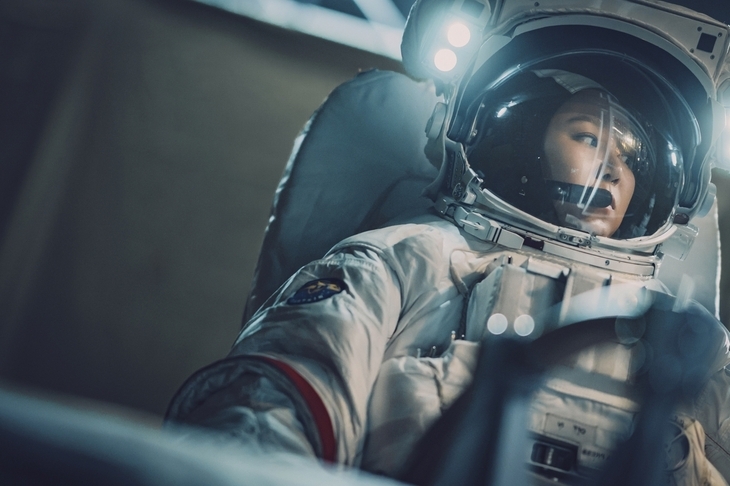
“When the Stars Gossip,” the Lee Min-ho and Gong Hyo-jin tvN series about a gynecologist who visits a space station as a tourist, fared considerably worse. It limped to a 2.4 percent average rating and is mostly remembered for some out-of-left-field space-station sex scenes.
So what’s the problem?
The go-to explanation for the failures has been money. Korean budgets can’t touch Hollywood’s, the reasoning goes, and space movies live or die by spectacle. “The Martian” cost $108 million; “The Moon” came in at roughly a quarter of that.
But upon closer look, the case doesn’t hold up. The VFX work on these films has, for the most part, been cited as a strength rather than a flaw. The tools are there; what hasn’t been there is a workable script.
“Honestly, it’s not that Korea can’t make sci-fi,” said Kim Bong-seok, a longtime film critic. “On screen, you get this strong sense of deja vu; nothing new jumps out. For audiences to bother showing up at a theater these days, a film has to offer something that catches the eye right away, and Korean sci-fi hasn’t been doing that.”
Yoon Sung-eun, another film critic, pointed to “Space Sweepers” as a telling case in point.
“It’s a Hollywood mash-up without any real local sensibility, without a convincing emotional hook,” she said. “‘Project Hail Mary,’ on the other hand, taps into something of the moment — this idea that we need to come together across race, across species, even across AI.”
Both kept coming back to the same fundamental problem: the writing.
“CG and effects aren’t the issue. It’s the script,” Yoon said. “Scripts with holes, or too much ambition, or this idea that sci-fi has to be self-serious”
Then there’s the melodrama problem. Korean space pictures have tended to reach for the same emotional button — fallen crewmates, bereaved families — and lean on it too hard. “‘Space Sweepers’ had the father-daughter thing. ‘Jung_E’ had the mother-daughter thing. Practically identical,” Yoon said. “Sci-fi should fuse more timely sensibilities with the strangeness of a cosmic setting. ‘Project Hail Mary’ does that.”
Kang Ji-woo, a film critic who hosts a podcast dedicated to sci-fi, made a similar point. “Korean sci-fi has been fixated on the surface — spectacle, graphics, the look,” she said. “The shell has been sci-fi, but the material inside just hasn’t been fresh.”
That said, there are bright spots still. Korea’s sci-fi literary scene has been quietly booming, with a new generation of writers including Kim Cho-yeop and Cheon Seon-ran building a deep catalog of well-regarded material, much of it ripe for adaptation. Kim’s “Spectrum” is slated for a film version; her “Greenhouse at the End of the Earth” is being developed as a series.
“I don’t think it’s a shortage of source material. The novels are there,” said Kim the film critic. “The industry has been lazy about adapting them into something that plays to a mass audience.”
“I think we’ll get there in a few years,” Yoon said. “We just need one success story. Everything so far has flopped, so there’s nothing to benchmark against.”